








Part 36 Consequences In Detailed Assessment | De Minimis Form Errors Will Not Invalidate Offers

Minor clerical errors in Part 36 offer forms that mislead no one will not prevent the offer attracting full CPR 36.17(4) consequences where the receiving party beats its own offer in detailed assessment proceedings.

Part 36 detailed assessment consequences apply despite minor form errors in CPR offer
In Stockler and Another v The Corporation of the Hall of Arts and Sciences, Deputy Costs Judge Joseph determined consequential issues following detailed assessment of the defendant’s costs, assessed at £120,221.98. The central issue was whether the defendant’s Part 36 offer dated 29 October 2024 to accept £115,000 was valid despite a clerical error on form N242A misdescribing it as a “claimant’s offer”. Applying F&C Alternative Investments v Barthelemy (No 3), the court held the error was de minimis and the offer valid. The court rejected the claimants’ argument that Part 36 consequences would be unjust given adverse Ainsworth rulings, holding that such reasoning would make consequences unjust “in almost every detailed assessment“. Consequently, the defendant was awarded costs on the standard basis until 19 November 2024 and indemnity basis thereafter, plus enhanced interest and the 10% additional amount under CPR 36.17(4)(d).

I am quite satisfied that the Part 36 offer dated 29 October 2024 by the defendant to accept £115,000 inclusive of interest was a valid Part 36 offer. Any deficiencies in it were minor and inconsequential. They could not possibly have caused any doubt in the mind of a reasonable reader as to what the Part 36 offer was intended to be, nor as to the consequences in the event that it was not beaten at the detailed assessment.

Citations

Ainsworth -v- Stewarts Law LLP [2020] EWCA Civ 178 The court held that points of dispute must provide sufficient detail to enable the receiving party to understand and respond effectively, and that failure to do so may lead to their dismissal without further consideration. Tibbles -v- SIG Plc [2012] EWCA Civ 518 The Court of Appeal confirmed that the discretion to vary or revoke an order under CPR 3.1(7) could be exercised where the facts on which the original decision was based were misstated, including innocent errors. F&C Alternative Investments (Holdings) Ltd -v- Barthelemy (No 3) [2012] EWCA Civ 843 The court accepted that minor or obvious slips that do not mislead the opposing party would not invalidate a Part 36 offer; such defects fall into the category of de minimis errors. O’Neill -v- AVIC International Corporation (UK) Ltd [2019] EWHC 374 (QB) The High Court held that multiple factors could be aggregated to justify an award of indemnity costs for unreasonable conduct in litigation. Bailey -v- IBC Vehicles Ltd [1998] 3 All E.R 570 The court confirmed that a bill of costs signed by a solicitor as an officer of the court carries a presumption that the indemnity principle has not been breached. Excelsior Commercial and Industrial Holdings Ltd -v- Salisbury Hammer Aspden and Johnson (a firm) [2002] EWCA Civ 879 Woolf LJ stated that indemnity costs require conduct that takes the case out of the norm, such as unreasonable behaviour during the litigation. Porter -v- Magill [2001] UKHL 67 The House of Lords established the test for apparent bias as whether a fair-minded and informed observer would conclude that there was a real possibility that the tribunal was biased.  

Key Points

  • A Part 36 offer made in detailed assessment proceedings is not invalidated by a minor or inconsequential error in the prescribed form, such as a misdescription of the offering party, provided the offer’s terms and intended consequences are clear and could not have misled a reasonable recipient. [§57, §60]
  • When a receiving party in detailed assessment proceedings obtains a judgment at least as advantageous as its own Part 36 offer, the court must, unless it considers it unjust, order indemnity costs, enhanced interest, and an additional amount from the expiry of the relevant period. Adverse rulings on Points of Dispute, including Ainsworth dismissals, do not render it unjust to apply these consequences. [§47, §61, §62]
  • The court may exercise its power under CPR 3.1(7) to vary or revoke an order arising from a detailed assessment where the facts on which the original calculation was based were innocently misstated, in order to prevent a breach of the indemnity principle and ensure the assessed sum is correct. [§40]
  • A paying party who, at the conclusion of a line-by-line assessment, proceeds on the basis of the receiving party’s calculation without challenge, is taken to have accepted that calculation. Having elected not to challenge at the proper time, the paying party is not entitled subsequently to dispute the figures. [§34-36]
  • In deciding whether to award indemnity costs for the detailed assessment proceedings on the grounds of conduct, the court will consider whether the paying party’s manner of pursuing its case was unreasonable to a high degree, taking the case out of the norm. This can include pursuing an opportunistic application for recusal, seeking to amend Points of Dispute at a very late stage to re-litigate decided points, and persistently advancing arguments with no merit. [§79-83, §86]

"If the quality of the Points of Dispute and/or the rulings on them were factors which then made it unjust to order the Part 36.17 consequences it would be unjust in almost every detailed assessment to order them. That cannot have been the intention of the Rules Committee, and it is not the proper construction of CPR Part 36.17."

Key Findings In The Case

  • The Claimants expressly accepted the Defendant’s calculation of the assessed costs bill at the conclusion of the line-by-line assessment on 29 August 2025 by failing to provide an alternative figure or breakdown and proceeding to make submissions on proportionality based on those figures. Accordingly, they were not later entitled to challenge the calculation absent a formal application demonstrating a compelling reason to revisit the figures [34–36].
  • The Defendant’s original figure of £120,513.88 for the assessed costs bill was subsequently shown to include an innocent error regarding an hourly rate applied in Part 2 of the bill. Applying CPR 3.1(7) and/or the slip rule, the court corrected the figure to £120,221.98 to avoid a breach of the indemnity principle, accepting that the misstatement was inadvertent and not the result of improper conduct [38–41].
  • The Defendant’s Part 36 offer to accept £115,000 (inclusive of interest) was deemed valid despite a minor error on the N242A form, and as the assessed costs exceeded the offer, the consequences under CPR 36.17 followed. These included indemnity costs from 19 November 2024, enhanced interest, and an additional sum of £12,022.20, with no sufficient reason advanced by the Claimants to disapply those consequences [45–48, 60–62].
  • In relation to conduct, the Claimants’ pursuit of a recusal application on the second day of the hearing, unsupported by any credible grounds, their attempt to amend Points of Dispute after rulings had been made, and their continued advancement of meritless arguments collectively amounted to unreasonable behaviour taking the case out of the norm, thereby justifying an indemnity costs order for the detailed assessment from 23 June 2025 [79–86].
  • The Defendant’s costs of the detailed assessment proceedings were summarily assessed at £98,542.89, reflecting appropriate deductions for excessive hourly rates claimed on the standard basis, duplication of fee earner time, and adjustments to counsel’s fees. Costs incurred prior to 19 November 2024 were assessed on the standard basis, and those thereafter on the indemnity basis pursuant to CPR 36.17 [87, 93–99].

“The detailed assessment has produced an outcome which is at least as advantageous to the defendant than the proposals contained in its Part 36 offer… For those reasons the consequences set out in CPR Part 36.17 will be applied… That means that, by the application of CPR Part 36.17, costs will be paid on the standard basis up to 19 November 2024 and on the indemnity basis thereafter.”

The Senior Courts Costs Office’s decision in Stockler and Another v The Corporation of the Hall of Arts and Sciences [2025] EWHC 3080 (SCCO) confirms that de minimis errors in Part 36 offer forms will not prevent the full statutory consequences applying in detailed assessment proceedings.

Background

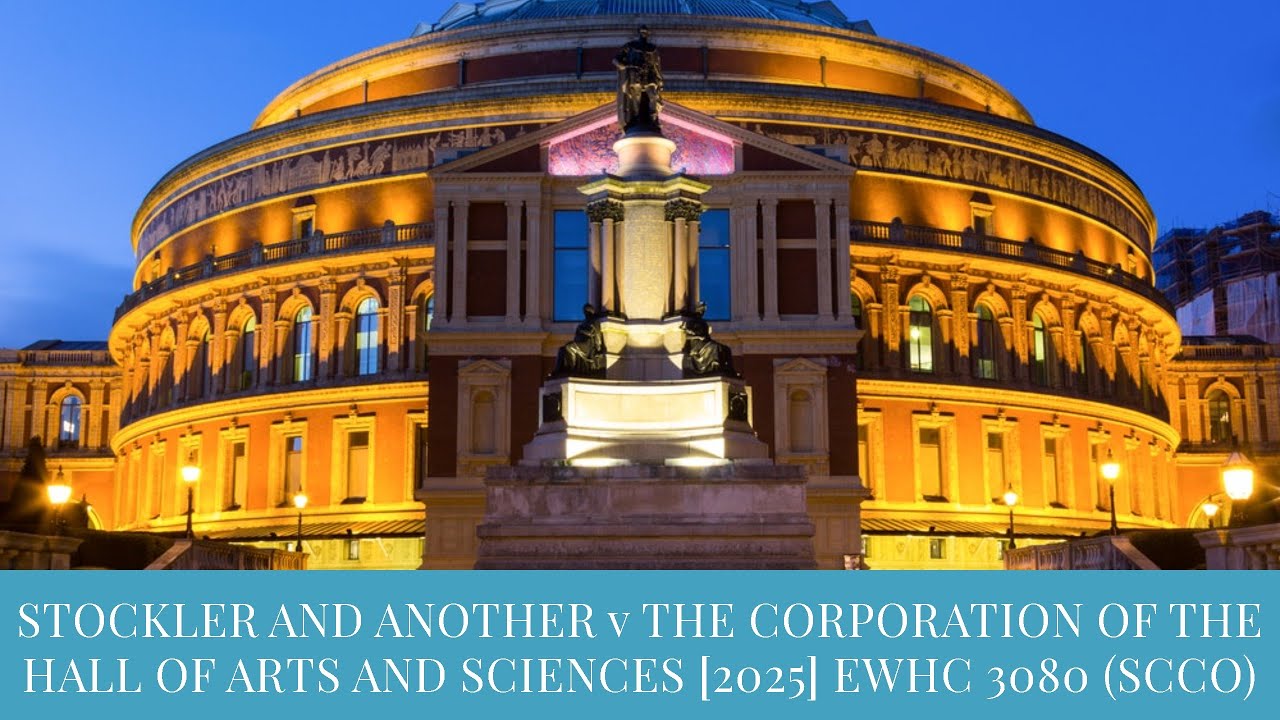
The claimants, William Thomas Stockler and Alexander Charles Stockler, are holders of rights to permanent seats in the Royal Albert Hall. The defendant is the corporation which holds a long lease of the Hall. Following underlying litigation, a costs order was made in the defendant’s favour.

The detailed assessment involved hearings on 23-24 June 2025 and 28-29 August 2025 before Deputy Costs Judge Joseph. At the outset, the judge disclosed he had sung in concerts at the Hall as a member of the City of Birmingham Symphony Orchestra Chorus; both parties confirmed this was not a basis for recusal. On the second day of the June hearing, however, the claimants applied for recusal alleging that positive comments about the Hall demonstrated inappropriate influence. The application was dismissed as totally without merit [§7].

Between hearings, the claimants amended their Points of Dispute. At the August hearing, the court disallowed all amendments pursuant to CPR PD 47 paragraph 13(10), finding it unfair and too late to permit them [§13]. The line-by-line assessment was completed on 29 August. The defendant presented a calculation of £120,513.88; the claimants did not challenge the figure and were held to have accepted it by proceeding on the basis they “assumed” it was correct [§14, §34-36]. The court later corrected this to £120,221.98 using CPR 3.1(7) after identifying an inadvertent error that would otherwise have breached the indemnity principle [§39-41].

A separate judgment dated 5 September 2025 [2025] EWHC 2262 (SCCO), which reported on here, addressed proportionality; no further reduction was warranted [§2].

The present judgment deals with the remaining consequential issues.

Costs Issues Before the Court

The court was required to determine four issues [§18]: interest payable on the assessed costs; whether the costs of the detailed assessment should be paid on the indemnity basis (due to a Part 36 offer or unreasonable conduct); the quantum of those costs; and permission to appeal.

The Parties’ Positions

The defendant sought indemnity costs on two grounds [§45]. First, a Part 36 offer dated 29 October 2024 to accept £115,000 inclusive of interest [§46]. The relevant period expired on 19 November 2024 without acceptance. As the assessed costs exceeded the offer, the defendant argued CPR 36.17, as modified by CPR 47.20(4), applied [§47]. Second, unreasonable conduct including pursuing unmeritorious Points of Dispute, failing to engage with ADR, and the opportunistic recusal application [§52].

The claimants argued the Part 36 offer was invalid due to a clerical error on form N242A, where it was misdescribed as a “claimant’s offer” despite the defendant being the receiving party [§54]. They contended it would be unjust to apply Part 36 consequences because their failure to beat the offer resulted from the court’s Ainsworth rulings and disallowance of amendments [§55]. On conduct, they submitted their behaviour did not take the case “out of the norm” per Excelsior v Salisbury Hammer Aspden [2002] EWCA Civ 879 [§56].

The Court’s Decision

The court held the Part 36 offer was valid [§60]. Applying F&C Alternative Investments (Holdings) Ltd v Barthelemy (No 3) [2012] EWCA Civ 843, the error was de minimis, falling into the class of “obvious slips which mislead no-one” [§57]. The offer was clear, made shortly after Replies were served, and provided sufficient information for evaluation [§62].

The court rejected the argument that Part 36 consequences would be unjust. If Ainsworth rulings and similar matters made it unjust, “it would be unjust in almost every detailed assessment to order them. That cannot have been the intention of the Rules Committee” [§61].

Consequently, the defendant was awarded costs on the standard basis until 19 November 2024 and on the indemnity basis thereafter [§63]. Interest on the assessed costs of £120,221.98 was awarded at 8% per annum from 1 July 2024 to 18 November 2024, and at 14% per annum thereafter [§65]. An additional sum of £12,022.20 was awarded under CPR 36.17(4)(d) [§65].

Conduct-Based Indemnity Costs

Separately from Part 36, the court analysed whether conduct justified indemnity costs [§67]. The defendant’s costs schedule only included costs from 27 August 2024 onwards, after expiry of its Calderbank offer [§53]. Conduct prior to the hearing did not sufficiently take the case out of the norm, but conduct from 23 June 2025 was “unreasonable to a high degree” and did take it out of the norm [§86]. This included:

      • The recusal application, found to be “entirely opportunistic and made not as a result of any genuine concern about the bias or apparent bias of the judge, but in an inappropriate attempt to circumvent or to cause to be revisited certain decisions” [§81]
      • Fixed costs arguments that “could not possibly have had any application to the matter” [§70]
      • Amendments to Points of Dispute seeking “another bite at a cherry which had already been swallowed”, with the claimants “oblivious to the self-evident prejudice” to the defendant [§83]

This was largely subsumed by the Part 36 consequences [§86].

Quantum of Costs

The court summarily assessed the defendant’s costs of the detailed assessment [§87]. From the claimed £105,092.89, reductions were made: £2,500 for document work and £750 for other costs (reflecting proportionality on the standard basis element), and £3,000 for duplication between fee earners [§93-95]. Counsel’s fees were adjusted to £16,500 for June and £12,500 for August [§96-97]. The final award was £98,542.89 [§99].

Permission to Appeal

Permission was refused on all ten grounds [§113]. The recusal allegations fell “way short of anything which could possibly have justified such an application” under Porter v Magill [2001] UKHL 67 [§102]. Decisions on fixed costs, amendments, and proportionality were within the court’s discretion [§106-112].
YouTube player
STOCKLER AND ANOTHER V THE CORPORATION OF THE HALL OF ARTS AND SCIENCES [2025] EWHC 3080 (SCCO) | DEPUTY COSTS JUDGE JOSEPH | CPR PART 36.17 | CPR PART 47.20 | CPR PART 44.2 | CPR PART 3.1(7) | INDEMNITY BASIS | STANDARD BASIS | DISALLOWING AMENDMENTS TO POINTS OF DISPUTE | SLIP RULE | AINSWORTH V STEWARTS LAW LLP [2020] EWCA CIV 178 | TIBBLES V SIG PLC [2012] EWCA CIV 518 | PART 36 OFFER | DETAILED ASSESSMENT COSTS | UNREASONABLE CONDUCT | ADDITIONAL AMOUNT UNDER CPR 36.17(4)(D) | BAILEY V IBC VEHICLES LTD [1998] 3 ALL ER 570 | EXCELSIOR V SALISBURY [2002] EWCA CIV 879 | FILTER INFORMATION IN ELECTRONIC BILLS | OVERLAPPING STANDARD AND INDEMNITY COSTS | FAILURE TO DISTINGUISH BASIS OF COSTS CLAIMED | PORTER V MAGILL [2001] UKHL 67 | REFUSAL TO RECUSE | MISINTERPRETATION OF LAW IN COSTS SUBMISSIONS | DELAYED AMENDMENTS TO POINTS OF DISPUTE | FAILURE TO ENGAGE IN ADR | CALDERBANK OFFER | PARAGRAPH 13(10) OF PRACTICE DIRECTION CPR PART 47 | COMPOSITE HOURLY RATE | SCHEDULE VERSUS BILL CONSISTENCY | COSTS FOLLOWING UNSUCCESSFUL RECUSE APPLICATION | COSTS CONSEQUENCES OF REJECTED PART 36 OFFERS | JUDGMENT INTEREST RATES | REASONABLENESS AND PROPORTIONALITY IN COSTS | ADDITIONAL AMOUNT CALCULATION UNDER PART 36 | SUMMARY ASSESSMENT UNDER CPR 47.20(5) | F&C ALTERNATIVE INVESTMENTS V BARTHELEMY (NO 3) [2012] EWCA CIV 843 | O’NEILL V AVIC INTERNATIONAL (UK) LTD [2019] EWHC 374 (QB) | PRACTICE DIRECTION – PRE-ACTION CONDUCT | SCHEDULES FOR SUMMARY ASSESSMENT AS NON-CONCLUSIVE | APPEAL GROUNDS AND REFUSAL OF PERMISSION | FIXED COSTS REGIME INAPPLICABILITY | SLIGHT REVISION TO DETAILED ASSESSMENT TOTAL | WORK ON DOCUMENTS TIME ADJUSTMENTS | BRIEF FEES AND REFRESHERS REASONABLENESS | MATERIAL EFFECT OF ERROR IN CLAIMED HOURLY RATE | SWIFT DISPOSAL OF INDEMNITY PRINCIPLE CHALLENGE | CRITERIA FOR COSTS ON INDEMNITY BASIS | LINE-BY-LINE ASSESSMENT OUTCOMES | WASTED COURT TIME DUE TO CONDUCT.