The High Court’s decision in Fernandez v Fernandez [2025] EWHC 2373 (Ch) demonstrates that executors who persist in defending removal applications after their position becomes untenable risk both personal costs liability and loss of their estate indemnity.

Background

The proceedings concerned the estates of Jean Fernandez, who died on 29 March 2010, and Alexander Fernandez, who died on 14 October 2013. The appellant, Julian Fernandez, was the executor of both wills, which were discovered after initial grants of administration had been made. The first and second respondents, Leessa and Graeme (Nick) Fernandez, had obtained letters of administration for Jean’s estate in 2013, believing she had died intestate. Julian subsequently found wills for both parents dated 1 October 1996, appointing him as executor. He obtained a grant of probate for Alexander’s estate in January 2016 and for Jean’s estate in November 2019, after the validity of her will was confirmed following a trial of a preliminary issue in July 2019.

On 10 July 2018, Julian issued a claim seeking revocation of the letters of administration granted to Leessa and Nick and a grant of probate to himself. Leessa and Nick defended the claim only by putting Julian to proof of the will’s validity and brought a counterclaim seeking Julian’s removal as executor of both estates and as trustee of a discretionary trust settled by the parents in 2008. The counterclaim alleged various instances of misconduct, including mismanagement of estate assets, conflicts of interest, and a breakdown in relations between Julian and the other beneficiaries.

The procedural history was protracted. In September 2019, District Judge Watson ordered Leessa and Nick to pay Julian’s costs of the preliminary issue concerning the validity of Jean’s will, with detailed assessment, and gave directions for a four-day trial of the counterclaim. However, the parties subsequently sought and obtained multiple stays to negotiate a settlement, including an unsuccessful mediation in January 2022. In June 2023, HHJ Paul Matthews refused a further stay, directing that the litigation must proceed. Fresh directions were given by District Judge Taylor in November 2023, leading towards a four-day trial.

On 28 March 2024, Leessa and Nick applied for summary determination of the removal application. This was heard by District Judge Wales on 16 September 2024 [§14]. On 29 October 2024 [§15], the judge handed down his substantive judgment. Following a hearing on 3 December 2024 for consequential matters, the judge made an order removing Julian as executor and trustee and appointing an independent professional trustee. At the hearing on 3 December 2024, the judge also dealt with consequential matters, including costs. He delivered a series of extempore judgments on costs, resulting in an order that Julian pay the respondents’ costs on the standard basis up to 28 March 2024 and on the indemnity basis from 28 March 2024 onwards [§26, §135], and that Julian be deprived of his right to indemnity from the estates and trust for his litigation costs (but not his administration costs) [§24, §127-128]. Julian appealed against this order, with permission granted by Michael Green J on 3 March 2025. The appeal was heard on 8 July 2025 before HHJ Paul Matthews sitting as a Judge of the High Court [§1].

Costs Issues Before the Court

The appeal required the court to review the costs orders made by District Judge Wales on 3 December 2024. The specific costs issues for determination were:

  • Whether the judge erred in ordering Julian to pay the respondents’ costs of the counterclaim and the application.
  • Whether the judge erred in awarding costs on the indemnity basis for the period following the application dated 28 March 2024.
  • Whether the judge erred in depriving Julian of his right to indemnity from the assets of the estates and trust in respect of his own litigation costs and the costs liability imposed by the order.
  • Whether the judge erred in setting the payment on account of costs at £55,000.

These issues arose in the context of hostile litigation between an executor/trustee and beneficiaries, engaging special principles under the Civil Procedure Rules and trust law.

The Parties’ Positions

The Appellant’s Position Julian argued that the costs orders were erroneous. He submitted that there was no sufficient evidence of misconduct to justify ordering him personally to pay costs or depriving him of his indemnity from the estates. He contended that the litigation was necessary for the proper administration of the estates and that he had acted properly throughout. Regarding indemnity costs, he argued that such an award required a finding of exceptional conduct, such as bad faith or gross negligence, which was not present. He also criticised the judge for failing to consider the respondents’ own litigation conduct and for not providing adequate reasons for the costs orders.

The Respondents’ Position The respondents supported the costs orders. They argued that the litigation was hostile and that Julian had acted in his own interests rather than for the benefit of the estates. They submitted that Julian’s continued resistance to removal after the application of 28 March 2024 was unreasonable, justifying indemnity costs for that period. They contended that Julian should not be entitled to an indemnity for litigation costs because he had acted for a benefit other than that of the estates, citing his conflicts of interest and the adversarial nature of the proceedings. They also argued that the payment on account was appropriately calculated. They faced a “formidable obstacle” in challenging the costs consequences [§17], citing Webb v Liverpool Women’s NHS Foundation Trust [2016] EWCA Civ 365.

The Court’s Decision

The appeal was dismissed, and the costs orders of District Judge Wales were upheld. The court analysed each costs issue as follows.

Order for Costs Against the Executor

The court held that the judge was entitled to order Julian to pay the respondents’ costs. The general rule under CPR rule 44.2(2) is that the unsuccessful party pays the costs, and the respondents were the successful parties on the counterclaim and application. The judge correctly characterised the litigation as hostile, meaning the usual inter partes principles applied, rather than treating it as trust litigation where costs might be paid from the estate. The court referred to the principle that a trustee or executor is not automatically entitled to an indemnity for costs incurred in hostile litigation, especially where they have acted for their own benefit. The judge’s decision that Julian had acted in substance for a benefit other than that of the estate was an evaluative judgment open to him on the evidence, particularly given the conflicts of interest and the breakdown in relations.

Indemnity Basis Costs

The court upheld the award of costs on the indemnity basis for the period following the application of 28 March 2024. The judge had applied the correct test, namely whether the case was taken “out of the norm” by the paying party’s conduct. The judge found that Julian should have realised his position was untenable after that date, given the clear conflicts of interest and the hostility between the parties. His continued resistance was conduct outside the ordinary and reasonable conduct of proceedings. The court cited Excelsior Commercial & Industrial Holdings Ltd v Salisbury Hammer Aspden & Johnson [2002] EWCA Civ 879 and Three Rivers District Council v Bank of England [2006] EWHC 816 (Comm) but emphasised that the test is not limited to specific examples like fraud; any conduct making the case exceptional can justify indemnity costs. The judge’s decision was not plainly wrong and fell within his discretion.

Deprivation of Indemnity from Estate/Trust

The court affirmed the order depriving Julian of his right to indemnify himself from the estates and trust for litigation costs [§127]. Under section 31(1) of the Trustee Act 2000 and CPR rule 46.3, a trustee or executor is entitled to an indemnity only for expenses “properly incurred”. CPR Practice Direction 46 paragraph 1 provides that costs are not properly incurred if the trustee acted for a benefit other than that of the estate. The judge found that Julian had acted in his own interest in the hostile litigation, which was a sufficient basis to deny the indemnity. The court noted that this was consistent with the obiter comments in Armitage v Nurse [1998] Ch 241, where a trustee who successfully defends a claim is entitled to an indemnity, but one who unsuccessfully defends may not be. Importantly, the judge’s distinction between administration costs (where indemnity was preserved) and litigation costs (where it was denied) was justified [§24, §128].

Payment on Account

The court found no error in the payment on account of costs set at £55,000. The judge had considered the estimated costs and exercised his discretion appropriately under CPR rule 44.2(8). No specific challenge to the amount was raised in the appeal, and the court saw no basis to interfere.

Adequacy of Reasons

The court rejected the argument that the judge failed to provide adequate reasons for the costs orders. The extempore judgments on costs spanned several pages and addressed the key issues, including the basis for awarding costs, the decision on indemnity costs, and the deprivation of indemnity. The court cited English v Emery Reimbold & Strick Ltd [2002] 1 WLR 2409, noting that reasons need not be exhaustive but must show the basis of the decision. The judge’s reasons met this standard.

In conclusion, the appeal court found that the judge below had correctly applied the legal principles and that his costs orders were within the generous ambit of his discretion. All grounds of appeal failed, and the appeal was dismissed.

YouTube player

A short judgment looking at trust and estate costs principles

Executors’ entitlement to indemnity from estates under Trustee Act 2000 s31 and CPR PD 46, distinguishing hostile litigation from proper administration.

Indemnity Basis Costs Following Discontinuance

When litigation conduct is sufficiently “out of the norm” to justify indemnity costs following discontinuance.

Claimant’s Costs Reduced By 40% Due To Chaotic Litigation Conduct

High Court reduces litigant in person’s costs by 40% for chaotic conduct whilst refusing indemnity costs despite fraud findings.

Being ‘Annoying and Difficult’ Not Sufficiently ‘Out Of The Norm’ For Indemnity Costs In Failed Liquidator Challenge

High threshold required for indemnity costs – difficult behaviour alone insufficient without exceptional circumstances.

CPR 46.4 | Protected Parties | Court Rejects ‘Light Touch’ Approach To Assessment Of Solicitor-Client Costs Shortfall

Trust and fund costs principles under CPR 46 including when costs must benefit the fund to qualify for indemnity.

The Court of Appeal’s decision in Gotti v Perrett [2025] EWCA Civ 1168 establishes that all pre-action applications constitute “proceedings” for costs purposes, closing a potential loophole across civil litigation.

Background

The dispute originated from an application for an interim injunction made by the Appellant, Christian Gotti, against the Respondent, Karen Perrett, under the Protection from Harassment Act 1997. The application was issued at Worcester County Court on 4 July 2023 using Form N16A, the general application form for an injunction under CPR Part 23. The application was listed for a contested hearing on 3 August 2023, where the Appellant was represented by counsel and the Respondent appeared in person. Following the hearing, an interim injunction was granted.

The injunction order contained significant procedural defects. No undertaking was given by the Appellant to issue a claim form, as required by the then-in-force CPR PD25A, paragraph 4.4(1). The court also failed to give directions for the issue of a claim form. Furthermore, no cross-undertaking in damages was offered by the Appellant or recorded in the order, despite the Respondent’s evidence that she would suffer financial loss. A penal notice was included on the face of the order. No claim form was ever issued by the Appellant.

The application was later acknowledged by the Appellant himself to be “deeply misconceived” [§20, §26] for multiple reasons: the county court lacked jurisdiction for defamation claims; interim injunctions are unavailable in defamation where the defendant seeks to defend; the PfHA 1997 lacked jurisdiction as the Appellant lived in Scotland; and Article 10 ECHR issues were not addressed.

On 27 February 2024, the Respondent issued an application to discharge the injunction and for damages and costs. Upon receipt of this application, the Appellant performed what the Court described as a “spectacular volte face” [§25], conceded that his application for the injunction was “deeply misconceived” and accepted that the order should never have been granted. He consented to its immediate discharge. However, he argued that as no Part 7 or Part 8 claim form had ever been issued, there were no valid “proceedings” before the court. Consequently, he contended that the court had no jurisdiction to make orders for costs or damages in favour of the Respondent.

Costs Issues Before the Court

The central costs issue was whether the court possessed the jurisdiction to make ancillary orders for costs and damages upon the discharge of an injunction where: (i) no undertaking to issue a claim form was given or recorded; (ii) no cross-undertaking in damages was offered or recorded; and (iii) no claim form was ever subsequently issued. The Appellant’s position was that the absence of a substantive claim form meant the injunction application was a “nullity” and that no “proceedings” existed in which the court could exercise its powers.

A secondary issue was whether, if the court found there were no valid proceedings, it could invoke CPR rule 3.10 to remedy the procedural error of using Form N16A instead of the required Part 8 Claim Form (N208) for a claim under the Protection from Harassment Act 1997.

The Parties’ Positions

The Appellant’s Position: The Appellant argued that the court had no jurisdiction. He submitted that “proceedings” are started only when the court issues a claim form at the request of a claimant, pursuant to CPR rule 7.2(1). As no Part 7 or Part 8 claim form was ever issued, there were no proceedings. He contended that the use of Form N16A did not constitute a prescribed originating process for this type of claim and that the entire process was therefore a nullity. He relied on authorities such as Citation plc v Ellis and Peterson v Howard de Walden Estates Ltd to support the proposition that costs cannot be awarded without a claim form. He further argued that CPR rule 3.10 could not be used to correct a procedural error that occurred before the commencement of any proceedings.

The Respondent’s Position: The Respondent argued that the court did have jurisdiction. She contended that the application for an interim injunction, properly issued under CPR Parts 23 and 25, constituted “proceedings” to which the Civil Procedure Rules applied. She relied on the equitable jurisdiction of the court to grant injunctions, as confirmed in Fourie v Le Roux, and the wide interpretation of “proceedings” in section 147 of the County Courts Act 1984, which “includes both actions and matters.” She also pointed to the court’s costs jurisdiction under section 51 of the Senior Courts Act 1981, which applies to “costs of and incidental to all proceedings.” In the alternative, she argued that the error in using the wrong form could and should be remedied under CPR rule 3.10, citing authorities such as Hannigan v Hannigan and Reddy v General Medical Council.

The Court’s Decision

The Court of Appeal dismissed the appeal, upholding the decisions of the courts below. Both Lewison LJ (in granting permission) and HHJ Salmon described the Appellant’s argument as “an affront to common sense” [§5-6]. Lord Justice Cobb, giving the lead judgment, held that the application for an interim injunction constituted “proceedings” within the meaning of the relevant statutes and rules. The court’s reasoning was based on several key points.

    • First, the court was exercising a statutory and equitable jurisdiction under section 38 of the County Courts Act 1984 when it granted the injunction. This power exists in “any proceedings,” a term which is not restricted to post-claim-form activity. The court endorsed the view that “proceedings” include any application with which the court is seised and in respect of which it is asked to make orders. The fact that the application was procedurally flawed and “deeply misconceived” did not mean it was a nullity; it simply meant the proceedings were brought in an inappropriate form.
    • Second, the court’s costs jurisdiction under section 51 of the Senior Courts Act 1981 applies to “all proceedings,” which must be given the same wide interpretation. Civil courts routinely make costs orders on pre-action interim injunction applications.
    • Third, disapplying the CPR and the overriding objective to a pre-action injunction application would be absurd, as such applications can have draconian consequences for respondents and must be dealt with justly. The Appellant’s concession that the court had jurisdiction to make and subsequently discharge the injunction was found to be inconsistent with his argument that the process was a nullity.

The court relied heavily on Lord Scott’s judgment in Fourie v Le Roux [2007] UKHL 1, which established that pre-action freezing orders are “not a nullity” and have “immediate effect” even without substantive proceedings [§58].

On the secondary issue, the court held that, if necessary, CPR rule 3.10 could be invoked to remedy the error of using Form N16A instead of Form N208. The error was one of procedure after proceedings had commenced, and it could be corrected to prevent the Appellant from benefiting from his own failure and to further the overriding objective. The case of Peterson was distinguished, as it concerned an error occurring before any proceedings were commenced.

In conclusion, the court found that the judges below were correct. The court had jurisdiction to make orders ancillary to the discharge of the injunction, including orders for costs and damages. The appeal was dismissed.

Wider implications beyond injunctions for costs jurisdiction in civil litigation

1. Pre-action applications generally The principle that “proceedings” under s.51 SCA 1981 encompasses any application where the court is asked to exercise jurisdiction extends to all pre-action remedies, not just injunctions. This would cover:

    • Pre-action disclosure applications (CPR r.31.16)
    • Norwich Pharmacal orders
    • Pre-action inspection orders
    • Any application under CPR Part 23 before a claim form

2. Procedurally defective proceedings The ruling that procedural errors don’t negate costs jurisdiction applies broadly. If parties commence any type of application using the wrong form or procedure, they cannot later rely on their own error to escape costs consequences. This prevents tactical exploitation of procedural mistakes across all litigation contexts.

3. Defining “proceedings” for costs purposes The Court’s expansive interpretation of “proceedings” – as any matter where the court is “seised” and asked to make orders [§69] – affects costs jurisdiction throughout the CPR. This could impact:

    • Costs in struck-out claims
    • Discontinued proceedings
    • Applications dismissed for procedural non-compliance
    • Stand-alone applications without underlying claims

4. CPR r.3.10 application The liberal approach to remedying procedural errors under CPR r.3.10 has implications for all litigation where the wrong form or process is used, confirming courts will prevent parties benefiting from their own procedural failures.

5. Section 51 jurisdiction The confirmation that s.51 SCA 1981 costs jurisdiction applies to “all proceedings” reinforces the court’s broad discretion over costs in any matter before it, strengthening the principle that costs follow the event regardless of procedural irregularities.

This decision essentially closes a potential loophole across civil litigation where parties might attempt to avoid costs liability through procedural technicalities.

YouTube player

CPR 38.6: Discontinuance And Costs – The Legal Principles

Discusses costs jurisdiction where proceedings are discontinued without substantive claims

Who Should Pay The Costs Of A Withdrawn And Undetermined Application?

Court of Appeal case examining costs jurisdiction for withdrawn applications and the court’s discretion under CPR 44.2

Recoverability Of Inquest Costs In A Civil Claim

Addresses the principles of costs recovery in proceedings that precede formal claims

CPR 45.8 Fixed Costs Apply To Interim Applications From Date Of Provisional Track Allocation

High Court decision on costs jurisdiction for interim applications

Part 20 Defendant Ordered To Pay 1/3rd Of Defendant’s Costs Of Defending The Action

Examines the court’s discretion under Section 51 Senior Courts Act 1981 to award costs in complex procedural scenarios

Court of Appeal: Fixed Costs Do Not Apply To Appeals But QOCS Does

Discusses Section 51 SCA 1981 and the court’s general discretion over costs in different procedural contexts

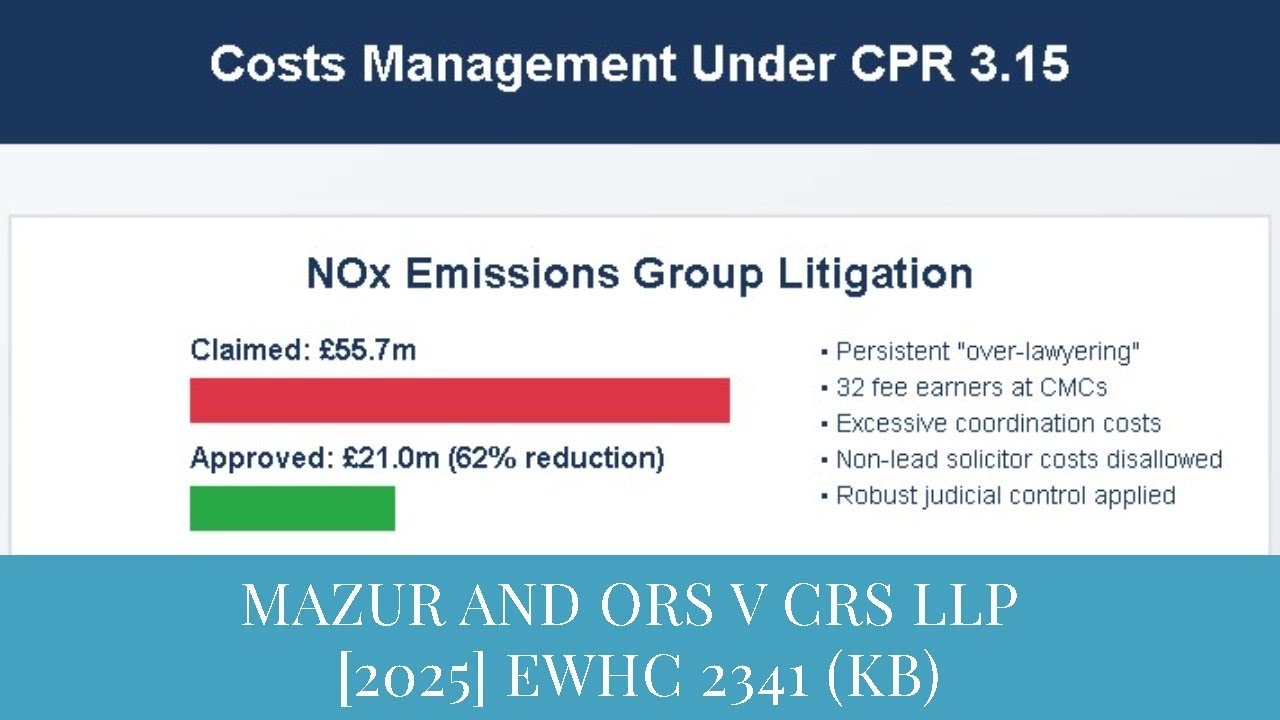
The High Court’s decision in Various Claimants v Mercedes-Benz Group AG & Ors [2025] EWHC 2307 (KB) demonstrates the court’s continued determination to control excessive costs in large-scale group litigation through robust budgeting reductions.

Background

The judgment concerns the second Costs Management Hearing (CMH) in the NOx Emissions Group Litigation, a series of consolidated Group Litigation Orders (GLOs) concerning claims against various vehicle manufacturers. The litigation is being case managed in tranches. The first trial (Tranche 1) on “KBA Issues” took place in October 2024. The second trial (Tranche 2) on “Prohibited Defeat Devices” (PDD) is scheduled for October 2025. The costs for these tranches were managed at the first CMH.

This second CMH dealt with the costs budgets for the third tranche of the litigation (Tranche 3) and a second period of general costs (Second General). Tranche 3, the “Quantum Trial”, concerns issues of causation and loss and is listed for eight weeks in October/November 2026. The Second General budget covers the period from Spring 2026 up to the Quantum Trial. The court was required to approve budgets for 63 Precedent Hs, comprising 390 costed phases, with total sums claimed of £55.7 million (claimants) and £75.8 million (defendants collectively) for Tranche 3, and £19.8 million (claimants) and £3.6 million (defendants) for the Second General phase.

The Lead GLO involves claims against Mercedes-Benz. Additional Lead GLOs (ALGLOs) involve Ford, Peugeot/Citroën (PCD), and Nissan/Renault. Claims against other manufacturers (e.g., BMW, Vauxhall, Volkswagen) are designated as Non-ALGLOs. The case management directions limited the participation of Non-ALGLOs in the upcoming trials, which was a key factor in the costs budgeting exercise. The claimants structured their budgets to distinguish between “Pan NOx” work (involving all GLOs), “Lead and ALGLO” work, and “GLO specific” work.

Costs Issues Before the Court

The primary task for the court was to determine the reasonable and proportionate budgeted costs for the future phases of the litigation, namely Tranche 3 and the Second General period. The key costs issues included:

    1. The appropriate level of reduction to the claimants’ budgets to address continued “over-lawyering”, a criticism made in the first CMH judgment.
    2. The relevance of the budgets approved for the longer and more complex Tranche 2 trial as a comparator for setting Tranche 3 budgets.
    3. Whether to allow standard figures for defendants performing similar tasks or to recognise a range of reasonable and proportionate costs.
    4. The recoverability of common costs claimed by numerous non-lead solicitors’ firms instructed by individual claimants within the GLOs.
    5. The reasonableness of the high number of fee earners the claimants had budgeted to attend hearings such as CMCs, the PTR, and the trial.
    6. Whether to approve budgets for the Expert Reports and ADR/Settlement phases at this stage or to defer this decision.

The Parties’ Positions

The defendants’ overarching position was that the claimants had failed to learn lessons from the first CMH and continued to advance unrealistic budgets characterised by excessive manpower and duplication. They argued that the budgets for Tranche 3 should generally be lower than those for the longer and more complex Tranche 2 trial. They criticised the claimants’ structure of involving multiple law firms and the vast number of fee earners budgeted for hearing attendance. For their own budgets, defendants generally sought to justify their figures based on the specific work required, though the claimants alleged some defendants were budgeting at lower rates than they were actually incurring.

The claimants argued they had responded to the first judgment by providing more detailed justification for their figures and by reallocating work within their budget structure. They contended that the “lived experience” of Tranche 2 had demonstrated that more work was required than initially anticipated, justifying higher figures for some Tranche 3 phases. They defended the involvement of non-lead firms, citing a solicitor’s duty to keep clients informed and the right of clients to choose their representation. For the defendants’ budgets, the claimants often made standard offers to groups of defendants (e.g., all Non-ALGLOs), arguing a single figure could be reasonable and proportionate for similar tasks.

The Court’s Decision

The court, applying the overriding objective and the principles of costs budgeting, made significant reductions to the budgets of both parties, particularly the claimants. The approved figures are set out in the conclusion below. The court’s key findings and rationale were as follows:

    • Over-lawyering and Lessons from the First CMH: The court found that the claimants’ efforts to provide more detail did not justify the “enormous amounts of time claimed”. It upheld the criticism of “over-lawyering”, citing as an example the claimants’ budget for 32 fee earners to attend CMCs at a cost of £3.3 million. The court found the claimants’ approach, particularly the layers of representation and involvement of multiple non-lead firms, led to duplication and inefficiency.
    • Comparison with Tranche 2: The court agreed with the defendants that the budgets approved for Tranche 2 were a relevant starting point and that, given the shorter length and less complex nature of the Quantum Trial, Tranche 3 budgets should generally be lower, not higher. The court expected improved cooperation and lessons learned from Tranche 2 to lead to more economical working.
    • Standard Figures vs. a Range: The court held that where defendants were undertaking the same tasks, a standard figure could be reasonable and proportionate. It noted that figures within 20% of a reasonable comparator could be considered within an acceptable range. However, figures more than 20% above a reasonable comparator required specific justification, which was often lacking.
    • Non-Lead Solicitors’ Costs: The court severely restricted the common costs recoverable by non-lead firms. It held that work such as keeping abreast of developments for client advice was primarily a solicitor-client matter, not recoverable between the parties. For sample claimants represented by non-lead firms, the cost of drafting witness statements or pleadings should be no more than if the work had been done by the lead solicitor.
    • Hearing Attendance: The court drastically reduced the claimants’ budgets for hearing attendance. It found the number of fee earners budgeted (e.g., 9 in person and 21 remotely for CMCs) to be unreasonable. For the trial, the court approved a team of only 4 fee earners from each lead firm attending in person, with no allowance for attendance by fee earners from other firms.
    • Specific Phase Reductions: The court made detailed reductions across all phases. For example, the claimants’ sought £3.3m for two CMCs was reduced to £850,000; their £1.4m for the PTR was reduced to £300,000. The defendants’ budgets were also reduced in many phases where they were found to be excessive, such as Vauxhall’s budget for reviewing statements of case.
    • Deferral of Expert Reports and ADR Phases: The court declined to budget the Expert Reports phase because the scope and necessity of this evidence was still to be determined at a future CMC. The ADR/Settlement phase was also deferred because the parties’ assumptions were too far apart (£11m claimed by claimants vs. £1.8m by defendants) to make sensible budgeting possible at this stage. The court proposed to reconsider these phases in January 2026.
    • Second General Costs: The court found the claimants’ claimed management costs of nearly £20m to be “frankly staggering” and illustrative of a “wildly inefficient” approach. The budget was based on assumptions of excessive monthly updates to a vast number of lawyers and clients. The court allowed only a modest sum for essential register updates and communication, significantly reducing the budget to £1.43m.

In conclusion, the court approved the following total budgets:

    • Tranche 3: Claimants: £21,024,850.01 (from £55.7m claimed); Defendants: £48,058,002.04 (from £75.8m claimed).
    • Second General: Claimants: £1,430,000.00 (from £19.8m claimed); Defendants: £1,319,114.70 (from £3.6m claimed).
YouTube player

CPR 3.15A | Costs Budget Revisions | Significant Developments And The Need To Act Promptly

Directly relevant as it covers CPR 3.15A budget revision applications which relate to the costs management framework applied in the NOx case

Costs Management Hearing | Unrealistic Budgets May Face Adverse Costs Orders

High Court decision (2025) discussing excessive costs budgets and judicial warnings about “unrealistic” budgets, highly relevant to the over-lawyering theme

Costs Budgeting and Costs Management – What You Need To Know

Essential background on CPR 3.15 costs management rules and procedures that practitioners need to understand the NOx judgment

Reasonable Joint Costs Recoverable In Full Regardless Of Number Of Defendants

Recent High Court decision (2025) on common costs in multi-party litigation, relevant to the GLO cost recovery issues

Budgets, Hourly Rates, Good Reason and Proportionality

Analysis of how courts assess reasonable and proportionate costs under CPR 3.18, relevant to the budget assessment principles

Significant developments and incurred costs

Chief Master Marsh decision examining costs budgeting practicalities and significant development applications

The Chancery Division’s decision in Akwagbe v Ulrick (Re BL 634 Ltd) [2025] EWHC 2371 (Ch) demonstrates how personal circumstances and litigation history can influence whether unsuccessful applicants face indemnity costs in liquidator removal proceedings.

Background

The matter concerned an application by Mr Samson Akwagbe, a creditor, for the removal of Mr Frazer Ulrick as the liquidator of BL 634 Limited. The application was heard on 14 May 2025. The Second Respondent, the liquidation committee, did not attend the hearing. The court declined to remove the liquidator. The hearing overran, and the issue of costs was adjourned for written submissions. The court extended the time for any appeal against the main judgment to twenty-one days after the handing down of this costs judgment. [§2, §27]

Mr Akwagbe had been instrumental in placing the company into liquidation on 29 March 2023, having persuaded a number of creditors to join him. [§11] He had personally lost compensation from a prior accident through a failed investment with the company. It was also revealed during the proceedings that Mr Akwagbe had suffered a serious head injury years earlier, which affected his executive functioning and ended his previous career. [§5] This background contributed to his deep personal investment in the liquidation’s progress and his sense of frustration at its pace.

Costs Issues Before the Court

The court was required to determine two primary costs issues following the unsuccessful application. The first was the basis of assessment: whether the successful First Respondent (the liquidator) should recover his costs from the applicant on the standard basis, or on the higher indemnity basis due to the nature of the application. The second issue concerned the quantum of costs, specifically requiring a summary assessment of the liquidator’s costs schedule. This included dealing separately with the costs of an earlier application made by the liquidator on 24 April 2025 for permission to rely on the witness evidence of a Mr Sadler. [§19]

The Parties’ Positions

The First Respondent argued that the application was baseless and vexatious. He sought an order that Mr Akwagbe pay his costs on the indemnity basis, with any unrecoverable amount to be treated as an expense of the liquidation. In support of this position, he relied on the case of Beattie v Smailes [2011] EWHC 1563, drawing parallels where a small creditor brought an application for removal based on hypothetical conflicts of interest that was deemed “extravagant” and one that “ought not to have been brought”. [§8] It was further submitted that the other creditors should not be required to underwrite the costs of Mr Akwagbe’s failed application. [§9]

Mr Akwagbe, acting in person, opposed the application for indemnity costs and relied on the court’s general discretion. His submissions centred on the conduct of the liquidator, citing a failure to communicate properly and what he perceived as a dismissive attitude towards his concerns. He also highlighted the liquidator’s conduct during the litigation, specifically in relation to the application concerning Mr Sadler’s witness evidence, which he argued was an error that should be reflected in the costs award. [§4]

The Court’s Decision

The court held that the starting point was that costs should follow the event, meaning the unsuccessful applicant should pay the successful respondent’s costs. The court found no sound reason to depart from this principle. [§7] However, it declined to award costs on the indemnity basis. The court distinguished the case from Beattie, noting Mr Akwagbe’s unique role in initiating the liquidation, his significant personal loss, and the impact of his head injury on his executive functioning. [§10] Whilst the application had little chance of success, the court did not find it to be so hopeless or his conduct in the litigation so out of the ordinary as to be considered “out of the norm”, which is the requisite threshold for an indemnity costs order. [§16-17]

The court then conducted a summary assessment of the costs. The total costs sought were £24,584 inclusive of VAT, comprising £20,065.80 for the main application and £4,518.20 for the application concerning Mr Sadler’s evidence. [§19] The court found the Grade A solicitor’s hourly rate of £255 to be modest and below guideline rates. Counsel’s fees were deemed reasonable. [§21]

Regarding the separate application to rely on Mr Sadler’s evidence, the court found this was necessitated by an error on the part of the liquidator. Although the application itself was not conceded by Mr Akwagbe, the court reduced the recoverable costs for this discrete application from £4,518.20 to £1,800 inclusive of VAT. [§23]

For the main application costs, the court disallowed some items relating to the liquidation committee (which was not dealt with at the hearing) and work connected to the Sadler statement issue. The court assessed the reasonable and proportionate costs of the main application at £18,000 inclusive of VAT. [§24-25]

Consequently, the total costs payable by Mr Akwagbe were summarily assessed at £19,800 (£18,000 + VAT). The court ordered that this sum be paid by 9 September 2025 or 28 days after service of the order, whichever was later. Furthermore, it was ordered that any shortfall in the recovery of these costs from Mr Akwagbe could be recovered as an expense of the liquidation. [§25-26]


YouTube player

Indemnity Basis Costs Following Discontinuance

Analysis of when conduct takes a case “out of the norm” to justify indemnity costs, including the threshold for unreasonable conduct and speculative claims.

Indemnity Costs | Be Reasonable

Exploration of limitations on indemnity basis costs awards, particularly regarding hourly rates and the continuing application of reasonableness tests even on the indemnity basis.

Who Should Pay The Costs Of A Withdrawn And Undetermined Application?

Recent 2025 case examining costs issues following withdrawn applications, including arguments for indemnity costs based on misconceived proceedings.

The Correct Approach To Summary Assessment | Guideline Hourly Rates Up By 35%?

Detailed guidance on the principles of summary assessment, including the “broad brush” approach versus item-by-item consideration.

Indemnity Costs And The Effect Of An Approved Costs Budget

Court of Appeal guidance on when speculative, weak, or opportunistic claims warrant indemnity costs and the relevance of Part 36 offers.

Claimant’s Costs Reduced By 40% Due To Chaotic Litigation Conduct

Recent examination of when indemnity costs are refused despite findings of fraud or procedural non-compliance, reinforcing the “unreasonable to a high degree” threshold.

The High Court’s decision in Pontis Finance LLP v Karam, Missick & Traube LLP [2025] EWHC 2298 (Ch) demonstrates how courts can address excessive hourly rates through broad-brush phase reductions without breaching CPR 3.15(8)’s prohibition on fixing rates.

The case concerned a professional negligence claim brought by Pontis Finance LLP, a lender, against the defendant firm of solicitors, Karam, Missick & Traube LLP. Pontis had agreed to lend approximately £812,500 to an individual purporting to be Stefano Brugnolo, secured by a charge on a Mayfair property. The defendant firm acted for the borrower. Pontis’s case was that the defendant’s client was an impostor and that the firm had failed to perform adequate identity checks. Having advanced the loan monies, which were then paid to the impostor, Pontis claimed it had no prospect of recovery. The claim was for the return of the loan monies, interest, and associated fees, totalling approximately £1.2 million.

Following a Costs and Case Management Hearing (CCMC) on 21 February 2025, the court ordered the parties to file updated costs budgets. The intention was for the court to rule on these budgets promptly on the papers. Due to an administrative oversight, this ruling was significantly delayed from March to September 2025 [§6-8]. Consequently, costs for several phases of the litigation, most notably the Disclosure phase, transitioned from being future costs to incurred costs, thereby limiting the court’s ability to budget for them effectively [§9, §11.1].

Costs Issues Before the Court

The court was required to determine the reasonable and proportionate budgeted costs for the phases where it retained jurisdiction, specifically the Trial Preparation and Trial phases. The court could not set budgets for the Disclosure phase (as costs were now incurred), nor for Witness Statements and Settlement/ADR phases (due to uncertainty about what work had been completed) [§11]. The central issue was whether the overall figures claimed were proportionate, with a particular focus on the Claimant’s use of solicitors’ hourly rates that substantially exceeded the applicable guideline rates and the instruction of both a King’s Counsel and a junior barrister. The court had to assess proportionality by reference to the factors in CPR 44.3(5), primarily the sums in issue (£800,000 to £1.2 million) and the complexity of the litigation [§15].

The Parties’ Positions

The Claimant argued that the case involved complex legal issues concerning whether a duty of care was assumed to a non-client, the nature of any undertakings given, and potential breaches of trust. It submitted that the majority of the budgeted work was appropriately focused on the Trial Preparation and Trial phases and that the use of both leading and junior counsel was justified. The solicitors’ high hourly rates were presented as a reflection of the firm’s expertise.

The Defendant contended that the claim, valued at approximately £1.2 million, was towards the lower end of the scale for Chancery Division litigation and was not sufficiently complex to be categorised as “very heavy commercial work.” It argued that the case would substantially turn on its facts. The Defendant submitted that the Claimant’s solicitors’ hourly rates were excessive and unjustified, and that instructing both leading and junior counsel was disproportionate, particularly as a managing associate was also budgeted to attend trial.

The Court’s Decision

The court found that the Claimant’s overall incurred and budgeted costs of £489,891.31 were disproportionate for a claim of this nature and value [§31]. The case was assessed as being of moderate complexity, turning largely on its facts, and not qualifying as “very heavy commercial work” [§22]. Consequently, the appropriate guideline band for assessing solicitors’ hourly rates was London Band 2, not Band 1 [§35].

The court acknowledged that its role under CPR 3.15(8) was to approve phase totals, not to fix or approve specific hourly rates [§23]. However, following the approach in GS Woodland Court GP1 Ltd v GRCM Ltd [§26], it held that the combination of excessive rates and the number of hours billed could render a phase total disproportionate. The court therefore made broad, downward adjustments to the phase totals to reflect this.

For the Trial Preparation phase, the Claimant sought £136,550. The court found the number of solicitors’ hours (110) to be reasonable but the rates charged were substantially above the London Band 2 guidelines [§39]. It also found the aggregate counsel brief fees of £90,000 to be disproportionate [§44]. Applying a broad-brush approach, the court approved a budget of £115,000 for this phase [§48].

For the Trial phase, the Claimant sought £88,700. The court identified that the Claimant had erroneously budgeted for four days of counsel refreshers for a four-day trial; only three days were permissible, as the brief fee covers the first day [§51]. Furthermore, the solicitors’ rates were again deemed excessive. The court also disallowed most of the costs for an unexplained Grade D fee earner charged at £400 per hour [§58]. Considering all elements, the court approved a budget of £50,000 for this phase [§60].

The court declined to set budgets for the Witness Statements and Settlement/ADR phases due to the uncertainty over how much work had been incurred during the delay, rendering it impossible to distinguish between incurred and future costs [§11.2, §11.5]. The parties were advised to apply for a further costs management hearing if they wished to budget for these phases.

GS Woodland Court GP1 Ltd v GRCM Ltd [2025] EWHC 285 (TCC)

Key authority on how courts apply downward adjustments to phase totals where excessive hourly rates render them disproportionate

CPR 3.18(b) | Underspend Does Not Constitute Good Reason To Depart From An Approved Budget

Explores the interplay between budgeting and detailed assessment, relevant to understanding how courts control costs through budgeting

CPR 3.15A | Costs Budget Revisions | Significant Developments And The Need To Act Promptly

Details the requirements for varying costs budgets, relevant given the administrative delays that affected budgeting in Pontis Finance

2021 Guideline Hourly Rates, Use of Counsel And Division Of Common Costs

Discusses the application of guideline hourly rates and the use of both leading and junior counsel, directly relevant to the excessive rates and counsel fees issues

How Relevant Are The Guideline Hourly Rates?

Examines judicial attitudes to guideline rates being exceeded, providing context for understanding when rates significantly above guidelines may be justified

CPR 3.14 | Late Costs Budget | Relief From Sanctions Denied

Illustrates the consequences of failing to comply with budgeting requirements, contrasting with the administrative issues in Pontis Finance


YouTube player

The Technology and Construction Court’s decision in Matière SAS v ABM Precast Solutions Ltd [2025] EWHC 2030 (TCC) establishes that Part 36 offers demanding “total capitulation” on multi-million pound counterclaims may not attract full indemnity costs consequences.

Background

The dispute arose from a Consortium Agreement between the French claimant, Matière SAS, and the defendant, ABM Precast Solutions Ltd. In December 2021, Matière issued proceedings to recover £373,295.06 in unpaid invoices. ABM’s Defence and Counterclaim, served in February 2022, partially admitted the debt, acknowledging £157,241.91 was due subject to set-off. The remainder of the claim was not admitted. ABM counterclaimed for damages for breach of express obligations of good faith under the Consortium Agreement and a subsequent Collaboration Agreement. The counterclaim was initially valued at approximately £4.8 million but was later amended to £18.92 million, alternatively £16.62 million.

By the time of the trial, ABM had admitted all but £35,000 of Matière’s claim. The court’s liability judgment, handed down on 11 June 2025, found in favour of Matière on the claim, awarding the full sum of £373,295.06 plus interest. The counterclaim was dismissed in its entirety.

A significant feature of the procedural history was a Part 36 offer made by Matière on 4 April 2022. This offer proposed settling the entire proceedings, including the claim and counterclaim, for a single payment of £350,000 to be made to Matière. The offer was expressed to have the consequences set out in CPR Part 36. ABM did not respond to this offer. A further Part 36 offer was made by ABM on 17 September 2024, shortly before trial, in which it offered to accept £5 million to settle the proceedings.

Costs Issues Before the Court

The court was required to determine the consequential matters arising from its liability judgment, with the primary focus being the appropriate costs orders. The central issue was whether Matière was entitled to the full beneficial consequences under CPR 36.17(4) as a result of its April 2022 Part 36 offer. This included claims for indemnity costs from the expiry of the offer’s relevant period, enhanced interest on both the damages awarded and costs, and an additional 10% uplift on the damages sum. A further issue was whether, in the alternative, the court should make an issue-based or proportionate costs order to reflect ABM’s success on certain sub-issues at trial and Matière’s conduct. Finally, the court was asked to determine the appropriate rate of interest on sums awarded and to rule on Matière’s application for a substantial payment on account of costs.

The Parties’ Positions

Matière argued that its April 2022 offer was a valid Part 36 offer and that it had achieved a result more advantageous than the terms of that offer. It contended that the full consequences of CPR 36.17(4) must follow unless ABM could demonstrate it would be unjust, a burden it characterised as a “formidable obstacle”. Matière submitted that the offer was a genuine attempt to settle the entire proceedings and that ABM had sufficient information to evaluate it at the time it was made. It sought indemnity costs from the expiry of the relevant period, the maximum 10% enhanced interest, the 10% uplift on damages, and a payment on account of 95% of its budgeted costs.

ABM accepted that the Part 36 offer was valid in relation to the claim and that Matière was therefore entitled to the 10% uplift on damages and enhanced interest on the claim. However, it contended that the offer was not a genuine attempt to settle the proceedings in respect of the counterclaim. ABM argued that an offer of ‘nil’ for a counterclaim valued at millions was a demand for total capitulation. It further submitted that, applying the principles of CPR 44.2, the court should make a proportionate costs order and reduce Matière’s costs of the counterclaim by 70% to reflect its success on certain issues (scope of duty and findings of breach) and to mark the court’s disapproval of Matière’s dishonest conduct. ABM also argued that the maximum 10% enhanced interest rate was inappropriate and proposed a rate of 4% above base rate.

The Court’s Decision

The court conducted a detailed analysis of whether it would be unjust to apply the full Part 36 consequences. It found that the April 2022 offer was a genuine attempt to settle the *claim*, representing a concession of approximately 12% of its value. However, it was not a genuine attempt to settle the *counterclaim*. The offer of ‘nil’ for a multi-million pound counterclaim amounted to a demand for total capitulation. The court noted that whilst Matière was ultimately successful in defending the counterclaim, it could not have been so confident of its prospects at the time of the offer that a nil valuation was justified, particularly given the court’s subsequent findings that Matière had acted dishonestly and in breach of its duties.

Consequently, the court held it would be unjust to apply the indemnity costs consequence of CPR 36.17(4) to the costs of the counterclaim. Matière was awarded its costs of the claim on a standard basis up to the expiry of the relevant period (25 April 2022) and on an indemnity basis thereafter. Its costs of the counterclaim were awarded on a standard basis throughout.

The court rejected ABM’s argument for a 70% reduction in costs under CPR 44.2. It found that the issues on which ABM succeeded (scope of duty and breach) were merely stepping stones to establishing its loss of chance claim, on which it failed entirely. There was significant overlap in the evidence between breach and causation, and ABM did not succeed on all its alleged breaches. The court also declined to reduce costs to mark its disapproval of Matière’s conduct, finding the dishonesty was not at the most egregious level and did not materially fuel the dispute or lengthen the trial beyond what was necessary.

On interest, the court awarded Matière the 10% uplift on the principal sum (£37,329.51) as provided for by CPR 36.17(4)(d). For the period before the relevant date, pre-judgment interest on the claim was awarded at 4% above base rate. Enhanced interest under CPR 36.17(4)(a) was awarded on the principal sum from the relevant date, but the court exercised its discretion to set this at 7% above base rate, not the maximum 10%. Enhanced interest on costs under CPR 36.17(4)(c) was also awarded at 7% above base rate, but only for the costs of the claim from the relevant date. Interest on the costs of the counterclaim was awarded at 2% above base rate.

On the application for a payment on account of costs, the court ordered ABM to pay 90% of Matière’s approved budgeted costs, amounting to £935,000. Interest on this payment was set at 2% above base rate. The costs of the consequential hearing were deemed to be part of the general costs of the proceedings and were subsumed within the overall costs order.

Key Takeaway

This decision reinforces that Part 36’s protective regime cannot be manipulated through offers that demand total capitulation on substantial claims. Practitioners should ensure settlement offers involve genuine concessions across all aspects of disputes to secure full Part 36 benefits.

CPR 36.17 And The Just Rewards Of A Good Part 36 Offer

Analysis of when it would be unjust to apply CPR 36.17 consequences and genuine attempt to settle requirements

Part 36 Offer Was Not A Genuine Offer To Settle

High Court decision on when high-value offers (99%) fail the genuine attempt to settle test under CPR 36.17(5)(e)

CPR 36.17(4) | Claimant’s Part 36 Offer Which Amounted To 99.7% Of The Claim Was A Genuine Attempt To Settle

Contrasting case where 99.7% offer was held genuine due to claimant’s strong prospects

Issues Based And Proportional Costs Orders: When Should They Be Made?

Commercial litigation guidance on CPR 44.2 proportionate costs orders and conduct considerations

CPR 36.17 | Part 36 Offer To Accept £1 Was A Genuine Attempt To Settle

Court of Appeal authority on genuine offers and CPR 36.17 consequences


YouTube player

The High Court’s decision in Thompson & Anor v Commissioner of Police of the Metropolis [2025] EWHC 2355 (Admin) demonstrates that costs capping orders under sections 88-89 of the Criminal Justice and Courts Act 2015 need not be set at identical levels.

Background

The claim for judicial review was issued on 24 May 2024 by Shaun Thompson and Silkie Carlo against the Commissioner of Police of the Metropolis. The claim initially challenged the lawfulness of the Defendant’s policy governing the deployment of Live Facial Recognition (LFR) technology. The proceedings were stayed by order of Sheldon J pending a review of that policy by the Defendant. Following the review, the original policy was withdrawn and replaced with a new policy dated 11 September 2024. The claim was subsequently amended to challenge the new policy, and the grounds relating to the old policy were withdrawn by consent.

On 30 April 2025, Mrs Justice Farbey granted permission for the Claimants to proceed on two amended grounds. Ground 1 alleged that the ongoing use of LFR breached the Claimants’ right to respect for private life under Article 8 of the European Convention on Human Rights because it was not “in accordance with the law”. Ground 2 alleged breaches of the rights to freedom of expression and assembly under Articles 10 and 11, on the basis that the interference was not “prescribed by law”. The Defendant did not resist the grant of permission, acknowledging the public importance of the issues.

At the permission stage, the court was also required to determine three interim applications made by the Claimants: an application to rely on expert evidence from Professor Martin Utley; an application for a costs capping order; and an application to rely on a third witness statement from Ms Carlo. This judgment deals solely with the determination of those applications.

Costs Issues Before the Court

The primary costs issue for determination was the Claimants’ application for a costs capping order under sections 88 and 89 of the Criminal Justice and Courts Act 2015. The parties agreed that reciprocal costs caps should be imposed. The dispute centred on the appropriate level of those caps. The Claimants sought an order capping their own liability at £40,900 and the Defendant’s liability at £107,700. The Defendant contended that both caps should be set at an identical figure of £107,700. The court was required to resolve this dispute by applying the statutory criteria, with particular focus on the financial resources of the parties.

The Parties’ Positions

The Claimants’ position was that the caps should not be identical. They argued that the statutory requirement was for reciprocal, not mirror, limits. They emphasised that their financial resources were limited. Ms Carlo is the Director of Big Brother Watch (BBW), a non-profit organisation which had agreed to indemnify the Claimants against an adverse costs award. Evidence was provided that BBW had raised £24,409 from crowdfunding (reducing to £23,299 after fees) and had secured an offer of £15,000 from Law for Change, totalling £40,900. It was argued that this was the maximum sum that could be raised through specific fundraising for the case. Further evidence from Lord Strasburger, Chair of BBW’s Board, stated that the organisation’s unrestricted funds of £235,221 were needed for core operational costs and that its reserves of £262,699 were below the recommended minimum. He stated that diverting funds to meet a costs award would be “completely irresponsible” and would jeopardise the organisation’s existence. The Claimants also argued that their legal team was working at significantly discounted rates and that a higher, identical cap would act as a disincentive to lawyers taking on public interest cases, thereby inhibiting access to justice.

The Defendant’s position was that the caps should be identical and set at £107,700. They submitted that BBW was effectively driving the litigation and should therefore be expected to deploy some of its own funds to pay for it. It was argued that a cap of £40,900, funded entirely by external donations, would allow the Claimants to litigate without meaningful financial constraint. The Defendant contended that the Claimants’ resort to expert evidence demonstrated a lack of concern for costs that would necessitate a costly response. The Defendant also relied on the principle that the public purse is not a “bottomless pit”, citing Good Law Project v Secretary of State for Health and Social Care, and argued that BBW was not impecunious, holding over £500,000 in combined unrestricted and reserve funds.

The Court’s Decision

The court allowed the application for a costs capping order but set the caps at different levels from those proposed by either party. On the Claimants’ costs liability, the court imposed a cap of £70,000. The court found that whilst it was appropriate to consider BBW’s financial resources, the organisation could reasonably be expected to contribute more than the £40,900 raised through specific fundraising. The court noted that BBW held £235,221 in unrestricted funds and £262,699 in reserves. Whilst acknowledging the importance of good governance and maintaining reserves, the court concluded that it was not unreasonable to expect BBW to make a strategic choice to prioritise the High Court litigation and take the risk of a “modest dip” in its reserves. The court found that a total cap of £70,000 struck a fair and just balance between the competing interests of access to justice and the call on public funds. The court was not satisfied that it would be reasonable for the Claimants to withdraw the claim if this cap were imposed.

On the Defendant’s costs liability, the court rejected the argument for identical caps and imposed a cap of £100,000. The court agreed with the Claimants that parity was neither necessary nor fair. The higher cap for the Defendant was intended to reflect the efficient and focused progress of the litigation whilst acknowledging the discounted rates at which the Claimants’ legal team was working. The court concluded that this moderate difference served the public interest.

The court also allowed the other two applications. Permission was granted for the Claimants to rely on the expert report of Professor Utley, to be considered de bene esse at the substantive hearing. Permission was also granted for the Claimants to rely on Ms Carlo’s Third Witness Statement, also to be considered de bene esse.

Implications for Costs Practice

This decision clarifies several important points for practitioners handling costs capping applications in judicial review cases.

The court will look beyond specific fundraising to assess the true financial resources available to support litigation. Campaign organisations cannot simply point to limited specific fundraising while holding substantial unrestricted funds. Good governance requirements for maintaining reserves will be recognised but will not automatically insulate those reserves from contributing to litigation costs.

The statutory requirement for “reciprocal” caps under section 89(2) does not mean identical caps. Courts will consider the relative financial positions of the parties and other relevant factors, including whether legal teams are working at reduced rates in the public interest.

Strategic arguments about deterring lawyers from public interest work carry some weight but will not override the court’s assessment of what each party can reasonably afford based on their actual financial resources.

For practitioners, the case reinforces the importance of providing comprehensive evidence about financial resources when seeking costs caps, while recognising that courts will expect applicants with significant organisational backing to contribute meaningfully to the costs risks they create through High Court litigation.

Costs Capping Orders And The Court’s Discretion As To Costs In Public Interest Judicial Review Proceedings

Court of Appeal decision in Elan-Cane v SSHD on whether courts can apply percentage reductions to agreed costs caps in public interest cases

Protective Costs Orders | The Principles

Analysis of Corner House principles and the distinction between PCOs and costs capping orders under the 2015 Act

Costs In Withdrawn Judicial Review Claims

Court of Appeal guidance on costs orders when judicial review claims are compromised or withdrawn before hearing

Costs management orders and costs capping orders: Costs capping orders

Practical guidance on CPR 3.19-3.21 and the general costs capping regime outside judicial review

The High Court’s decision in Mazur & Anor v Charles Russell Speechlys LLP [2025] EWHC 2341 (KB) confirms that CPR 45.8 fixed costs apply from the moment of provisional Intermediate Track allocation.

Background

The case originated from a claim brought by the Respondent law firm, Charles Russell Speechlys LLP, to recover unpaid legal fees totalling £54,263.50 from the Appellants, Mrs Julia Mazur and Mr Jerome Stuart. Goldsmith Bowers Solicitors (GBS) was instructed to pursue the debt recovery. A claim was issued, and the Appellants subsequently filed a Defence and Counterclaim. The Claim Form was signed by GBS, and the Particulars of Claim were signed by Peter Middleton, identified as the “Head of Commercial Litigation” at GBS.

The Appellants raised an issue regarding Mr Middleton’s authorisation, as he did not hold a current practising certificate. They applied for directions, seeking an order that the Respondent replace Mr Middleton with a qualified solicitor. The application was opposed. Acting on his own motion, Deputy District Judge Campbell ordered a stay of proceedings. He found evidence that Mr Middleton was engaging in “reserved activity” under the Legal Services Act 2007 by conducting litigation. The order required any application to lift the stay to be supported by a statement from a partner providing a full explanation. If no application was made within three months, the claim would be struck out automatically.

The Respondent applied to lift the stay. The matter came before His Honour Judge Simpkiss. The initial hearing was adjourned, and further submissions were heard on 17 December 2024. In the interim, on 2 October 2024, Mr Middleton’s involvement ceased, and he was replaced by Lisa Adkin, a qualified solicitor. On 18 November 2024, a director at GBS, Mr Robert Ashall, made a self-report to the Solicitors Regulation Authority (SRA) concerning Mr Middleton’s employment. The SRA decided not to investigate on 2 December 2024.

Costs Issues Before the Court

The primary costs issue before the court was whether the Appellants should be liable for the Respondent’s costs of the application to lift the stay, which had been summarily assessed at £10,653. This award was made following the judge’s decision to lift the stay. The appeal raised two core costs-related issues: firstly, whether the judge erred in his interpretation of the Legal Services Act 2007, which formed the basis for finding the Appellants’ challenge unsuccessful and thus liable for costs; and secondly, whether the judge had the power to award costs in that amount given that the claim had been allocated to the Intermediate Track, which attracts a fixed costs regime for interim applications.

The Parties’ Positions

The Appellants argued that the judge erred in law by concluding that Mr Middleton was entitled to conduct litigation under the supervision of an authorised solicitor. They contended this misinterpretation of the Legal Services Act 2007 was the foundation for the costs order against them. They further submitted that the case was subject to CPR Part 45 as it had been allocated to the Intermediate Track. Consequently, the recoverable costs for an interim application were fixed at £333 plus a court fee of £303, pursuant to CPR 45.8. They also argued the Respondent had failed to comply with CPR 45.63 by not filing a completed Precedent U form.

The Respondent argued that the judge was entitled to make the costs order as they were the successful party on the application. They contended the fixed costs regime under CPR Part 45 did not apply because the claim was only formally allocated to the Intermediate Track at the conclusion of the hearing before HHJ Simpkiss. They also submitted that their costs statements, though not on a Precedent U form, substantially complied with the rules.

The Court’s Decision

The High Court allowed the appeal and quashed the costs order. On the first issue, the court found that HHJ Simpkiss had erred in law by relying on the SRA’s letter and concluding that section 21(3) of the Legal Services Act 2007 permitted an employee to conduct litigation under supervision. The court held that the LSA draws a clear distinction between authorised persons and their employees. An employee is not entitled to conduct a reserved legal activity merely by virtue of their employment by an authorised entity; they must themselves be authorised or fall within a specific exemption. The SRA’s interpretation in its letter was incorrect, and the judge’s reliance on it was a legal error that vitiated the basis for the costs award.

On the second issue, the court held that the case was subject to the fixed costs regime in Section VII of CPR Part 45 because it had been provisionally allocated to the Intermediate Track. CPR 45.8 therefore applied, limiting the recoverable costs for an interim application to the fixed sum of £333 plus the court fee of £303. The judge had not identified any “exceptional circumstances” under CPR 45.9 that would justify departing from this fixed cap. The award of £10,653, which was based on counsels’ fees, therefore exceeded the court’s powers. While the Respondent’s costs statement was found to be in substantial compliance, this did not alter the application of the costs cap.

The court rejected the appellants’ argument that no costs should be payable due to non-compliance with CPR 45.63. Although the respondent had not used a Precedent U form, their cost statements provided sufficient detail. The court found substantial compliance with the rule, noting the appellants suffered no disadvantage from the alternative format.

The court varied the order of HHJ Simpkiss to “no order as to costs” to reflect the fact that while the application to lift the stay was correctly granted (as Mr Middleton was no longer involved), the Respondent’s primary legal argument on the point had been erroneous. The court declined to make any other orders, such as striking out the claim or referring individuals to the SRA, leaving any further regulatory action to the SRA’s discretion.

YouTube player

CPR 45.29J: Master Wrong To Set “Low Bar” To Escaping Fixed Costs – Court of Appeal decision on exceptional circumstances under CPR 45.29J, explaining the high threshold required to escape fixed costs regime

The Extended Fixed Recoverable Costs Regime | 18 Months On – Analysis of CPR 45.9 exceptional circumstances provisions and strategic approaches to fixed costs regimes

Allocation to Multi-Track Automatically Disapplies Fixed Costs Regime – High Court decision on how track allocation affects fixed costs regime application under CPR 45.29B

CPR 45.29J | Exceptional Circumstances – High Court guidance on exceptional circumstances test for escaping fixed costs in portal cases

Fixed costs under Section III of CPR 45: is there any escape? – Detailed analysis of attempts to escape fixed costs regime through exceptional circumstances arguments

The High Court’s decision in Ivey & Ors v Lythgoe & Anor [2025] EWHC 2325 (Ch) demonstrates the narrow circumstances in which costs-only joinder CPR 46.2 is appropriate, particularly where non-parties actively contest liability for negligence.

Background to the Costs Application

The claimants challenged two wills of their deceased uncle, claiming he died intestate or alternatively seeking rectification. Their case centred on allegations that Trust Inheritance Limited (the will-writing company) had negligently implemented the deceased’s 2009 will instructions, removing not just one beneficiary as requested but also the deceased’s own family members.

The claimants had issued separate negligence proceedings against Trust Inheritance in the County Court but had not served particulars of claim. They then applied to either join Trust Inheritance as a costs-only party to the probate proceedings under CPR 46.2, or alternatively to consolidate the two sets of proceedings.

The Costs-Only Party Application

The claimants sought to join Trust Inheritance as a costs-only party to facilitate a future non-party costs order under section 51 of the Senior Courts Act 1981. They argued the rectification claims arose directly from Trust Inheritance’s negligence and that it was just and reasonable for the company to bear the associated costs.

The claimants cited authorities including Re Bimson, Gerling v Gerling, and Pead v Prostate Cancer UK where non-party costs orders had been made against solicitors for will drafting errors.

Trust Inheritance opposed costs-only joinder, arguing that the summary procedure for non-party costs orders was inappropriate where it actively contested allegations of negligence requiring a full trial on breach, causation, and quantum.

The Court’s Costs Analysis

HHJ Paul Matthews refused the costs-only joinder application, applying the principles from Deutsche Bank AG v Sebastian Holdings Inc [2016] EWCA Civ 23. The court emphasised that summary procedure under section 51 is only appropriate where the non-party has “a sufficiently close connection to the litigation such that it would not be unjust to bind them to the findings of fact made in the main action.”

The judge distinguished the cited authorities on the basis that in those cases, the solicitors had not resisted the applications. Here, Trust Inheritance contested liability, meaning complex issues of negligence, causation, and loss would require a full trial.

The court held it would be inappropriate to engage the summary jurisdiction before conclusion of the probate claim, stating: “if it would not be appropriate to engage the summary procedure after the conclusion of this claim, it is even less appropriate to do so before that conclusion.”

Consolidation as Alternative

Instead, the court granted the alternative application for consolidation under CPR 3.1(2)(h). Both claims arose from the same factual matrix and Trust Inheritance did not oppose consolidation. The effect was that Trust Inheritance became a party to the single set of consolidated proceedings to be managed in the High Court.

Following consolidation, the court exercised its power under CPR 3.1(2)(o) to order Trust Inheritance to attend mediation scheduled for 17 October 2025. However, recognising Trust Inheritance’s need for detail, the court ordered the claimants to serve particulars of claim in the negligence action by 17 September 2025, giving a month to prepare for mediation.

Practical Implications for Solicitors

This decision clarifies when costs-only joinder is appropriate versus consolidation where separate proceedings exist. The court’s analysis reveals several key principles:

Costs-only joinder requires uncontested liability: The summary procedure under section 51 works where non-parties do not seriously contest their involvement. Where liability is actively disputed, the full trial process is necessary.

Timing matters for costs applications: Courts will not engage summary costs jurisdiction before the underlying claim concludes, particularly where complex issues of causation and quantum require determination.

Consolidation offers broader remedies: Where separate proceedings exist against the same non-party, consolidation may achieve practical objectives (such as mediation orders) more effectively than costs-only joinder.

Documentary requirements for mediation: Even where courts order mediation, parties must have sufficient detail about claims against them to participate meaningfully.

The decision reinforces that section 51 applications work best where non-parties acknowledge their role in causing the litigation costs, rather than where substantive disputes about professional negligence require resolution through the full trial process.


The case concerned a claim by Xtellus Capital Partners Inc against DL Invest Group PM S.A. for a success fee payable under a mandate agreement. The Claimant had provided services to the Defendant in relation to the arrangement of two financing facilities. The first facility was dated 20 September 2022, and the second was an amendment and restatement agreement dated 23 May 2023. The success fee was calculated at 1.25% of the total amount of financing, amounting to €1,542,500 for the first facility and €249,743.93 for the second. The claim was issued on 13 February 2023. Following a trial, judgment was entered in favour of the Claimant on 28 July 2025 for the full sum of €1,792,247.93, to be paid by 11 August 2025. This judgment deals with the consequential matters of interest and costs.

Costs Issues Before the Court

The court was required to determine several consequential issues arising from the substantive judgment. These included: the applicable dates from which pre-judgment interest should run; the correct rate of pre-judgment interest; whether currency fluctuations affected the interest calculation; the appropriate rate of post-judgment interest; the basis on which the Claimant’s costs should be assessed (standard or indemnity); whether the Claimant’s costs budget should be varied; the rate of interest to be applied to costs; and the amount of a payment on account of costs.

The Parties’ Positions

On the issue of when the judgment sum fell due, the Claimant submitted that the full sum was due on 20 September 2022, pursuant to clause 4 of the mandate. The Defendant argued that the sums fell due in tranches based on drawdown dates, or alternatively, that the first sum fell due on 3 October 2022 (the date of an invoice) and the second on 23 May 2023.

Regarding the pre-judgment interest rate, both parties agreed that the Euro Interbank Offered Rate (Euribor) plus 1% should apply, as the judgment was in Euros. The Defendant submitted that the forward-looking 12-month rate of 2.05% (plus 1%) at the judgment date should be used. The Claimant argued for a weighted average of the 12-month Euribor rates between September 2022 and July 2025, which equated to 3.24% (plus 1%). The Defendant also submitted that no pre-judgment interest should be awarded due to a currency fluctuation windfall enjoyed by the Claimant.

For post-judgment interest, the Claimant, citing Britned v ABB, sought a rate of 8%, akin to the Judgments Act rate for sterling. The Defendant contended for a rate based on the forward-looking Euribor.

On the basis of assessment, the Claimant sought an order for indemnity costs. It argued the Defendant’s conduct took the case out of the norm, citing a dishonest defence supported by dishonest evidence, including findings that its evidence was “fanciful”, “patently false”, and “bordered on the outrageous”. The Defendant contended that the case was merely hard-fought commercial litigation with no procedural failings, and an indemnity basis order was not justified.

The Claimant also applied to vary its costs budget upwards by £104,876.54. The Defendant opposed this application.

On interest on costs, the Claimant sought a rate of US Prime plus 1%, reflecting its US Dollar operations. The Defendant’s position on this point was not detailed in the judgment.

Finally, for the payment on account, the Claimant sought 90% of its total budgeted and variation costs (£714,562.70), plus interest. The Defendant’s position was not explicitly stated.

The Court’s Decision

The court held that the success fee for the first facility fell due on 3 October 2022 (the invoice date) and the fee for the second facility fell due on 23 May 2023. This represented a waiver of the Claimant’s strict contractual rights concerning the first payment.

On pre-judgment interest, the court applied the compensatory principle and adopted a broad-brush approach. It awarded interest at a rate of 4.24% (a weighted average Euribor of 3.24% plus 1%) from the respective due dates. The court rejected the Defendant’s argument on currency fluctuation, finding it impermissible to investigate what the Claimant would have done with the money. The court upheld the standard approach of compensating a claimant for being kept out of the judgment currency.

For post-judgment interest, the court again applied the compensatory principle. It found the Claimant’s proposed 8% rate would overcompensate them, as it was based on a US Dollar borrowing cost, not the Euro judgment currency. The court awarded a forward-looking rate of 3.05% (a Euribor rate of 2.05% plus 1%).

The court found this was a clear case for ordering costs to be assessed on the indemnity basis. It concluded the Defendant’s conduct was well outside the ordinary and reasonable conduct of proceedings, taking the case out of the norm. This was based on findings that its defence was “thin”, “far-fetched”, and “fanciful”, and that its evidence was “patently false” and “bordered on the outrageous”. The court held that this widespread conduct justified a full indemnity costs order, not one limited to specific phases.

The court declined to rule on the Claimant’s application to vary its costs budget. It reasoned that as costs were to be assessed on the indemnity basis, CPR 3.18 (which requires a “good reason” to depart from a budget) did not apply. The assessing court could therefore depart from the budget more freely, making a variation order unnecessary and potentially hollow.

On interest on costs, the court awarded interest at the Bank of England base rate plus 1 percentage point, not the US Prime rate sought by the Claimant. It held that by choosing an English jurisdiction clause, the Claimant must be taken to have accepted that costs would be incurred in sterling.

Finally, the court ordered a payment on account of costs of £700,000, plus £36,750 in interest (representing 5.25% per annum for one year). This was a round figure based on the Claimant’s budgeted costs and the court’s wide discretion.

Indemnity Basis Costs Following Discontinuance – Examines factors that lead to indemnity basis costs, including speculative pursuit of weak claims and allegations of commercial impropriety

Speculative Claims, Indemnity Costs And The Effect Of An Approved Costs Budget – Discusses when conduct justifies indemnity costs and the “out of the norm” test from Excelsior

CPR 3.18(b) | Underspend Does Not Constitute Good Reason To Depart From An Approved Budget – Directly relevant to the budget variation issue and CPR 3.18 application

CPR 44.2(8) | Payments On Account In Costs Budgeted Cases – Covers payment on account principles and the approach to budgeted costs in setting amounts

Indemnity Costs Awarded For Unsubstantiated Fraud Allegations In Original Pleading – Recent 2025 case on indemnity costs for dishonest pleadings and conduct outside the norm