
CPR 44.11 detailed assessment proceedings Senior Courts Costs Office legal judgmentExecutor costs indemnity removed following hostile trust litigationCosts management CPR 3.15 budget reduction showing 62% cut from £55.7m to £21.0m in NOx emissions group litigation over-lawyerinExcessive hourly rates CPR 3.15(8) costs budgeting reduction Pontis FinanceHigh Court judgment on indemnity costs following unsuccessful liquidator removal applicationPart 36 genuine attempt settle counterclaim nothing offer Matière v ABM case


September delivered critical decisions on costs budgeting, indemnity costs thresholds, and procedural jurisdiction. The NOx Emissions litigation saw budgets slashed by 62%, whilst courts clarified when “annoying” behaviour remains insufficient for indemnity basis awards. Pre-action applications now definitively constitute “proceedings” for costs purposes. Practitioners must note the firm line drawn against Part 36 offers demanding total capitulation and the narrow scope for costs-only joinder applications.

Detailed Assessment & CPR 44.11

No Procedural Tension Between CPR 44.11 And s57 of the Criminal Justice and Courts Act 2015 Costs Judge Nagalingam refused permission to appeal, holding that CPR 44.11 and s57 Criminal Justice and Courts Act 2015 serve distinct purposes with no procedural tension. Detailed assessment cannot become a forum for quasi-fundamental dishonesty findings that should have been pursued at trial, and settlement without apportionment prevents retrospective allocation of damages to specific heads of loss.

Trust and Estate Costs

Executor’s Litigation Costs Indemnity Denied And Personal Costs Ordered In Hostile Trust Dispute 

HHJ Paul Matthews dismissed an appeal against costs orders depriving an executor of estate indemnity for litigation costs. Executors defending hostile removal proceedings in their own interests rather than for the estate’s benefit lose entitlement to indemnity under Trustee Act 2000 s31, even where administration costs indemnity is preserved.

Section 51 Jurisdiction

Court Of Appeal Confirms That Pre-Action Applications Constitute ‘Proceedings’ for Costs Purposes
Lord Justice Cobb held that pre-action injunction applications constitute “proceedings” under s51 Senior Courts Act 1981, closing a loophole where parties might escape costs consequences through procedural technicalities. Courts possess costs jurisdiction for any application where they are seised and asked to make orders, regardless of whether a claim form was issued.

Costs Budgeting

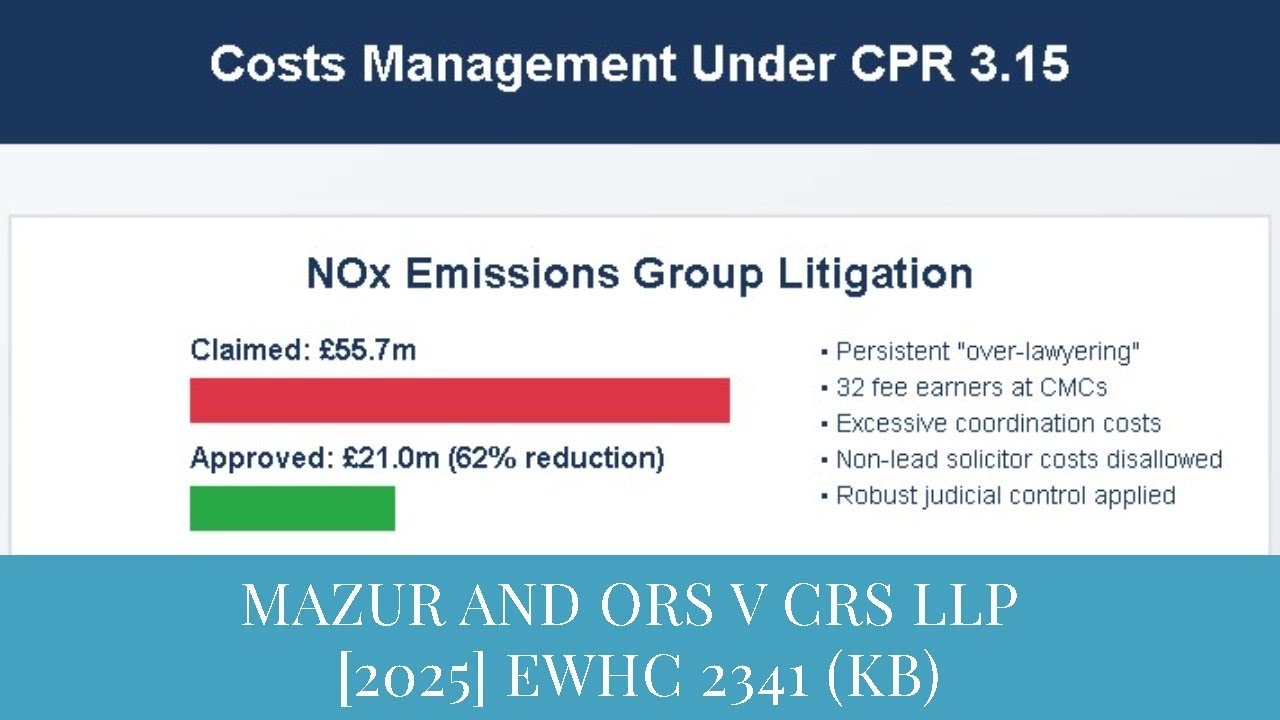
High Court Slashes Claimants’ Costs Budgets by 62% In NOx Emissions Litigation
Cockerill J and Senior Costs Judge Rowley approved just £21m of £55.7m sought by claimants for Tranche 3 of the NOx Group Litigation. The court criticised continued “over-lawyering”, drastically reduced budgets for CMC attendance from 32 fee earners to 9 in-person attendees, and confined non-lead firms’ recoverable involvement to narrow circumstances, with routine “keeping abreast” work deemed non-recoverable inter partes.

CPR 3.15(8) | £870 Hourly Rate And £90,000 Brief Fee For Leading Counsel Deemed Disproportionate In £1.2m Claim
The High Court reduced trial preparation and trial budgets through broad-brush phase reductions where solicitors’ rates substantially exceeded London Band 2 guidelines and counsel brief fees totalled £90,000. Courts can address excessive rates without breaching CPR 3.15(8)’s prohibition on fixing hourly rates by applying downward adjustments to disproportionate phase totals following GS Woodland Court GP1 Ltd v GRCM Ltd.

Indemnity Costs

Being ‘Annoying and Difficult’ Not Sufficiently ‘Out Of The Norm’ For Indemnity Costs In Failed Liquidator Challenge
The Chancery Division refused indemnity costs against an unsuccessful creditor applicant, finding his conduct, though creating a weak application, did not meet the “out of the norm” threshold. Personal circumstances including head injury and deep investment in the liquidation distinguished the case from authorities like Beattie v Smailes where extravagant applications warranted higher basis awards.

Part 36 Offers

When Part 36 Offers Demand Total Capitulation | Matière v ABM
Alexander Nissen KC held that a Part 36 offer of nil for a multi-million pound counterclaim was not a genuine attempt to settle that aspect of proceedings, making it unjust to apply indemnity costs consequences under CPR 36.17(4) to counterclaim costs. The offer’s genuine nature regarding the claim secured full Part 36 benefits for those costs only, demonstrating offers must involve realistic concessions across all dispute aspects.

Costs Capping

Costs Capping Order | Court Sets Different Caps Despite Defendant’s Push For Parity In Facial Recognition Challenge
Farbey J set reciprocal but non-identical costs caps at £70,000 (claimants) and £100,000 (defendant) in a judicial review of Live Facial Recognition technology policy. Courts will look beyond specific fundraising to assess campaign organisations’ true financial resources, expecting strategic deployment of unrestricted funds whilst recognising that “reciprocal” caps under Criminal Justice and Courts Act 2015 ss88-89 need not be identical.

Fixed Costs Regime

CPR 45.8 Fixed Costs Apply To Interim Applications From Date Of Provisional Track Allocation
Sheldon J quashed a costs order of £10,653 where the case had been provisionally allocated to the Intermediate Track, limiting recoverable costs to £333 plus £303 court fee under CPR 45.8. Fixed costs regime applies from provisional allocation, not formal allocation, and conducting litigation as an unauthorised person constitutes a reserved activity barred under Legal Services Act 2007 absent specific exemption.

Costs-Only Proceedings

Court Refuses Costs-Only Joinder But Orders Consolidation in Will Dispute
HHJ Paul Matthews refused to join a will-writing company as a costs-only party under CPR 46.2 where it contested negligence allegations requiring full trial on breach, causation and quantum. Summary procedure under s51 Senior Courts Act 1981 is inappropriate where non-parties actively dispute liability; consolidation under CPR 3.1(2)(h) offers broader case management solutions where separate proceedings exist.

The Court of Appeal’s decision in Gotti v Perrett [2025] EWCA Civ 1168 establishes that all pre-action applications constitute “proceedings” for costs purposes, closing a potential loophole across civil litigation.

Background

The dispute originated from an application for an interim injunction made by the Appellant, Christian Gotti, against the Respondent, Karen Perrett, under the Protection from Harassment Act 1997. The application was issued at Worcester County Court on 4 July 2023 using Form N16A, the general application form for an injunction under CPR Part 23. The application was listed for a contested hearing on 3 August 2023, where the Appellant was represented by counsel and the Respondent appeared in person. Following the hearing, an interim injunction was granted.

The injunction order contained significant procedural defects. No undertaking was given by the Appellant to issue a claim form, as required by the then-in-force CPR PD25A, paragraph 4.4(1). The court also failed to give directions for the issue of a claim form. Furthermore, no cross-undertaking in damages was offered by the Appellant or recorded in the order, despite the Respondent’s evidence that she would suffer financial loss. A penal notice was included on the face of the order. No claim form was ever issued by the Appellant.

The application was later acknowledged by the Appellant himself to be “deeply misconceived” [§20, §26] for multiple reasons: the county court lacked jurisdiction for defamation claims; interim injunctions are unavailable in defamation where the defendant seeks to defend; the PfHA 1997 lacked jurisdiction as the Appellant lived in Scotland; and Article 10 ECHR issues were not addressed.

On 27 February 2024, the Respondent issued an application to discharge the injunction and for damages and costs. Upon receipt of this application, the Appellant performed what the Court described as a “spectacular volte face” [§25], conceded that his application for the injunction was “deeply misconceived” and accepted that the order should never have been granted. He consented to its immediate discharge. However, he argued that as no Part 7 or Part 8 claim form had ever been issued, there were no valid “proceedings” before the court. Consequently, he contended that the court had no jurisdiction to make orders for costs or damages in favour of the Respondent.

Costs Issues Before the Court

The central costs issue was whether the court possessed the jurisdiction to make ancillary orders for costs and damages upon the discharge of an injunction where: (i) no undertaking to issue a claim form was given or recorded; (ii) no cross-undertaking in damages was offered or recorded; and (iii) no claim form was ever subsequently issued. The Appellant’s position was that the absence of a substantive claim form meant the injunction application was a “nullity” and that no “proceedings” existed in which the court could exercise its powers.

A secondary issue was whether, if the court found there were no valid proceedings, it could invoke CPR rule 3.10 to remedy the procedural error of using Form N16A instead of the required Part 8 Claim Form (N208) for a claim under the Protection from Harassment Act 1997.

The Parties’ Positions

The Appellant’s Position: The Appellant argued that the court had no jurisdiction. He submitted that “proceedings” are started only when the court issues a claim form at the request of a claimant, pursuant to CPR rule 7.2(1). As no Part 7 or Part 8 claim form was ever issued, there were no proceedings. He contended that the use of Form N16A did not constitute a prescribed originating process for this type of claim and that the entire process was therefore a nullity. He relied on authorities such as Citation plc v Ellis and Peterson v Howard de Walden Estates Ltd to support the proposition that costs cannot be awarded without a claim form. He further argued that CPR rule 3.10 could not be used to correct a procedural error that occurred before the commencement of any proceedings.

The Respondent’s Position: The Respondent argued that the court did have jurisdiction. She contended that the application for an interim injunction, properly issued under CPR Parts 23 and 25, constituted “proceedings” to which the Civil Procedure Rules applied. She relied on the equitable jurisdiction of the court to grant injunctions, as confirmed in Fourie v Le Roux, and the wide interpretation of “proceedings” in section 147 of the County Courts Act 1984, which “includes both actions and matters.” She also pointed to the court’s costs jurisdiction under section 51 of the Senior Courts Act 1981, which applies to “costs of and incidental to all proceedings.” In the alternative, she argued that the error in using the wrong form could and should be remedied under CPR rule 3.10, citing authorities such as Hannigan v Hannigan and Reddy v General Medical Council.

The Court’s Decision

The Court of Appeal dismissed the appeal, upholding the decisions of the courts below. Both Lewison LJ (in granting permission) and HHJ Salmon described the Appellant’s argument as “an affront to common sense” [§5-6]. Lord Justice Cobb, giving the lead judgment, held that the application for an interim injunction constituted “proceedings” within the meaning of the relevant statutes and rules. The court’s reasoning was based on several key points.

    • First, the court was exercising a statutory and equitable jurisdiction under section 38 of the County Courts Act 1984 when it granted the injunction. This power exists in “any proceedings,” a term which is not restricted to post-claim-form activity. The court endorsed the view that “proceedings” include any application with which the court is seised and in respect of which it is asked to make orders. The fact that the application was procedurally flawed and “deeply misconceived” did not mean it was a nullity; it simply meant the proceedings were brought in an inappropriate form.
    • Second, the court’s costs jurisdiction under section 51 of the Senior Courts Act 1981 applies to “all proceedings,” which must be given the same wide interpretation. Civil courts routinely make costs orders on pre-action interim injunction applications.
    • Third, disapplying the CPR and the overriding objective to a pre-action injunction application would be absurd, as such applications can have draconian consequences for respondents and must be dealt with justly. The Appellant’s concession that the court had jurisdiction to make and subsequently discharge the injunction was found to be inconsistent with his argument that the process was a nullity.

The court relied heavily on Lord Scott’s judgment in Fourie v Le Roux [2007] UKHL 1, which established that pre-action freezing orders are “not a nullity” and have “immediate effect” even without substantive proceedings [§58].

On the secondary issue, the court held that, if necessary, CPR rule 3.10 could be invoked to remedy the error of using Form N16A instead of Form N208. The error was one of procedure after proceedings had commenced, and it could be corrected to prevent the Appellant from benefiting from his own failure and to further the overriding objective. The case of Peterson was distinguished, as it concerned an error occurring before any proceedings were commenced.

In conclusion, the court found that the judges below were correct. The court had jurisdiction to make orders ancillary to the discharge of the injunction, including orders for costs and damages. The appeal was dismissed.

Wider implications beyond injunctions for costs jurisdiction in civil litigation

1. Pre-action applications generally The principle that “proceedings” under s.51 SCA 1981 encompasses any application where the court is asked to exercise jurisdiction extends to all pre-action remedies, not just injunctions. This would cover:

    • Pre-action disclosure applications (CPR r.31.16)
    • Norwich Pharmacal orders
    • Pre-action inspection orders
    • Any application under CPR Part 23 before a claim form

2. Procedurally defective proceedings The ruling that procedural errors don’t negate costs jurisdiction applies broadly. If parties commence any type of application using the wrong form or procedure, they cannot later rely on their own error to escape costs consequences. This prevents tactical exploitation of procedural mistakes across all litigation contexts.

3. Defining “proceedings” for costs purposes The Court’s expansive interpretation of “proceedings” – as any matter where the court is “seised” and asked to make orders [§69] – affects costs jurisdiction throughout the CPR. This could impact:

    • Costs in struck-out claims
    • Discontinued proceedings
    • Applications dismissed for procedural non-compliance
    • Stand-alone applications without underlying claims

4. CPR r.3.10 application The liberal approach to remedying procedural errors under CPR r.3.10 has implications for all litigation where the wrong form or process is used, confirming courts will prevent parties benefiting from their own procedural failures.

5. Section 51 jurisdiction The confirmation that s.51 SCA 1981 costs jurisdiction applies to “all proceedings” reinforces the court’s broad discretion over costs in any matter before it, strengthening the principle that costs follow the event regardless of procedural irregularities.

This decision essentially closes a potential loophole across civil litigation where parties might attempt to avoid costs liability through procedural technicalities.

YouTube player

CPR 38.6: Discontinuance And Costs – The Legal Principles

Discusses costs jurisdiction where proceedings are discontinued without substantive claims

Who Should Pay The Costs Of A Withdrawn And Undetermined Application?

Court of Appeal case examining costs jurisdiction for withdrawn applications and the court’s discretion under CPR 44.2

Recoverability Of Inquest Costs In A Civil Claim

Addresses the principles of costs recovery in proceedings that precede formal claims

CPR 45.8 Fixed Costs Apply To Interim Applications From Date Of Provisional Track Allocation

High Court decision on costs jurisdiction for interim applications

Part 20 Defendant Ordered To Pay 1/3rd Of Defendant’s Costs Of Defending The Action

Examines the court’s discretion under Section 51 Senior Courts Act 1981 to award costs in complex procedural scenarios

Court of Appeal: Fixed Costs Do Not Apply To Appeals But QOCS Does

Discusses Section 51 SCA 1981 and the court’s general discretion over costs in different procedural contexts

The High Court’s decision in Various Claimants v Mercedes-Benz Group AG & Ors [2025] EWHC 2307 (KB) demonstrates the court’s continued determination to control excessive costs in large-scale group litigation through robust budgeting reductions.

Background

The judgment concerns the second Costs Management Hearing (CMH) in the NOx Emissions Group Litigation, a series of consolidated Group Litigation Orders (GLOs) concerning claims against various vehicle manufacturers. The litigation is being case managed in tranches. The first trial (Tranche 1) on “KBA Issues” took place in October 2024. The second trial (Tranche 2) on “Prohibited Defeat Devices” (PDD) is scheduled for October 2025. The costs for these tranches were managed at the first CMH.

This second CMH dealt with the costs budgets for the third tranche of the litigation (Tranche 3) and a second period of general costs (Second General). Tranche 3, the “Quantum Trial”, concerns issues of causation and loss and is listed for eight weeks in October/November 2026. The Second General budget covers the period from Spring 2026 up to the Quantum Trial. The court was required to approve budgets for 63 Precedent Hs, comprising 390 costed phases, with total sums claimed of £55.7 million (claimants) and £75.8 million (defendants collectively) for Tranche 3, and £19.8 million (claimants) and £3.6 million (defendants) for the Second General phase.

The Lead GLO involves claims against Mercedes-Benz. Additional Lead GLOs (ALGLOs) involve Ford, Peugeot/Citroën (PCD), and Nissan/Renault. Claims against other manufacturers (e.g., BMW, Vauxhall, Volkswagen) are designated as Non-ALGLOs. The case management directions limited the participation of Non-ALGLOs in the upcoming trials, which was a key factor in the costs budgeting exercise. The claimants structured their budgets to distinguish between “Pan NOx” work (involving all GLOs), “Lead and ALGLO” work, and “GLO specific” work.

Costs Issues Before the Court

The primary task for the court was to determine the reasonable and proportionate budgeted costs for the future phases of the litigation, namely Tranche 3 and the Second General period. The key costs issues included:

    1. The appropriate level of reduction to the claimants’ budgets to address continued “over-lawyering”, a criticism made in the first CMH judgment.
    2. The relevance of the budgets approved for the longer and more complex Tranche 2 trial as a comparator for setting Tranche 3 budgets.
    3. Whether to allow standard figures for defendants performing similar tasks or to recognise a range of reasonable and proportionate costs.
    4. The recoverability of common costs claimed by numerous non-lead solicitors’ firms instructed by individual claimants within the GLOs.
    5. The reasonableness of the high number of fee earners the claimants had budgeted to attend hearings such as CMCs, the PTR, and the trial.
    6. Whether to approve budgets for the Expert Reports and ADR/Settlement phases at this stage or to defer this decision.

The Parties’ Positions

The defendants’ overarching position was that the claimants had failed to learn lessons from the first CMH and continued to advance unrealistic budgets characterised by excessive manpower and duplication. They argued that the budgets for Tranche 3 should generally be lower than those for the longer and more complex Tranche 2 trial. They criticised the claimants’ structure of involving multiple law firms and the vast number of fee earners budgeted for hearing attendance. For their own budgets, defendants generally sought to justify their figures based on the specific work required, though the claimants alleged some defendants were budgeting at lower rates than they were actually incurring.

The claimants argued they had responded to the first judgment by providing more detailed justification for their figures and by reallocating work within their budget structure. They contended that the “lived experience” of Tranche 2 had demonstrated that more work was required than initially anticipated, justifying higher figures for some Tranche 3 phases. They defended the involvement of non-lead firms, citing a solicitor’s duty to keep clients informed and the right of clients to choose their representation. For the defendants’ budgets, the claimants often made standard offers to groups of defendants (e.g., all Non-ALGLOs), arguing a single figure could be reasonable and proportionate for similar tasks.

The Court’s Decision

The court, applying the overriding objective and the principles of costs budgeting, made significant reductions to the budgets of both parties, particularly the claimants. The approved figures are set out in the conclusion below. The court’s key findings and rationale were as follows:

    • Over-lawyering and Lessons from the First CMH: The court found that the claimants’ efforts to provide more detail did not justify the “enormous amounts of time claimed”. It upheld the criticism of “over-lawyering”, citing as an example the claimants’ budget for 32 fee earners to attend CMCs at a cost of £3.3 million. The court found the claimants’ approach, particularly the layers of representation and involvement of multiple non-lead firms, led to duplication and inefficiency.
    • Comparison with Tranche 2: The court agreed with the defendants that the budgets approved for Tranche 2 were a relevant starting point and that, given the shorter length and less complex nature of the Quantum Trial, Tranche 3 budgets should generally be lower, not higher. The court expected improved cooperation and lessons learned from Tranche 2 to lead to more economical working.
    • Standard Figures vs. a Range: The court held that where defendants were undertaking the same tasks, a standard figure could be reasonable and proportionate. It noted that figures within 20% of a reasonable comparator could be considered within an acceptable range. However, figures more than 20% above a reasonable comparator required specific justification, which was often lacking.
    • Non-Lead Solicitors’ Costs: The court severely restricted the common costs recoverable by non-lead firms. It held that work such as keeping abreast of developments for client advice was primarily a solicitor-client matter, not recoverable between the parties. For sample claimants represented by non-lead firms, the cost of drafting witness statements or pleadings should be no more than if the work had been done by the lead solicitor.
    • Hearing Attendance: The court drastically reduced the claimants’ budgets for hearing attendance. It found the number of fee earners budgeted (e.g., 9 in person and 21 remotely for CMCs) to be unreasonable. For the trial, the court approved a team of only 4 fee earners from each lead firm attending in person, with no allowance for attendance by fee earners from other firms.
    • Specific Phase Reductions: The court made detailed reductions across all phases. For example, the claimants’ sought £3.3m for two CMCs was reduced to £850,000; their £1.4m for the PTR was reduced to £300,000. The defendants’ budgets were also reduced in many phases where they were found to be excessive, such as Vauxhall’s budget for reviewing statements of case.
    • Deferral of Expert Reports and ADR Phases: The court declined to budget the Expert Reports phase because the scope and necessity of this evidence was still to be determined at a future CMC. The ADR/Settlement phase was also deferred because the parties’ assumptions were too far apart (£11m claimed by claimants vs. £1.8m by defendants) to make sensible budgeting possible at this stage. The court proposed to reconsider these phases in January 2026.
    • Second General Costs: The court found the claimants’ claimed management costs of nearly £20m to be “frankly staggering” and illustrative of a “wildly inefficient” approach. The budget was based on assumptions of excessive monthly updates to a vast number of lawyers and clients. The court allowed only a modest sum for essential register updates and communication, significantly reducing the budget to £1.43m.

In conclusion, the court approved the following total budgets:

    • Tranche 3: Claimants: £21,024,850.01 (from £55.7m claimed); Defendants: £48,058,002.04 (from £75.8m claimed).
    • Second General: Claimants: £1,430,000.00 (from £19.8m claimed); Defendants: £1,319,114.70 (from £3.6m claimed).
YouTube player

CPR 3.15A | Costs Budget Revisions | Significant Developments And The Need To Act Promptly

Directly relevant as it covers CPR 3.15A budget revision applications which relate to the costs management framework applied in the NOx case

Costs Management Hearing | Unrealistic Budgets May Face Adverse Costs Orders

High Court decision (2025) discussing excessive costs budgets and judicial warnings about “unrealistic” budgets, highly relevant to the over-lawyering theme

Costs Budgeting and Costs Management – What You Need To Know

Essential background on CPR 3.15 costs management rules and procedures that practitioners need to understand the NOx judgment

Reasonable Joint Costs Recoverable In Full Regardless Of Number Of Defendants

Recent High Court decision (2025) on common costs in multi-party litigation, relevant to the GLO cost recovery issues

Budgets, Hourly Rates, Good Reason and Proportionality

Analysis of how courts assess reasonable and proportionate costs under CPR 3.18, relevant to the budget assessment principles

Significant developments and incurred costs

Chief Master Marsh decision examining costs budgeting practicalities and significant development applications

The High Court’s decision in Pontis Finance LLP v Karam, Missick & Traube LLP [2025] EWHC 2298 (Ch) demonstrates how courts can address excessive hourly rates through broad-brush phase reductions without breaching CPR 3.15(8)’s prohibition on fixing rates.

The case concerned a professional negligence claim brought by Pontis Finance LLP, a lender, against the defendant firm of solicitors, Karam, Missick & Traube LLP. Pontis had agreed to lend approximately £812,500 to an individual purporting to be Stefano Brugnolo, secured by a charge on a Mayfair property. The defendant firm acted for the borrower. Pontis’s case was that the defendant’s client was an impostor and that the firm had failed to perform adequate identity checks. Having advanced the loan monies, which were then paid to the impostor, Pontis claimed it had no prospect of recovery. The claim was for the return of the loan monies, interest, and associated fees, totalling approximately £1.2 million.

Following a Costs and Case Management Hearing (CCMC) on 21 February 2025, the court ordered the parties to file updated costs budgets. The intention was for the court to rule on these budgets promptly on the papers. Due to an administrative oversight, this ruling was significantly delayed from March to September 2025 [§6-8]. Consequently, costs for several phases of the litigation, most notably the Disclosure phase, transitioned from being future costs to incurred costs, thereby limiting the court’s ability to budget for them effectively [§9, §11.1].

Costs Issues Before the Court

The court was required to determine the reasonable and proportionate budgeted costs for the phases where it retained jurisdiction, specifically the Trial Preparation and Trial phases. The court could not set budgets for the Disclosure phase (as costs were now incurred), nor for Witness Statements and Settlement/ADR phases (due to uncertainty about what work had been completed) [§11]. The central issue was whether the overall figures claimed were proportionate, with a particular focus on the Claimant’s use of solicitors’ hourly rates that substantially exceeded the applicable guideline rates and the instruction of both a King’s Counsel and a junior barrister. The court had to assess proportionality by reference to the factors in CPR 44.3(5), primarily the sums in issue (£800,000 to £1.2 million) and the complexity of the litigation [§15].

The Parties’ Positions

The Claimant argued that the case involved complex legal issues concerning whether a duty of care was assumed to a non-client, the nature of any undertakings given, and potential breaches of trust. It submitted that the majority of the budgeted work was appropriately focused on the Trial Preparation and Trial phases and that the use of both leading and junior counsel was justified. The solicitors’ high hourly rates were presented as a reflection of the firm’s expertise.

The Defendant contended that the claim, valued at approximately £1.2 million, was towards the lower end of the scale for Chancery Division litigation and was not sufficiently complex to be categorised as “very heavy commercial work.” It argued that the case would substantially turn on its facts. The Defendant submitted that the Claimant’s solicitors’ hourly rates were excessive and unjustified, and that instructing both leading and junior counsel was disproportionate, particularly as a managing associate was also budgeted to attend trial.

The Court’s Decision

The court found that the Claimant’s overall incurred and budgeted costs of £489,891.31 were disproportionate for a claim of this nature and value [§31]. The case was assessed as being of moderate complexity, turning largely on its facts, and not qualifying as “very heavy commercial work” [§22]. Consequently, the appropriate guideline band for assessing solicitors’ hourly rates was London Band 2, not Band 1 [§35].

The court acknowledged that its role under CPR 3.15(8) was to approve phase totals, not to fix or approve specific hourly rates [§23]. However, following the approach in GS Woodland Court GP1 Ltd v GRCM Ltd [§26], it held that the combination of excessive rates and the number of hours billed could render a phase total disproportionate. The court therefore made broad, downward adjustments to the phase totals to reflect this.

For the Trial Preparation phase, the Claimant sought £136,550. The court found the number of solicitors’ hours (110) to be reasonable but the rates charged were substantially above the London Band 2 guidelines [§39]. It also found the aggregate counsel brief fees of £90,000 to be disproportionate [§44]. Applying a broad-brush approach, the court approved a budget of £115,000 for this phase [§48].

For the Trial phase, the Claimant sought £88,700. The court identified that the Claimant had erroneously budgeted for four days of counsel refreshers for a four-day trial; only three days were permissible, as the brief fee covers the first day [§51]. Furthermore, the solicitors’ rates were again deemed excessive. The court also disallowed most of the costs for an unexplained Grade D fee earner charged at £400 per hour [§58]. Considering all elements, the court approved a budget of £50,000 for this phase [§60].

The court declined to set budgets for the Witness Statements and Settlement/ADR phases due to the uncertainty over how much work had been incurred during the delay, rendering it impossible to distinguish between incurred and future costs [§11.2, §11.5]. The parties were advised to apply for a further costs management hearing if they wished to budget for these phases.

GS Woodland Court GP1 Ltd v GRCM Ltd [2025] EWHC 285 (TCC)

Key authority on how courts apply downward adjustments to phase totals where excessive hourly rates render them disproportionate

CPR 3.18(b) | Underspend Does Not Constitute Good Reason To Depart From An Approved Budget

Explores the interplay between budgeting and detailed assessment, relevant to understanding how courts control costs through budgeting

CPR 3.15A | Costs Budget Revisions | Significant Developments And The Need To Act Promptly

Details the requirements for varying costs budgets, relevant given the administrative delays that affected budgeting in Pontis Finance

2021 Guideline Hourly Rates, Use of Counsel And Division Of Common Costs

Discusses the application of guideline hourly rates and the use of both leading and junior counsel, directly relevant to the excessive rates and counsel fees issues

How Relevant Are The Guideline Hourly Rates?

Examines judicial attitudes to guideline rates being exceeded, providing context for understanding when rates significantly above guidelines may be justified

CPR 3.14 | Late Costs Budget | Relief From Sanctions Denied

Illustrates the consequences of failing to comply with budgeting requirements, contrasting with the administrative issues in Pontis Finance


YouTube player

Background

The costs determination arose from Century Property (Leeds) Limited’s successful application for mandatory injunctions to enforce a judgment debt against Dr Jason Aldiss’s self-invested personal pension (SIPP). The underlying judgment debt of £402,500 stemmed from an order made by Master Eastman on 31 October 2023, which was subsequently assigned to Century Property on 1 December 2023.

The enforcement proceedings involved Century Property obtaining a charging order over Dr Aldiss’s SIPP on 11 June 2024, with the total sum due reaching £450,939 by 29 April 2025, accruing interest at £88.22 daily. The SIPP, valued at £618,249.94 as of 16 April 2025, could not be accessed until Dr Aldiss reached his 55th birthday on 17 August 2025.

The application proceedings involved two hearings. At the first hearing, Dr Aldiss, appearing as a litigant in person, successfully applied for an adjournment to gather evidence to respond to Century Property’s application. Despite being granted this adjournment, Dr Aldiss failed to serve any evidence and provided no explanation for this failure. Shortly before the second hearing in April 2025, Dr Aldiss made an application to the Court of Appeal for permission to appeal the original Tomlin Order, and at the second hearing, he unsuccessfully sought both an adjournment and a stay of enforcement proceedings.

Following the court’s judgment on 4 June 2025 allowing Century Property’s application, the parties were directed to submit written representations on consequential matters, including costs, by 30 May 2025. Dr Aldiss’s response to Century Property’s statement of costs was delayed due to an injury, with his submissions ultimately provided on 9 June 2025.

Costs Issues Before the Court

The court was required to determine three principal costs issues following the successful enforcement application. First, whether Dr Aldiss should bear Century Property’s costs or whether the circumstances justified departing from the general rule under CPR 44.2(2)(a) that the unsuccessful party pays the successful party’s costs.

Second, the court needed to consider the appropriate basis of assessment. Century Property sought its costs on the indemnity basis, arguing that Dr Aldiss’s conduct throughout the proceedings was sufficiently unreasonable to take the case “out of the norm” as established in Excelsior Commercial and Industrial Holdings Ltd v. Salisbury Hannah Aspden & Johnson [2002] EWCA Civ 879. The alternative was assessment on the standard basis.

Third, the court was asked to summarily assess the quantum of costs. Century Property submitted two statements of costs: the first dated 28 April 2025 for £55,363.02 (including VAT) covering both hearings, and the second dated 29 May 2025 for £2,204.41 (including VAT) for work on consequential matters, totalling £57,567.43. The court needed to determine whether these costs were reasonable and proportionate in accordance with CPR 44.3(5) and 44.4.

The Parties’ Positions

Dr Aldiss advanced four principal arguments against any costs order. He emphasised his status as a litigant in person who found the litigation uniquely stressful as it concerned both his reputation and his sole retirement asset. He contended that the enforcement application was premature given that his 55th birthday was not until August 2025. He pointed to his recent application for permission to appeal the Tomlin Order as evidence of genuine concerns about its validity. Finally, he maintained that his challenges were not designed to delay enforcement but reflected legitimate concerns about the underlying settlement.

Regarding the basis of assessment, Dr Aldiss argued for the standard basis, relying on the same grounds he had advanced against any costs order being made.

On quantum, Dr Aldiss challenged the costs as disproportionate and sought only nominal costs. He specifically criticised Mr Toby Starr’s hourly rate of £685 and the Grade C associate solicitor’s rate of £420 as significantly exceeding guideline rates without justification for enhancement. He argued that the claims for work on documents (£14,375), email correspondence, and counsel fees (£15,405) were excessive without proper breakdown or itemisation. He alleged duplication of work and excessive time on routine tasks, suggesting the statements had been “padded out”.

Century Property’s position was straightforward on liability: having succeeded on the application, there was no reason to depart from the general rule requiring the unsuccessful party to pay costs. On the basis of assessment, Century Property argued that Dr Aldiss’s conduct warranted indemnity costs, citing his non-compliance with the Tomlin Order, his request for an adjournment to gather evidence which he subsequently failed to serve, his unreasonable opposition to the application, his unsubstantiated challenges to the Tomlin Order’s validity, and his failed attempts to adjourn the second hearing and stay enforcement. Century Property maintained that this conduct took the case “out of the norm”.

On quantum, Century Property defended its costs as reasonable given the unusual nature of the application, which had only been considered in three reported first instance cases. Century Property made no specific submissions responding to Dr Aldiss’s detailed criticisms of the costs claimed.

The Court’s Decision

On the principle of costs liability, the court applied the general rule under CPR 44.2(2)(a) and ordered Dr Aldiss to pay Century Property’s costs. The court found that none of Dr Aldiss’s four grounds provided sufficient reason to displace the general rule. Whilst acknowledging his status as a litigant in person and the litigation’s impact, the court noted that Dr Aldiss had “vigorously fought, but lost, the application”. The prematurity argument had already been dismissed in the substantive judgment at paragraph 53(e). The pending appeal application did not justify departing from the general rule, and whilst not doubting Dr Aldiss’s sincerity, the court noted he had done nothing to substantiate his validity challenges despite being given opportunities to submit evidence.

On the basis of assessment, the court adopted a nuanced approach. After reviewing the principles from Excelsior Commercial and Industrial Holdings Ltd v. Salisbury Hannah Aspden & Johnson [2002] EWCA Civ 879 and Three Rivers DC v. Bank of England [2006] EWHC 816 (Comm), the court recognised that the test was unreasonableness rather than moral condemnation. The court acknowledged that the application was “far from straight-forward”, concerning an area of law with limited authority, and that Dr Aldiss was entitled to defend against enforcement directed at his sole retirement asset.

However, the court found that Dr Aldiss, as “a professional and articulate man”, understood the need to present evidence and comply with orders. His failure to serve evidence after obtaining an adjournment specifically for that purpose, without good reason or application to vary the timetable, was particularly significant. The court concluded that Dr Aldiss’s applications at both hearings were “designed to delay determination of Century Property’s application and, ultimately, enforcement of the judgment debt”.

The court ordered costs on the standard basis, except for the costs of the first hearing which were to be assessed on the indemnity basis. This reflected a balance between the unusual nature of the application and the fact that the first hearing costs were “wasted because of Dr Aldiss’ ultimately pointless application to adjourn”.

On quantum, the court conducted a summary assessment applying the principles from West v. Stockport NHS Foundation Trust [2019] EWCA Civ 1220. For the first statement of costs, the court found the solicitors’ hourly rates and counsel’s fees reasonable. However, it reduced the correspondence costs from the claimed amount to £6,000, finding the costs for correspondence with Dr Aldiss higher than expected given its “brief and succinct nature”. The court also reduced the documents costs to £13,000, finding excessive time spent on the chronology and response to Dr Aldiss’s request for information.

The court approved the second statement of costs in full at £2,204.91. The total costs allowed were £54,432.93 (including VAT), reduced from the £57,567.43 claimed. The court found this sum proportionate under CPR 44.3(5) and 44.4, considering the unusual nature of the application, the substantial sums at stake (approximately £450,000), the additional work caused by the adjournment, and Dr Aldiss’s conduct in seeking information on matters previously communicated to him. The court refused to stay the costs order for the same reasons it had refused to stay enforcement of the substantive order.

Background

The claimants, William Thomas Stockler and Alexander Charles Stockler, were holders of permanent seats at the Royal Albert Hall. They brought proceedings against The Corporation of the Hall of The Arts and Sciences, which operates the venue, concerning payments due under the Hall’s Ticket Return Scheme (TRS). Under this scheme, introduced in 1993, seat-holders could return unwanted tickets in exchange for payment.

Following amendments to the TRS payment terms in April 2018, the claimants disputed the defendant’s calculations and commenced proceedings in September 2022 seeking an account and payment of monies allegedly due. The claim was initially valued at less than £10,000, with the claimants indicating on the claim form that it fell within the small claims track limit. The defendant counterclaimed seeking, amongst other matters, a declaration as to the proper construction of the contractual arrangements.

Both parties issued applications for summary judgment in late 2022. On 23 February 2023, Deputy District Judge Kirby KC granted summary judgment to the defendant on the interpretation of the 5 April 2018 letter, stayed the balance of proceedings to enable agreement on an account, and allocated the matter to the fast track. Significantly for costs purposes, he ordered the claimants to pay the defendant’s costs of the hearing, including the summary judgment applications limited to the interpretation issue, subject to detailed assessment if not agreed.

When settlement negotiations failed, the matter returned before DJ Mauger on 24 May 2024. The judge refused the claimants permission to amend their particulars of claim, dismissed the balance of their claim, and gave judgment for the defendant on the counterclaim in the sum of £3,054.24. The judge made a further costs order requiring the claimants to pay the defendant’s costs of the claim and counterclaim on the standard basis until 8 June 2023 and on the indemnity basis thereafter.

The defendant commenced detailed assessment proceedings on 6 September 2024, serving a bill totalling £162,789.37. The bill was divided into three parts: Part 1 for standard basis costs (£76,066.38), Part 2 for indemnity basis costs, and Part 3 for bill preparation costs. Points of Dispute were served on 1 October 2024, followed by Replies, with the assessment hearing requested on 10 December 2024.

Costs Issues Before the Court

The primary issue before Deputy Costs Judge Joseph was whether the defendant’s costs should be reduced on grounds of proportionality following the line-by-line assessment. This issue arose specifically in relation to Part 1 of the bill, which covered costs incurred on the standard basis up to 8 June 2023.

The court was required to apply CPR 44.3 and 44.4, which mandate that on a standard basis assessment, only costs that are proportionate to the matters in issue should be allowed. Under CPR 44.3(5), proportionality requires costs to bear a reasonable relationship to various factors including the sums in issue, value of non-monetary relief, complexity of litigation, conduct of the paying party, and any wider factors such as reputation or public importance.

A preliminary issue concerned whether the court should assess proportionality across the entire bill or focus solely on Part 1. This was significant because Part 2 costs were assessed on the indemnity basis, where proportionality does not apply. Additionally, the court had to determine the appropriate approach to proportionality assessment following the guidance in West and Demouilpied v Stockport NHS Foundation Trust [2019] Costs LR 1265.

The line-by-line assessment had already addressed various contested issues, including the reasonableness of instructing London-based solicitors, appropriate fee earner grades, and the dismissal of numerous Points of Dispute for insufficient particularisation under Ainsworth v Stewarts Law LLP [2020] EWCA Civ 178. Following this assessment, Part 1 of the bill had been reduced from £76,066.38 to £55,581.38.

The Parties’ Positions

The claimants, represented initially by Counsel and subsequently by the first claimant acting in person, argued that the assessed costs were manifestly disproportionate. Their primary submission was that proportionate costs should be calculated by reference to a multiple of the monetary value of the claim. They proposed that a base figure should be between one and a half to two times the £3,200 monetary claim value (producing £4,800-£6,400), with additional allowances of £1,000-£1,500 for non-monetary relief and similar amounts for conduct-related work. This methodology produced a range of £6,800-£9,400, with a mid-point of £8,100 representing their view of proportionate costs.

The claimants relied on the fact that the claim had been initially valued at less than £10,000 and would ordinarily have fallen within the small claims track. They pointed to comments by DDJ Kirby suggesting concern about costs being incurred in relation to potential claims by other seat-holders, and to DJ Mauger’s ultimate dismissal of the account claim as disproportionate. They maintained that spending approximately £55,000 on a claim worth £3,200 was wholly disproportionate regardless of other factors.

The defendant, represented by Mr Paul Hughes, rejected the claimants’ mathematical approach to proportionality. He argued that all factors in CPR 44.3(5) should be considered without giving special weight to monetary value alone. The defendant emphasised that the DDJ had allocated the matter to the fast track despite its monetary value, indicating the case’s unsuitability for the small claims track. This allocation decision suggested a total claim value, including non-monetary elements, potentially up to the fast track limit of £25,000.

The defendant highlighted the complexity of the contractual interpretation issues, evidenced by detailed skeleton arguments and the instruction of Counsel throughout. He argued that decisions already made during the line-by-line assessment – including approval of London solicitors’ instruction and appropriate fee earner grades – demonstrated reasonableness that should not be undermined through proportionality. The defendant also stressed wider factors, including potential reputational damage and the risk of similar claims from other seat-holders among the Hall’s 320 seat-holders who returned 179,000 tickets in 2022 alone.

The Court’s Decision

Deputy Costs Judge Joseph rejected the claimants’ mathematical approach to proportionality assessment. The court held that there was no basis in West and Demouilpied for calculating proportionate costs using arbitrary multiples of claim value. Such an approach was deemed fundamentally flawed and contrary to CPR requirements, which mandate consideration of multiple factors without attributing special significance to any single element.

The court determined that proportionality assessment should focus solely on Part 1 of the bill, as proportionality does not apply to indemnity basis costs. Following West and Demouilpied, the court examined the work reasonably undertaken during the relevant period, finding it included substantial tasks: reviewing proceedings, drafting pleadings, considering documents, preparing for and attending the summary judgment hearing, responding to requests for information, and conducting settlement negotiations.

On the monetary value factor, whilst acknowledging the claim’s small financial component, the court held this should not carry special weight. The DDJ’s allocation to the fast track despite the low monetary value indicated the claim’s overall significance. The court accepted that when monetary and non-monetary elements were combined, the total claim value approached £25,000.

Regarding complexity, the court found the contractual interpretation issues required specific expertise and justified Counsel’s instruction. The earlier decisions allowing London solicitors and grade B fee earners supported this assessment. The court noted that having found these costs reasonable during line-by-line assessment, it would be difficult to subsequently deem them disproportionate.

The court accepted that the defendant was entitled to consider potential reputational damage and the risk of similar claims from other seat-holders as genuine wider factors. The Hall’s considerable public status meant the defendant could legitimately take the proceedings seriously. However, this did not entitle unlimited expenditure, and the court noted the bill had already been reduced by nearly 27% during line-by-line assessment.

A significant factor was the dismissal of numerous Points of Dispute for insufficient particularisation. The court held it would be inherently unfair to allow the claimants to achieve through proportionality what they had failed to achieve through properly formulated challenges. This would effectively permit reduction “through the back door” despite the claimants’ procedural failures.

The court concluded that the assessed costs of £55,581.38 for Part 1 were not disproportionate when all factors were properly considered. The reasonable costs were also proportionate costs, and no further reduction was warranted. The court emphasised that proportionality had already been partially considered during line-by-line assessment, particularly regarding hourly rates and fee earner grades, making further reduction inappropriate.

Implications

This case demonstrates several principles for costs practitioners. Mathematical formulae based on claim value multiples will not survive scrutiny – courts must consider all CPR 44.3(5) factors without giving special weight to monetary value alone. Track allocation decisions carry weight in proportionality assessment, particularly where judges depart from normal expectations based on case characteristics.

The decision reinforces that properly particularised Points of Dispute remain essential. Attempting to achieve reductions through proportionality arguments after failing to mount specific challenges during line-by-line assessment will not succeed. Courts will consider whether allowing such reductions would be unfair to the receiving party.

The case also shows how wider factors like reputational damage and potential satellite litigation can influence proportionality assessment, provided the receiving party can demonstrate genuine concerns rather than speculative risks.

YouTube player

https://tmclegal.co.uk/ainsworth-v-stewarts-law-llp/

https://tmclegal.co.uk/west-and-demouilpied/

https://tmclegal.co.uk/malmston-v-bohinc-proportionality/

https://tmclegal.co.uk/east-sussex-fire-and-rescue-service-v-austin/

https://tmclegal.co.uk/may-v-wavell/

https://tmclegal.co.uk/barts-health-nhs-trust-v-hilrie-rose-salmon-2/

https://tmclegal.co.uk/incurred-costs/

https://tmclegal.co.uk/worcester-v-hopley/

https://tmclegal.co.uk/pxt-v-atere-roberts/

https://tmclegal.co.uk/court-of-appeal-offers-guidance-on-applications-for-security-for-costs-and-the-role-of-court-approved-costs-budgets/

https://tmclegal.co.uk/issues-based-and-proportional-costs-orders/

https://tmclegal.co.uk/inquest-costs-recovery/

https://tmclegal.co.uk/a-practical-guide-to-the-new-intermediate-track-costs-rules/

https://tmclegal.co.uk/cpr-47-pd-8-2-points-of-dispute-be-specific/

https://tmclegal.co.uk/n260/

https://tmclegal.co.uk/scenic-international-group-ltd-v-adenaike-ors/

In Voltaire Capital Holdings Limited & Ors v Watson & Ors [2025] EWHC 1948 (Comm), Nigel Cooper KC (sitting as a Deputy Judge) departed from the default costs position for disclosure guidance applications under PD57AD, ordering the unsuccessful applicant to pay £63,267 in costs. This decision provides valuable guidance on when courts will treat supposedly informal disclosure guidance hearings as contested applications warranting inter partes costs orders.

The Default Costs Position Under PD57AD

Paragraph 11.5 of Practice Direction 57AD establishes a clear default position: costs of disclosure guidance applications are costs in the case unless otherwise ordered. This reflects the intended informal and cooperative nature of the disclosure guidance procedure, which envisages:

    • Maximum 60-minute hearings with 30 minutes pre-reading
    • Legal representatives with direct disclosure responsibility rather than counsel
    • Resolution through guidance rather than formal determination

The Practice Direction aims to foster a “new culture of disclosure stressing the imperative nature of party cooperation” – an aspiration that carries direct costs implications.

When Guidance Becomes Litigation | The Costs Turning Point

The judge identified several factors that transformed this disclosure guidance application into something warranting departure from the default costs position:

Scale and Complexity

    • 2.5+ hour hearing (versus standard 60 minutes)
    • 900-page hearing bundle including 261 pages of correspondence
    • Substantial skeleton arguments (16 and 39 pages)
    • Instruction of counsel, including leading counsel for the claimants

Nature of Contest The judge found the application was “conducted in a manner consistent with a heavily contested disclosure application rather than an application for informal guidance envisaged by PD57AD.” This characterisation proved crucial to the costs decision.

Relative Success The court conducted a detailed analysis of success:

    • Claimants substantially succeeded on the main issues
    • More hearing time spent on issues where claimants succeeded
    • Volume of documents from ordered searches significantly smaller than sought
    • Second Defendant’s limited success occupied minimal hearing time

The Costs Assessment | Significant Reductions Applied

The summary assessment demonstrates the court’s rigorous approach to costs recovery even for successful parties:

Solicitors’ Costs

    • Claimed: £59,862.75
    • Assessed: £46,000
    • Key reductions:
      • Hourly rates exceeding guideline rates without sufficient justification
      • £4,000 specific reduction for excessive time on witness statement preparation

Counsel’s Fees

    • Claimed: £34,297 (including leading counsel)
    • Assessed: £24,000
    • £10,000 reduction reflecting that leading counsel was unnecessary for the hearing

Final Calculation

    • Total assessed: £70,297
    • 10% reduction for opponent’s limited success: £63,267
    • Overall reduction: approximately 33% from amount claimed

Key Costs Principles Emerging

Procedural Defaults and Costs

The court dismissed the respondent’s reliance on the claimants’ failure to serve a statement of costs before the hearing (contrary to PD44 paragraph 9.5(4)(b)). The judge found:

    • Both parties could foresee costs applications would follow
    • The default caused no difficulty to either party or the court
    • Late submission did not prevent the claimants seeking costs

This pragmatic approach suggests procedural defaults in costs procedure may not defeat otherwise meritorious costs applications.

Attribution of Delay

The court rejected arguments that claimants’ delays necessitated the hearing, finding it “impossible to assign any responsibility for any delay.” This reinforces the difficulty of establishing causation for costs purposes where both parties contribute to procedural history.

Proportionality in Success

The 10% reduction for the opponent’s limited success demonstrates the court’s nuanced approach to “relative success” – even substantially successful parties may face reductions where opponents achieve discrete wins.

Implications for Costs Practice

This decision reinforces several important costs principles:

For Disclosure Applications

    • Courts will look beyond labels to substance when determining costs
    • Default positions are starting points, not immutable rules
    • The scale and manner of conduct matters more than the procedural vehicle

For Summary Assessment

    • Guideline rates remain starting points requiring justification for departure
    • Courts will scrutinise time spent on specific tasks
    • Necessity of leading counsel must be demonstrable, not assumed

Strategic Considerations

    • Parties escalating “informal” procedures risk adverse costs consequences
    • Providing hit counts and engaging cooperatively may influence costs outcomes
    • Limited success on discrete issues can reduce costs recovery even for substantially successful parties

The Broader Context | Costs and Cooperation

This judgment sits within the broader framework of disclosure reform emphasising cooperation and proportionality. The costs consequences here serve as a reminder that parties who transform cooperative procedures into adversarial contests may face financial penalties.

The decision also demonstrates the interplay between different costs regimes – whilst PD57AD creates specific defaults for disclosure guidance, the court retains discretion to apply general costs principles where the nature of proceedings warrants it.

Conclusion

Voltaire Capital Holdings provides clear guidance on when courts will depart from default costs positions in disclosure contexts. The message for practitioners is straightforward: approach disclosure guidance as intended – cooperatively and proportionately – or risk bearing the costs consequences of unnecessary escalation. The 33% reduction in assessed costs further reinforces that even successful parties must demonstrate both necessity and proportionality in their costs claims.

The Senior Courts Costs Office has provided valuable guidance on proportionality principles in a personal injury case where a bill totalling £517,985 was reduced by over £193,000 following detailed assessment. In XX v Jordan Young & Aviva Insurance Limited [2025] EWHC 2073 (SCCO), the court examined how vulnerability factors under CPR 44.3(5)(f) interact with proportionality considerations, whilst also clarifying the court’s jurisdiction regarding retrospective conduct allegations.

The Costs Context

The costs dispute arose from personal injury proceedings that settled for £149,000 net of contributory negligence, having been pleaded at up to £2.5 million. Leigh Day’s bill comprised profit costs of £349,826.92, counsel’s fees of £39,638.54, other disbursements of £43,783.05, and VAT of £84,736.49. The defendants challenged whether costs exceeding £500,000 bore a reasonable relationship to the settlement achieved.

Following a three-day detailed assessment before Costs Judge Nagalingam, the initial line-by-line assessment reduced the bill to £339,565.16, representing a 34.4% reduction. However, the court’s proportionality analysis resulted in further cuts, ultimately bringing the total down to £324,029.77.

The Proportionality Assessment | West v Stockport Applied

The court applied the mandatory approach established in West v Stockport NHS Foundation Trust [2019] EWCA Civ 1220, completing the line-by-line assessment before considering proportionality. Having given a preliminary indication that the costs as claimed appeared disproportionate, Costs Judge Nagalingam analysed each factor under CPR 44.3(5).

Sums in Issue | Beyond Settlement Figures

The court rejected any limitation to the £149,000 settlement figure. Instead, it adopted a “notional bracket” approach spanning £149,000 to £2.5 million as representing the range of possible outcomes. The judge concluded, however, that whilst the true value exceeded £149,000, it was realistically closer to that figure than the pleaded maximum.

The court noted that the settlement terms expressly referenced contributory negligence, indicating the gross value exceeded the net settlement regardless of any conduct arguments.

Complexity and Conduct Factors

The litigation was neither straightforward nor particularly complex. Liability remained disputed throughout, with significant injuries creating medical complexity that generated legal complexity in quantifying damages. The court recognised that the defendants’ conduct in keeping liability live without making early settlement proposals generated additional work for the claimants.

Claimant Vulnerability | Multiple Contributing Factors

The court determined that claimant vulnerability was a relevant factor under CPR 44.3(5)(f). The judge identified several contributing factors:

  • Significant physical injuries sustained by the claimant
  • Impact on family members from the same incident
  • Isolation during Covid-19 lockdowns affecting a previously sociable individual
  • Language barriers requiring interpreters for documentation
  • The claimant’s age and specific dialect requirements

The court emphasised there is “no automatic presumption that a Claimant of advanced years alone equates to vulnerability,” but found the combination of factors meant the solicitors were dealing with a vulnerable client requiring additional work.

Surveillance Evidence and Retrospective Conduct Allegations | Court’s Jurisdictional Limits

The defendants tried to use the assessment proceedings to establish misconduct and exaggeration based on surveillance evidence, despite having already agreed settlement terms and a standard basis costs order. The court firmly rejected this approach, stating: “I rejected the assertion that on an assessment of costs I could retroactively conduct a trial of an issue that the Defendant had alleged but neglected to run to trial as an argument.”

The judgment clarifies that agreed terms in costs orders referring to conduct do not create a gateway for retrospective determinations of issues not pursued at trial. Such clauses are unnecessary as parties can always raise conduct issues in points of dispute.

The Final Proportionality Reduction | Internal Communications Targeted

Despite finding vulnerability factors, the court concluded the assessed sum remained disproportionate. Rather than applying a broad percentage reduction, the court adopted a targeted approach, identifying internal communications as requiring further scrutiny.

This element had already been reduced from £27,724.50 to £22,946.15 during line-by-line assessment but was cut further to £10,000 plus VAT on a broad brush basis. The court considered this reasonable for the case circumstances, resulting in base profit costs (excluding assessment costs) of £169,534.99 plus VAT.