The Technology and Construction Court’s decision in The New Lottery Company Limited and Northern & Shell Plc v The Gambling Commission [2026] EWHC 1311 (TCC) addresses when cumulative unreasonable conduct from the outset of proceedings justifies indemnity costs across all claims, and whether proportionality is relevant to that assessment.

Background

This matter arose from proceedings brought in the Technology and Construction Court by The New Lottery Company Limited and Northern & Shell Plc (together, the claimants) against the Gambling Commission (the defendant), with Allwyn Entertainment Ltd, Allwyn International AG, and Camelot UK Lotteries Limited joined as interested parties. The proceedings concerned two distinct but intertwined claims: the Process Claim and the Modifications Claim, both arising from the fourth National Lottery competition, which the claimants described as “the most financially significant procurement process in UK history”.

The Process Claim challenged the conduct of the competition itself, including the evaluation and award process. The Modifications Claim concerned modifications made to the enabling agreement following the award decision. The claimants sought damages in excess of £1 billion and a declaration of ineffectiveness, which, if granted, would potentially have brought the National Lottery to a standstill. The proceedings were substantial, with the list of issues originally running to 64 issues in relation to the Process Claim and 17 issues in relation to the Modifications Claim.

Throughout the proceedings, the claimants advanced numerous serious allegations against the defendant and the interested parties, including allegations of bias, conflicts of interest, pre-determination of the competition outcome, retrospective amendment of reasoning to “retrofit” feedback to scores already awarded, and preferential treatment of Allwyn in the provision of Phase One Feedback. Many of these allegations were abandoned shortly before or during trial, often without notice and without explanation. Issues were dropped at the outset of trial, at the outset of closing submissions, and even during closing submissions, frequently only after the court or the other parties drew attention to the fact that they had not been addressed or could no longer be maintained.

The judgment, handed down by Mrs Justice Joanna Smith DBE, found against the claimants on all material issues. The consequentials hearing took place on 22 May 2026, at which the costs issues described below fell to be determined. By that stage, the claimants were represented by Mr Roger Mallalieu KC, without the assistance of any of their trial counsel. The defendant was represented by Ms Sarah Hannaford KC, Ms Rachael O’Hagan, and Mr Barney McCay, and the interested parties by Mr Mark Howard KC, Mr Malcolm Birdling KC, and Mr Jamie Carpenter KC.

Costs Issues Before the Court

Two principal costs issues required determination at the consequentials hearing.

The first was whether the defendant and the interested parties were entitled to recover their costs on an indemnity basis rather than the standard basis. It was common ground that the claimants were liable to pay the costs of both the defendant and the interested parties on a standard basis. The dispute was as to whether the basis of assessment should be elevated to an indemnity basis. The defendant and the interested parties sought indemnity costs in respect of the entirety of the proceedings, covering both the Process Claim and the Modifications Claim. The claimants conceded realistically that there were grounds for an indemnity costs order in respect of the costs of the trial of the Process Claim, or perhaps the costs of the Process Claim from the date of the pre-trial review, but contended that standard costs should apply to everything else, including the Modifications Claim in its entirety and the Process Claim up to the pre-trial review or the start of trial.

The second issue was whether the court should depart from the general rule that the winning party recovers all of its costs, by making a reduction to the defendant’s recoverable costs to reflect what the claimants characterised as an unreasonable approach to disclosure. The claimants sought a reduction to the defendant’s costs on the basis that the defendant’s conduct of the disclosure exercise had substantially increased the costs of all parties. The figure sought shifted between the witness evidence and the skeleton argument: the thirteenth statement of Mr Bryant suggested a 7.3% reduction, while the skeleton argument for the hearing proposed a 20% reduction for the first time, which would have had the effect of reducing the defendant’s costs bill by approximately £4 million. The application was made on 18 May 2026, four days before the hearing.

A third, more discrete point also arose concerning the extent of the interested parties’ involvement in the proceedings for the purposes of costs assessment, specifically whether the claimants could go behind the agreed list of issues, which had been annotated with references to the pleadings and had delineated the interested parties’ involvement throughout the trial.

The Parties’ Positions

On indemnity costs: The defendant and the interested parties submitted that the conduct of the claimants throughout the entirety of the proceedings was such as to take the case out of the norm and to warrant an order for indemnity costs across the board. They relied upon the cumulative effect of a number of factors: the inadequate and unparticularised pleadings from the outset; the broad and scattergun nature of the allegations, which included serious allegations of impropriety and dishonesty; the repeated and unexplained abandonment of issues and allegations, often at the last moment and without proper notice; the prejudice and disruption caused to the defendant and the interested parties by those abandonments; the unpleaded and fluctuating nature of the allegations advanced at trial; and the weak and speculative character of the claims from the beginning. Ms Hannaford KC submitted that the conduct warranting indemnity costs was not confined to the trial itself, because the conduct at trial was itself a consequence of the highly unreasonable manner in which the proceedings had been advanced from the outset. Mr Howard KC submitted that there was a need for the court to mark its disapproval of the claimants’ conduct by making an order for indemnity costs.

The claimants, through Mr Mallalieu KC, conceded realistically that there were grounds for an indemnity costs order in respect of the costs of the trial of the Process Claim, or at least from the date of the pre-trial review. However, they argued that standard costs should apply to the Modifications Claim in its entirety and to the Process Claim up to the pre-trial review or the start of trial. Mr Mallalieu also submitted that the defendant’s and interested parties’ costs were extremely high and raised proportionality as a relevant consideration in the exercise of the court’s discretion, arguing that the disproportionate level of those costs was a factor that should weigh against an indemnity costs order. He further cautioned the court against the exercise of hindsight in assessing the reasonableness of the claimants’ conduct.

On departure from the general rule: The claimants submitted that the defendant’s approach to disclosure had substantially increased the costs of all parties and that it would be unreasonable or unjust to require them to bear those increased costs. The application was advanced through the thirteenth statement of Mr Bryant, initially proposing a 7.3% reduction, with the skeleton argument for the hearing escalating that figure to 20% without adequate explanation. The claimants relied on the principles set out in TMO Renewables v Timothy Yeo [2021] EWHC 2773 (Ch), [2021] Costs LR 947.

The defendant, through Ms Hannaford KC, characterised Mr Bryant’s witness statement on the subject as “extremely thin” and submitted that the application was little more than a last-ditch attempt to obtain a reduction in the defendant’s costs. The defendant noted that it had had no proper opportunity to put in evidence in response to the application, given the very late service of the witness statement. The defendant also confirmed that it had excluded from its overall costs application both existing costs orders made during the proceedings and costs incurred in relation to the inadvertent disclosure of privileged documents, and that these would not be added back at a later stage.

The Court’s Decision

Indemnity costs: Mrs Justice Joanna Smith DBE ordered that both the defendant and the interested parties were entitled to recover their costs on an indemnity basis in respect of the entirety of the proceedings, covering both the Process Claim and the Modifications Claim.

The applicable principles were not in dispute. The court referred to Three Rivers DC v Bank of England [2006] EWHC 816 (Comm) at [25] per Tomlinson J, which cited Excelsior Commercial and Industrial Holdings Ltd v Salisbury Hammer Aspden & Johnson [2002] EWCA Civ 879, and to the summary of the law in Hislop v Perde Kaur [2018] EWCA Civ 1726 per Coulson LJ at [35] to [36]. Essentially, there must be conduct which takes the case out of the norm. That is a highly fact-sensitive question and the court’s discretion is extremely wide. The touchstone is unreasonableness, but that unreasonableness must be “to a high degree”. Unreasonable in this context does not mean merely wrong or misguided in hindsight. The court may have regard to an aggregation of factors and there are infinite situations that may give rise to highly unreasonable conduct.

The court found that this was a huge and important claim, billed by the claimants as “the most financially significant procurement process in UK history”. The claimants sought damages of over £1 billion together with a declaration of ineffectiveness which, if granted, would potentially have brought the National Lottery to a standstill. One would expect such a significant and substantial claim to be advanced in a serious, responsible, and proper manner. That was not what happened.

The court noted its observation in the main judgment that, notwithstanding the size of the claim and the legal resources available, the Process Claim had been advanced by the claimants in an apparently unfocused manner, leading to various of the numerous original issues being dropped at the outset of trial, at the outset of closing submissions and even during closing submissions. In many cases, the issues were not dropped until it was specifically drawn to the claimants’ attention by the court or by the other parties that they had not been addressed in the claimants’ written closing submissions or that there no longer seemed to be any viable basis on which they could be maintained. The extent of this moveable feast was regrettable and, given the legal resources available to the claimants, inexcusable. It led to significant time being wasted by the other parties in dealing with issues which were subsequently abandoned. It also risked leaving the court with an imperfect understanding of how the case was being advanced. The court described this as surprising, given the nature and alleged value of the claim, which would be an understatement.

There were numerous serious and wide-ranging allegations, including of impropriety and dishonesty, made by the claimants running through the litigation from the outset. These included allegations of: bias against the defendant as a whole and against specific individuals working for the defendant; conflicts of interest of varying types; pre-determination by the defendant’s Evaluators of the outcome of the Competition leading to only a perfunctory review at moderation; amendments to the defendant’s reasoning after the award decision was made but before it was communicated to the applicants so as to “retrofit” the feedback and comments to the scores awarded; and preferential treatment of Allwyn by the defendant in the provision of Phase One Feedback. These allegations were all advanced over an extended period of time. Many of them were only dropped shortly before or at the trial in wholly unsatisfactory and unreasonable circumstances.

By the end of trial, the list of issues, which originally ran to 64 issues in relation to the Process Claim and 17 issues in relation to the Modifications Claim, had been very substantially reduced, often without any proper notice being given to the other parties. This was, in the court’s judgment, highly unreasonable and wholly out of the norm. The court observed that no explanation had ever been provided by the claimants for their abandonment of any of the issues, nor had any reason been given by them for what the court considered to be a cavalier and highly unusual and unreasonable way of proceeding.

One of the most serious of the allegations made in the Modifications Claim was that the need for the Challenged Modifications was brought about “wholly or substantially by Allwyn’s failures to meet its obligations under the Enabling Agreement”, an allegation which was taken seriously by Allwyn, but mysteriously abandoned by the claimants without explanation during the course of the trial.

In addition to these numerous, serious, and wide-ranging allegations, the scale of the abandonments caused very significant disruption to the court and to the other parties, which the court considered to be out of the norm. It caused significant prejudice to the other parties in terms of their defence of the proceedings, in particular their understanding as to the case that was being advanced against them and the costs they had spent in trying to address that case. It also made it difficult for the court to understand the way in which the case was being advanced. At times, it was advanced in a fluid and apparently fully flexible and opportunistic manner.

Indeed, the claimants advanced a number of wholly unpleaded and unparticularised allegations at the trial and frequently sought to amend and reformulate existing allegations in a manner which the court considered also fell well outside the norm. The court commented on this approach in numerous places in the judgment. At [746] the court observed that the claimants had been forced in light of their abandonments “to reformulate (and often to reinvent their case) at every opportunity” throughout the trial. The court observed that this appeared to be a strong indicator that there was “really no basis whatever for [the] claim of manifest error or, indeed, therefore, for the intervention of the court”.

The court considered that the claimants advanced weak and speculative allegations in respect of both the Process Claim and the Modifications Claim from the outset. They pursued these all the way to trial notwithstanding that they had been notified by the defendant that those claims were doomed to fail from early in 2023. In the Process Claim the claimants had to overcome an almost insuperable hurdle: they had to establish that The New Lottery Company Limited would have passed every one of the 12 Pass/Fail Areas in respect of which it was failed during the Competition and that Camelot and Allwyn should both have been disqualified. The issue of standing, which the court found against the claimants in the Process Claim, meant that, absent proper evidence as to the counterfactual, the Modifications Claim could not succeed. Yet, the claimants fought the Modifications Claim (which it is now accepted was intertwined with the Process Claim) without such evidence. The court also agreed with Ms Hannaford KC that the Modifications Claim was always very weak in its own right owing to The New Lottery Company Limited’s woeful performance in the fourth National Lottery competition, the gap between its score and the scores of Allwyn and Camelot being 30%.

Mr Mallalieu correctly cautioned the court against the exercise of hindsight, and the court considered whether any of these matters might be affected by hindsight, but agreed with Ms Hannaford that hindsight did not affect the analysis in this case given the way in which the trial and case had proceeded from the outset.

Individually or cumulatively, the matters identified by the court were, in its judgment, highly unreasonable and took the case out of the norm. The court relied upon the many detailed points made in the judgment as to the claimants’ poor and unparticularised pleadings, their abandonment of claims, the prejudice and disruption caused by these abandonments, the extent of the unpleaded and fluctuating allegations and the weak and speculative nature of the claims.

The court did not accept the claimants’ evidence in the thirteenth statement of Mr Bryant that they were not to blame for the approach they took to the litigation or that their conduct was the consequence of circumstances imposed upon them. The court also did not consider it to be appropriate to “salami slice” the orders for costs by reference to individual issues or periods of time, as Mr Mallalieu suggested. The court accepted Ms Hannaford’s submissions that the conduct of the claimants which warranted an order for indemnity costs was not just their conduct at trial, because that conduct was itself a consequence of the highly unreasonable way in which these proceedings had been advanced and pursued from the beginning. The pleadings were inadequate and unparticularised from the outset, the claims were weak and none of these issues was remedied prior to trial. The pleadings gave no proper indication to the defendant and the interested parties as to the case that they must meet. The allegations made by the claimants, as Mr Howard KC said, were broad and scattergun because there did not appear to be a realistic pleaded case. They were not supported by adequate evidence from the claimants. Yet the defendant and the interested parties had to expend very considerable amounts of money in preparing to meet those allegations as best they could, only to find them being peremptorily abandoned or changed at trial.

Accordingly, the conduct that the court found to be highly unreasonable was conduct running through the whole of the case. It plainly warranted an order for indemnity costs in relation to the entirety of the proceedings. Further, the court agreed with Mr Howard that there was a need to mark disapproval on the part of the court of such extraordinary conduct by the making of such an order.

During the course of his submissions, Mr Mallalieu suggested that the defendant’s and interested parties’ costs were extremely high, that there were issues arising in relation to their proportionality, and that this was a relevant consideration to take into account in the exercise of the court’s discretion. Specifically he prayed in aid the disproportionate nature of those costs in seeking to persuade the court not to award costs on an indemnity basis. However, the court rejected that submission. The court stated that there is nothing in the authorities to suggest that proportionality is a relevant factor in considering whether to make an order for indemnity costs and that it was inclined to think that it is not. If a party has conducted itself in a highly unreasonable fashion which is out of the norm so as to justify the award of indemnity costs, that party has forfeited the right to any assessment based on arguments of proportionality. In any event, even if the court was wrong about that, it did not consider that Mr Mallalieu’s arguments on proportionality would have shifted the dial given the serious and highly unreasonable nature of the conduct in this case. The conduct here was such that there was no injustice in the claimants being unable to challenge the quantum of the other parties’ costs on the grounds of proportionality.

Departure from the general rule: The court turned to deal with the claimants’ application for the court to depart from the general rule that the winning party should recover all of its costs. The claimants sought an order for a reduction to the defendant’s costs to reflect various issues that they had identified with the disclosure exercise, as explained in the thirteenth statement of Mr Bryant. In short, the claimants submitted that the defendant’s approach to disclosure had substantially increased the costs of all parties involved and that it would be unreasonable or unjust to expect them to pay those increased costs.

The court was referred by Mr Mallalieu to the relevant principles in relation to the approach to costs, which are set out in the case of TMO Renewables v Timothy Yeo [2021] EWHC 2773 (Ch), [2021] Costs LR 947 at [7] to [14]. The court bore those in mind, but did not need to recite them. In the evidence of Mr Bryant, it was suggested that there should be a 7.3% reduction of the defendant’s costs to reflect the unreasonable costs incurred during disclosure. However, in the claimants’ skeleton argument for the hearing it was suggested for the first time that there should be a 20% reduction. No adequate explanation was given as to why that should be the case.

Having considered the arguments, the court was not prepared to make any reduction to the defendant’s costs. Having regard to all the circumstances of this case, the court considered justice to require that the defendant, as the winning party, should be entitled to recover all of its costs.

This application was made only on 18 May (the hearing being on 22 May) in the witness statement of Mr Bryant. Ms Hannaford described Mr Bryant’s witness statement on the subject as “extremely thin”, and the court agreed. No adequate explanation for the proposed reduction had been given. The defendant had had no proper opportunity to put in evidence in response to the application, which the court considered to be unfair, and the court bore in mind that the judgment in this matter had been handed down over a month ago and that this consequentials hearing was taking place, therefore, some considerable time after receipt of the judgment. If an application for a 20% reduction (or any reduction) from the defendant’s costs was to be made, it should have been made with proper notice being given to the defendant.

The court agreed with the defendant that this was little short of a last-ditch attempt on the part of the claimants to obtain a reduction of the defendant’s costs. A reduction of 20% would have the effect of slicing around £4 million from the defendant’s cost bill. The court did not consider there to be any basis for such an order, nor did it consider it to be fair, just or in accordance with the overriding objective to make that order.

The defendant had excluded both existing costs orders made during the course of the proceedings and costs incurred in relation to its inadvertent disclosure of privileged documents from its overall application for indemnity costs. It had confirmed that these would not be added back later. If the defendant spent an unreasonable amount of time on disclosure, that could be addressed on the assessment of costs. The court accepted that there were difficulties in this case with disclosure, but bore in mind that the issues raised in these proceedings necessitated a substantial and complex disclosure exercise. Disclosure in tranches was the subject of court orders, including as to costs. That was not unusual in a case of this magnitude and the court did not consider the disclosure issues identified by the claimants to go beyond what one would expect to see in the ordinary cut and thrust of litigation of this type.

Accordingly, in the exercise of its discretion and having regard to the relevant principles and the overriding objective, this was not a case in which the court should depart from the general rule that the losing party must pay all of the winning party’s costs.

The extent of the interested parties’ interests in the proceedings: Finally, the court observed that the extent of the interested parties’ interest in these proceedings was agreed by the parties in the list of issues which was annotated with relevant references to the pleadings. The trial proceeded on the basis that the list of issues accurately identified and delineated the interested parties’ involvement. The court did not consider there now to be any scope for the claimants to go behind that identification and delineation when it comes to the assessment of costs.

▶ Watch the case summary

Indemnity Costs And The High Risk Of Pursuing A Weak Case

Costs Thrown Away, Indemnity Costs And Payments On Account

Dishonest Evidence And Baseless Allegations Justify Indemnity Costs Order

Indemnity Costs | Be Reasonable

Probate Challenger Ordered To Pay Indemnity Costs After Maintaining Baseless Opposition For Eight Years

Costs On Indemnity Basis For Wasted Hearing Due To Unreasonable Adjournment Application

The King’s Bench Division’s decision in Various Claimants v Mercedes-Benz Group AG and Others [2026] EWHC 1335 (KB) addresses the appropriate ratio of legal fees to expert fees in costs budgeting for multi-party litigation.

Background

The NOx Emissions Group Litigation comprises 13 Group Litigation Orders covering claims by various claimants against vehicle manufacturers and dealers relating to alleged emissions irregularities in diesel vehicles. The lead GLO was made against Mercedes, with additional lead GLOs (“ALGLOs”) against Ford, Nissan, Renault and Peugeot-Citroen. The remaining GLOs are referred to as Non-ALGLOs.

Two previous Costs Management Hearings had produced detailed judgments and Costs Management Orders. At the second hearing in July 2025, two phases were adjourned: the ADR/settlement phase of the Second General budget, and the expert evidence phase within Tranche 3. The third Costs Management Hearing took place on 16 April 2026. Following that hearing, the court granted permission for experts in five disciplines to give written and oral evidence at the quantum trial, though the scope of issues was reduced. The parties were given a further opportunity to revise their budgets in light of those decisions. The judgment was handed down on 4 June 2026 by Mr Justice Constable and Senior Costs Judge Rowley.

Both previous judgments had criticised the claimants’ estimated costs in strong terms. At the third hearing, reassurances were again given on behalf of the claimants that the court’s earlier criticisms had been taken on board, particularly regarding the layers of solicitor representation. However, that reassurance was undermined by the claimants’ own counsel accepting that the extent of counsel time, particularly in relation to the experts’ phase, could not be justified and would no doubt be reduced. The court observed that, given that concession, it was not apparent why realistically reduced figures had not been put forward before the hearing.

Issues Before the Court

The court was required to assess and approve budgeted costs for two phases left outstanding from the second hearing. The first was the experts’ phase within Tranche 3, covering five separate expert disciplines. The second was the ADR/settlement discussions phase of the Second General budget, covering the period from 1 April 2026 to the end of the quantum trial in December 2026.

Within the experts’ phase, the court had to grapple with a recurring structural issue: the ratio of legal fees to expert fees. The court had previously commented on the inappropriate level of lawyer time being spent in the curation of expert evidence, and the same concern arose again. The claimants’ budgets for several disciplines reflected what the court described as a “1:1:1” ratio between profit costs, counsel’s fees and experts’ fees, meaning that the total legal spend was approximately twice the amount being charged by the experts themselves. The court had to determine, for each discipline, what level of legal input was reasonable and proportionate relative to the expert work being undertaken.

A further structural issue concerned the claimants’ practice of suppressing profit costs figures to bring them into line with the other two elements. The court noted that this did not address the underlying concern about the overall ratio, and if anything reinforced the view that the legal team’s input into the expert evidence was excessive.

For the ADR/settlement phase, the court was required to assess the claimants’ revised budget of approximately £1.98 million. The defendants’ combined budget for this phase had been agreed by the claimants in its entirety. The court also had to address specific disputes in relation to individual GLOs.

The Parties’ Positions

Claimants

The claimants maintained that their revised budgets, produced following the hearing, reflected the court’s decisions on the scope of expert evidence and were reasonable and proportionate.

In relation to Loss Assessment, the claimants submitted that the list of issues approved by the court encompassed the majority of the issues in their original proposal, together with some further issues and complexities, and that the budgets had not otherwise been reduced beyond a moderate reduction in counsel’s fees.

In relation to Mechanical Engineering, the claimants pointed to the reductions made following the hearing, which they attributed to the removal of the initial joint expert meeting and joint statement, counterbalanced to some extent by the permission given to the defendants to serve additional factual witness statements. The claimants also highlighted the particular demands of the Mercedes GLO given the number of core sample vehicles involved, and the Nissan/Renault GLO which they said justified a higher budget given the involvement of two separate original equipment manufacturers. The claimants relied on the defendants’ own correspondence, in a different context, asserting significant differences in the technical issues facing the manufacturers.

On the 1:1:1 ratio point, Mr Barclay informed the court that the profit costs figures had been reduced to bring them into line with the other two elements, on the basis that this reflected what was reasonable and proportionate in accordance with the statement of truth on the budgets. He characterised this as the solicitors taking a reduction rather than as reverse engineering to produce aligned figures.

In relation to Consumer Behaviour, the claimants submitted that the reduction in scope did not materially affect the work required. For Software Engineering, the claimants said the budgets had been reduced to reflect the fact that no separate reports were required, but that the costs for joint meetings and joint statements would be greater than originally budgeted. For UK Vehicle Valuation, the claimants submitted that the single remaining issue had been significantly expanded and encompassed some of the issues originally set out elsewhere, resulting in only a moderate adjustment to the proposed budget.

Defendants

Numerous defendants’ counsel took aim at the amounts claimed for solicitors’ profit costs, counsel’s fees and experts’ charges. The similarity between them led to the description of them being incurred in a “1:1:1” ratio. After numerous attacks upon the unlikely nature of the similar figures being spent by all concerned, the claimants’ explanation that profit costs figures had been reduced to match the other two elements was described by the court as not reassuring and as not meeting the substance of the criticism, namely that a ratio of 1:1:1 was itself inappropriate.

Mr Carlo Taczalski, for the defendants generally on the Mechanical Engineering issue, disputed the extent of the asymmetry between the claimants and defendants. He accepted that the defendants have in-house expertise but denied that this was a substitute for the work needed to be carried out by the CPR Part 35 expert. Mr Taczalski also disputed that the need to deal with more core sample vehicles justified the claimants’ assumption that there would need to be a double allocation of costs to Mercedes.

Mr Bailey, for Renault, submitted that there was an unexplained discrepancy in circumstances where the claimants’ mechanical engineering expert fees were 1.5 times the defendants’ experts but the solicitors and counsel fees were double. He submitted that the result was more extreme than the 1:1:1 approach seen elsewhere. For Peugeot-Citroen, Mr Hogan described the sums claimed for both expert fees and counsel’s fees as “surprising” and the profit costs as “arbitrary”.

For Software Engineering, the defendants said the work required was limited to the filing of a joint statement following a meeting between the respective experts. Notwithstanding this, the claimants still sought nearly half of the original budgeted sums even though the cost of preparing an initial report and two responsive reports was no longer required. The extent of counsel’s fees was also criticised as not reflecting the expert led exercise allowed by the court.

For Consumer Behaviour, the defendants’ offer of little more than one third of the sums claimed by the claimants reflected the stark difference in the parties’ views of its utility. The defendants made a valid point regarding the reduction in issues to be dealt with by this expert, but their offer allowed for little more than the expert’s fees claimed.

For UK Vehicle Valuation, the defendants referred to the “considerably reduced scope” and quoted the managing judge as saying that the remaining issue was a “very limited question”. The defendants described the remaining issue as being slightly expanded, rather than the claimants’ description of it. Notwithstanding this description, the reduction in the claimants’ budgets of just over a fifth did not reflect the reduction in scope, in the defendants’ submission.

The Court’s Decision

The 1:1:1 Ratio

The court held that the explanation given by the claimants for the 1:1:1 ratio was not reassuring and did not meet the substance of the criticism. The fact that profit costs figures had been suppressed to match counsel’s fees and expert fees did not address the underlying concern about the overall ratio. If anything, it reinforced the view that there was too much input from the legal team into the expert evidence.

The court stated that it ought not to be the case that the legal fees are anywhere close to twice the amount of the expert fees required to produce the necessary evidence. Previous judicial comments had been made about an inappropriate amount of lawyer time being spent in the curation of expert evidence.

The court noted that the budgets produced by the Lead and ALGLO defendants suggested that the legal input of solicitors and counsel combined would be no more costly than the expert evidence and on some occasions rather less. Whilst the court did not rely too heavily upon such budgets, which were inevitably produced on a somewhat speculative basis where the defendants did not consider that evidence was required, it reinforced the view that the amount of legal input into the claimants’ production of expert evidence was some way beyond what was reasonable between the parties.

Loss Assessment

Prior to the hearing, the claimants’ budgeted costs for this discipline amounted to £1,855,808.74 in addition to incurred costs of £2,355,017.34. Following the undertaking to revise counsel fees given at the hearing, counsel’s fees were claimed in the sum of £558,277.87 (a reduction of £62,030.87) whilst the profit costs remained at £618,000 and experts’ fees at £617,500. The overall estimated costs claimed were therefore £1,793,777.87. The defendants’ offer was £1,267,500.

The court noted that the proposed reduction in the legal fees was exactly 10% in this field and that this reduced the proportion from being 2:1 to 1.9:1. The court was under the impression that something rather more significant was being contemplated by the claimants’ legal team.

Taking the experts’ fees figure of £617,500 and doubling it as a starting point to reflect an equal amount for legal fees, the court reached a figure which was below the defendants’ offer of £1,267,500. In such circumstances, it was difficult to consider the defendants’ offer to be anything other than a reasonable sum to allow and so the court allowed £1,267,500.

Mechanical Engineering

Prior to the hearing, the budgeted costs claimed were £3,234,598.19, together with £2,481,298.26 in respect of incurred costs. Following the hearing, the fees were reduced by, in round terms, £279,000 (profit costs), £364,000 (counsel’s fees) and £144,000 (experts’ fees) totalling a revised estimated figure of £2,445,959.49. The defendants’ offer for this element totalled £1,460,605.

The court noted that the incurred costs under this heading were more easily explained than for the loss assessment discipline, given the further testing regime in the context of quantum which had involved mechanical engineers. There was little challenge to the experts’ fees themselves as opposed to the fees expected to be required for legal oversight.

If the court again took, as a starting point, the doubling of the experts’ fees for the various Lead and ALGLOs it reached, in round terms, £680,000 for Mercedes; £340,000 each for Peugeot-Citroen and Ford; and £515,000 in respect of Nissan/Renault.

The court considered that this starting point in respect of Mercedes was sufficiently close to the (revised) sum actually sought by the claimants of £718,681.65 for the estimated sum to be allowed as claimed.

The same was not true for the remainder of the ALGLO budgets, where the total revised sums sought remained significantly in excess of double the expert fees. The court tended to the view that the same sum should be allowed in respect of Peugeot-Citroen and Ford given that these manufacturers would appear to be broadly similar (at least in terms of number of sample vehicles). The figure of £340,000 fell squarely between the offers made by the two defendants. The court considered that the Peugeot-Citroen offer was unrealistic assuming the experts’ fees were allowed as claimed. However, the Ford figure of £400,000 allowed for 1 to 1.5 times those experts’ fees for legal fees and the court viewed this as a reasonable sum to be allowed to the claimants rather than the sum being claimed of nearly £500,000.

In relation to Nissan/Renault, it appeared that both sides were working on the principle that something in the region of 1.5 times the other ALGLO budgets would be reasonable. The court agreed, and with that in mind, allowed £600,000 in respect of that budget.

Accordingly, the court allowed £400,000 for each of Peugeot-Citroen and Ford.

Software Engineering

Costs in respect of this expert discipline were claimed at the GLO specific level. Prior to the hearing the estimated costs claimed were £1,956,800.90. Following the hearing, the estimated costs had been reduced to £759,015.80 based on £234,000 (profit costs), £223,133.70 (counsel’s fees) and £301,882.10 (experts’ fees). This estimated sum was in fact now considerably lower than the £951,128.93 offered by the defendants prior to the hearing. In large part this was explained by the reduction in scope of the evidence allowed.

At the case management hearing, the managing judge ruled that (at least for the time being) there need not be a separate report in addition to a joint report. It was presently anticipated therefore that the software engineers produce a joint report which sufficiently articulates the reasons for any areas of disagreement in respect of any areas where the software engineers cannot agree. The areas of disagreement were anticipated to be limited.

The court accepted that input into discussions as to how helpful the evidence is, or could be, with further exploration, forms an integral part of the experts’ evidence whether in conference with counsel or otherwise. On the face of it, the reduction of a little over half from the previously contemplated figures seemed to the court to be a realistic reduction. Nevertheless, the court saw some force in the defendants’ argument that the proportion of legal time, and in particular counsel input, should be lessened by the reduction in formal documentation needing to be served. On this basis, the court considered that the budgeted sum should be £125,000 per ALGLO save for Nissan/Renault where it should be £250,000.

Consumer Behaviour

Costs in respect of consumer behaviour were claimed at the Pan NOx level. Prior to the hearing they were claimed in a total sum of £1,425,823.50. Following the hearing, the experts’ fees continued to be claimed at £473,900, the solicitors’ fees had been reduced by £7,000 to £465,850 and counsel’s fees by roughly £88,000 to £391,166.51. The revised sum of £1,330,916.51 claimed for estimated costs remained considerably more than the £525,000 offered by the defendants for this field.

In giving permission for consumer behaviour evidence to be produced at the quantum trial, the managing judge emphasised that the evidence obtained from the consumer behaviour expert was to be non-duplicative to work carried out by the loss assessment expert.

The defendants’ offer of little more than one third of the sums claimed by the claimants for this discipline reflected the stark difference in the parties’ views of its utility. However, the court had determined that evidence under this heading was reasonable. Arguments as to utility, when the court may have relied or not relied at all on such evidence may be made in due course in the usual way if or when any costs order is made, but that was not relevant for the budgeting exercise once permission had been granted. Whilst the defendants made a valid point regarding the reduction in issues to be dealt with by this expert, their offer allowed for little more than the expert’s fees claimed.

The court held that there certainly ought to be some reduction in the expert’s fees, given the focussing of the issues and the court’s exhortation to avoid duplicating evidence being provided by other experts. That was also bound to flow through into the associated legal work. Doing the best it could in what was suspected to be a niche area of expertise, the court allowed a total of £1 million at the Lead/ALGLO level.

UK Vehicle Valuation and/or Pricing

The costs in this expert discipline were also claimed at the Lead/ALGLO level. A total of £938,286.95 for estimated costs was claimed prior to the hearing. Unlike the other disciplines, this sum was made up of four essentially equal parts with “other disbursements” adding to the profit costs, counsel’s fees and experts’ fees. The estimated costs were reduced to £730,333.26 following the hearing. The “other disbursements figure” of £219,300 did not change, but the other three elements were reduced to £175,650 (profit costs), £145,583.26 (counsel’s fees) and £189,800 (experts’ fees). The defendants’ offer for this field was £400,000.

At the case management hearing, the managing judge allowed evidence from an expert in this discipline in a considerably reduced scope from that sought by the claimants. Many of the issues proposed by the claimants to be considered by this expert were rejected.

The court thought it was clear from the determination made by the managing judge that the court’s intention was to provide the claimants with no more than a facility to combat the inevitable expertise contained inhouse at the defendants regarding the marketing of their products. The description of a “limited question” based on only one of nine questions originally proposed and with almost no amendment did not fit with the claimants’ approach as described in their post hearing letter.

The defendants had maintained their offer of £400,000 (which was now more than 50% of the total claimed). It seemed to the court that that was an entirely reasonable sum in respect of this element of the budget and it was allowed as such.

Defendants’ Budgets for the Experts’ Phase

It was confirmed by counsel to the court during the hearing that, in respect of the Tranche 3 expert reports, all of the ALGLO and non-ALGLO defendants’ individual budgets had been agreed, save for Vauxhall. All of the other non-ALGLO defendants had agreed their budget at a maximum of £20,000 for the experts in loss assessment and mechanical engineering. Further sums up to £10,000 had been agreed by those same defendants for the three contingent experts’ disciplines.

This left Vauxhall alone in contending for £23,453.56 for the loss assessment and mechanical engineering experts and £11,726.78 in respect of each of the three contingent experts. Ms Collar made oral submissions in support of the non-contingent experts’ budget by making reference to it amounting to less than 30 minutes for considering the main reports and less than 20 minutes for the contingencies. In Ms Collar’s submission, that time could not be reasonably reduced.

The court held that there was certainly the opportunity for the court to vary sums for different defendants in respect of the same phase in an appropriate case. The difficulty with Vauxhall’s argument was that it inevitably led to a consideration of the hourly rates that were charged in combination with the time claimed. It was trite to say that hourly rates were not set when budgets were considered and therefore it was a slippery slope to consider submissions of this nature in any detail. The task of the court was to set the global figure for each phase and it was a matter for the party thereafter as to what level of lawyer dealt with what aspect of the work required.

All of the non-ALGLO defendants would have to carry out similar work in respect of considering the expert reports obtained in the Lead and ALGLO cases. There was no good reason, as far as the court could see, for Vauxhall to be required to spend more time and effort in this task than any of the other non-ALGLO defendants. The other defendants had either estimated amounts less than £10,000 or £20,000, or been prepared to agree offers, at those sums. The court therefore came to the conclusion that the reasonable sum to allow for Vauxhall’s budget in respect of the Tranche 3 expert reports was also the combined figure of £50,000 made up of £20,000 and three £10,000 budgets.

ADR/Settlement Discussions Phase | Defendants’ Budgets

The entirety of the defendants’ budgets for this phase had been agreed by the claimants. The current defendants’ budgets totalled £1,687,074.55, representing a reduction of a little over £100,000 from the budget put forward for the second hearing.

The claimants said that it was not always obvious why there was a variation in the budgets between defendants given the paucity of assumptions set out. However, the claimants were committed to ensuring that all parties were adequately resourced to engage meaningfully and constructively in ADR/Settlement Discussions and were open to any approach that may facilitate a productive resolution of the dispute, including giving the defendants the benefit of the doubt in their estimates for the ADR phase. Accordingly, the claimants were prepared to agree the totality of the defendants’ projected future costs in the ADR phase of the Second General Budgets.

The court held that it did not seem that the claimants’ approach of effectively agreeing to whatever the defendants said they required to enter into ADR was one which should be endorsed by the court. This was particularly so where the claimants’ own assumptions for this phase were now much more limited. They accepted the defendants’ view that it was unlikely there would be any substantial settlement discussions before the formal PDD judgment was handed down (probably in July). The claimants said that any settlement discussions taking place would be informal rather than via any formal ADR process such as a mediation. Any settlement work was likely to take place prior to the quantum trial beginning in October and that thereafter, the parties would be too busy with the trial to be able to engage in settlement discussions. In any event, no concluded settlement was expected to be reached by the end of the period (31 December 2026), or indeed nor was it expected that any discussions were likely to have reached an advanced stage by then.

Given these limitations, the court recalibrated its view of the sufficiency of the defendants’ estimated costs. Rather than being the lowest sum which could be put forward to avoid judicial criticism, the court took the view that they were quite generous. As such, they had relevance to the sums claimed by the claimants.

ADR/Settlement Discussions Phase | Claimants’ Budgets

The total sum claimed by the claimants had reduced markedly from the previous figure of £11 million to one of £1,984,770. Those costs were claimed against the individual GLOs with just over £1 million claimed against the Lead and ALGLOs and just under £900,000 being claimed against the Non-ALGLOs. The defendants’ offer of £1,211,162 broke down almost exactly two thirds/one third between the Lead and ALGLO defendants and the Non-ALGLOs.

For Peugeot-Citroen, the claimants claimed £192,136 and were offered £168,330 for this phase. The reason for the difference was the sum claimed for the non-lead firms of £52,836. The defendants’ offer allowed for £29,030 for that work on the assumption that the lead solicitors’ time and disbursements were allowed in full.

The lead solicitors’ time in respect of each of the Lead and ALGLOs’ budgets was claimed at the same figure and so too were the disbursements. The only variable between those budgets was where there was a steering committee involved, such as in the Mercedes GLO, and the number of non-lead solicitors involved. In respect of the latter, 17 hours per non-lead solicitor had been allowed for in the claimants’ budgets, save for the Johnson Law Group who had been allowed 25.5 hours and who were intending to provide a co-ordinating role amongst non-lead solicitors in the GLOs in which they were involved.

Mercedes and Ford had agreed figures with the claimants in respect of their budgets. Assuming that the lead solicitors’ time and disbursements had been allowed in full in each, these agreed budgets suggested that Ford had allowed the equivalent non-lead solicitors’ time in full and Mercedes had reduced the non-lead solicitors’ time by roughly one third. The Ford and Mercedes agreements with the claimants suggested that the Peugeot-Citroen offer of 55% or thereabouts was a little low and the court allowed £175,000 for this phase.

For Nissan/Renault, the claimants’ figures were double the other ALGLOs in respect of lead solicitors’ time and disbursements and totalled the sum of £406,816. Nissan offered £235,000 and Renault offered £221,846. At first blush, the defendants had offered at least as much as was being claimed by the claimants and it might be expected that the claimed figure would therefore be agreed. However, the claimants understood from past experience that the Nissan/Renault defendants made separate and different offers which were not capable of being accepted without the agreement of the other. In practice, this meant that the lower of the two offers was the only one which the claimants could actually accept.

In submissions, Mr Teasdale did not shy away from the doubling of the figures under this phase and pointed to the defendants’ budget discussion reports which indicated that, at least as far as Renault were concerned, there would not be any coordination between the defendants in respect of settlement. If the defendants were to go in different directions, then there was no justification for suggesting that the claimants’ costs in this ALGLO should be similar to those in the other ALGLOs. Whilst he contended for the doubling figures in their entirety, Mr Teasdale indicated that in any event, the figures would be higher than those agreed in the Mercedes GLO.

The budgeted figures for these defendants were £200,840.00 (Nissan); £7,675.00 (Nissan authorised dealerships) and £144,966.30 (Renault), making a total of £353,481.30. Based on these figures agreed between the parties, it would appear that the defendants expected to spend approximately 1.5 times more than they considered was reasonable for the claimants to spend in respect of any settlement negotiations.

The court held that there were numerous possibilities as to the methodology of any settlement reached between the claimants and some or all of the defendants. The estimated figures were therefore particularly broad brush in this phase. The court did not think there was any great purpose in considering whether doubling the claimants’ figures in order to cope with two separate OEMs was precisely the correct approach. But it seemed unlikely that the claimants would spend less than the defendants in such negotiations. Consequently, the court considered that £350,000, representing essentially the same sum as claimed by the defendants overall, was the reasonable and proportionate sum for this phase.

For the non-ALGLO defendants, all offered the sum of £50,000 to the claimants in the budget discussion reports in respect of each GLO specific budget. By the time of the hearing, Toyota had agreed a sum of £69,450, but the remaining seven budgets were not agreed. The sums claimed by the claimants in those budgets ranged from £75,400 to £149,363. The lowest three budgets (including Toyota) had been reduced following a decision by the claimants to reflect the fact that in those budgets, only one of the lead solicitor firms was instructed by the claimants. As such, less work was likely to be done. Overall, the claimants did not accept that simply halving the time claimed was appropriate.

The other five budgets were much closer in range (between £121,486 and £149,363) and, as with the ALGLO budgets, they were based on a standard figure for the lead solicitors and for counsel’s fees. Those figures were reduced. As with the ALGLO budgets, these non-ALGLO budgets varied depending upon the amount of non-lead solicitors’ time involved. They contained the same amounts of time as for the ALGLO budgets in respect of each individual non-lead solicitor.

The non-ALGLO defendants’ own budgets generally ranged between £40,000 and £70,000 with Volvo (£82,827.50) and Vauxhall (£103,836.91) being the outliers.

The defendants’ offer of £50,000 on the claimants’ budget per non-ALGLO defendant was said to be based upon the allowances made in the first hearing judgment regarding this phase. However, as Mr Teasdale pointed out, the figures in fact varied quite considerably, with, for example, the budget in the Vauxhall GLO being allowed at £100,000 whereas in the Toyota GLO it was £20,000, which perhaps reflected the suggestion that it ought to be at the lower end of the sums involved given the comparative simplicity of any settlement mechanism. The court considered it was difficult to say any standard figure ought properly to apply in this phase. Even a regimented methodology for settlement of individual claims would require more time where there were considerably more claimants than in others. The court therefore rejected the defendants’ approach of simply allowing a standard figure.

Nevertheless, the court considered the defendants’ two thirds/one third approach between ALGLO and non-ALGLO defendants to be a more appropriate division than allowed for in the 55/45 figures proposed by the claimants and moved the sums allowed towards the defendants’ split. As Mr Kapoor submitted on behalf of the defendants on this subject, any settlement of these claims was likely to be based on a framework which cascaded from the lead and ALGLO defendants to the non-ALGLO defendants, at least in its general shape.

The court also agreed with the general thrust of the defendants that any negotiation would have to be dealt with in a compressed period. Until the PDD judgment was available for consideration, little or no negotiating was likely. Once the quantum trial had commenced, the scope for industry in respect of settlement was also constrained. The court acknowledged Mr Teasdale’s comments that if there was traction in the manner of any negotiations, then significant time may be spent in seeking to resolve the claims. Equally, there may be little or no traction and the court’s task was not to budget on a worst case approach.

Balancing these various factors, and having allowed £975,986 in respect of the ALGLO budgets for this phase, the court allowed the sum of £649,450 in respect of the non-ALGLO defendants. The court allowed a maximum of £75,000 in respect of the single lead firm defendants and allocated the remainder so as to achieve a figure which was approximately 60%/40% overall.

Conclusion

The court’s approach to the experts’ phase established a clear methodology: doubling the approved expert fees as a starting point for reasonable legal costs. This produced total allowed costs of £5,411,181.65 for the claimants and £12,858,057.16 for the defendants.

For the ADR/settlement discussions phase, the court allowed £1,625,436.00 for the claimants and £1,687,074.55 for the defendants. The court rejected both the claimants’ initial £11 million estimate and the defendants’ attempt to impose a uniform £50,000 cap across all non-ALGLO defendants, instead adopting a nuanced approach that reflected the varying complexity of individual GLOs while maintaining an overall two thirds/one third split between ALGLO and non-ALGLO work.

The judgment reinforces the principle that legal fees for curating expert evidence must bear a reasonable relationship to the cost of the expert work itself, and that a ratio approaching 2:1 in favour of legal fees will ordinarily be regarded as disproportionate in multi-party litigation.

▶ Watch the case summary

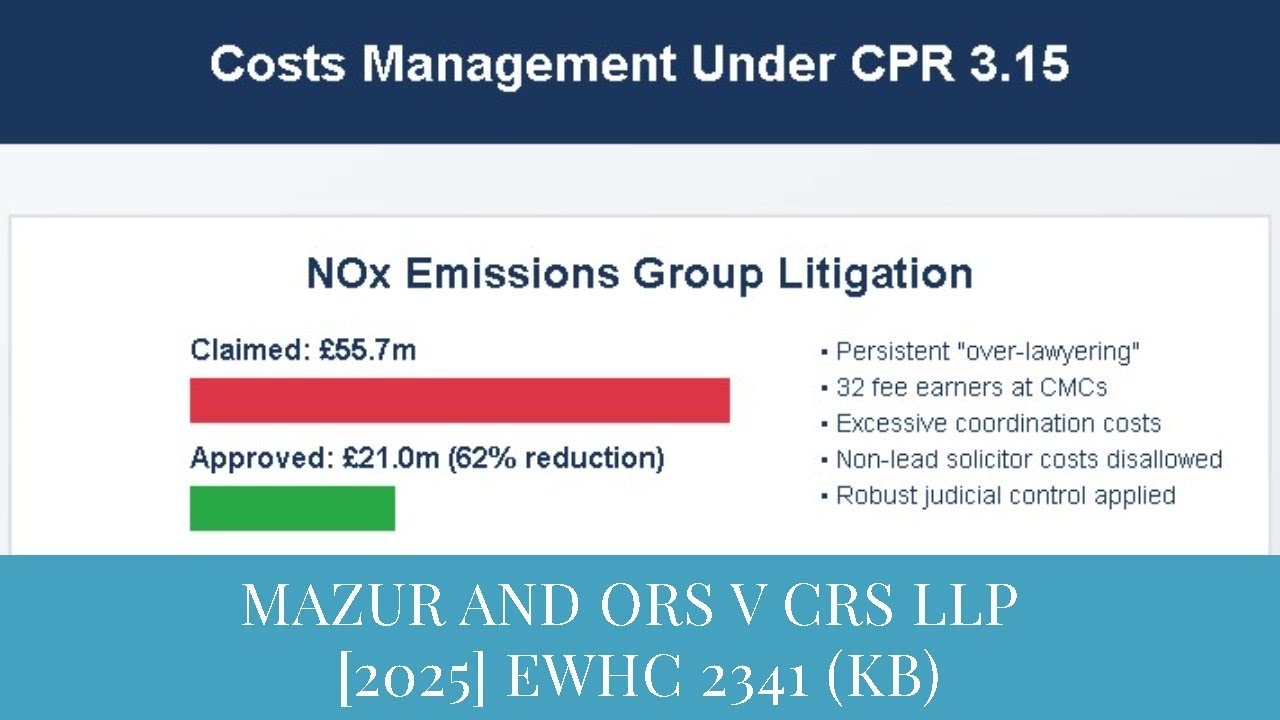
High Court Slashes Claimants’ Costs Budgets by 62% In NOx Emissions Litigation

Costs Budgeting, Proportionality and Incurred Costs

Group litigation: a determination of costs related to common issues

Co-Claimants Pursuing Common Case Face Joint And Several Liability For Adverse Costs

Parties warned to stop treating costs budgeting “as a form of game”

Claimant Penalised In Costs For “Unreasonable and Unrealistic” Costs Budget

The County Court at Central London’s decision in O’Sullivan v Trading 212 UK Limited [2026] EWCC 32 addresses the circumstances in which a court may depart from approved costs budgets under CPR 3.18 when conducting a summary assessment following trial.

Background

This matter concerned a claim brought by Mr Peter O’Sullivan against Trading 212 UK Limited, arising from the closure of his share trading account in August 2021. The substantive judgment, delivered orally by Recorder Benjamin Wood on 12 February 2026 at the County Court at Central London, dismissed the claim. The recorder found that the defendant had both the contractual right and the regulatory obligation to close the account, the latter arising under the applicable anti-money laundering regulations, though no suggestion was made that the claimant had been involved in anything other than entirely legitimate activity.

The claim had been valued at under £30,000 on the Claim Form, with the prayer to the Particulars of Claim pleading monetary relief of £37,106. No non-monetary relief was sought. As the recorder noted in the costs judgment, when properly analysed, the claim was only ever worth a few thousand pounds. It turned on the application of the relevant regulations and the parties’ written contract to a set of facts that were largely apparent from contemporaneous written communications, with the relevant documents running to no more than a few dozen pages.

The claim was initially issued and case managed in Hull. A costs and case management conference took place before a district judge at the County Court at Hull on 11 December 2024, at which the claim was allocated to the multi-track and a costs management order was made. The claimant’s budget was agreed at £59,575 (of which £8,625 had already been incurred), and the defendant’s budget was approved at £188,558.98 (of which just over £88,000 had already been incurred). All figures in the judgment were stated net of VAT.

The defendant applied to strike out the claim on the basis that the claimant’s conduct, which was said to involve attempts to interfere with witnesses and intimidate the defendant’s employees, jeopardised the fairness of the proceedings. That application was heard on 15 September 2025 and adjourned, with the claimant offering undertakings to the court. Costs were reserved. The claimant’s costs schedule for that hearing totalled £20,800 and the defendant’s totalled £59,513.67, both figures being additional to the budgeted costs.

At the pre-trial review on 16 October 2025, a circuit judge increased each party’s budget by £18,243.50. Three phases of the claimant’s budget were increased (witness statements, PTR and trial preparation) and two of the defendant’s phases (witness statements and trial preparation) were increased.

During the course of the trial itself, the defendant produced late disclosure of documents, including internal “Slack” messages, which ought to have been identified and disclosed considerably earlier. That late disclosure generated a significant volume of additional work, including a partially successful and partially unsuccessful application to amend the Particulars of Claim. Both parties filed Precedents T in respect of their increased costs: the claimant’s increase was £54,115 and the defendant’s was £63,330.91, though the defendant later indicated it would seek only £41,477.33 of that figure.

By the time judgment was handed down on the substantive claim, the parties had, between them, a little over £482,000 in costs on the table. The recorder noted that the parties’ actual costs incurred were somewhat higher: the claimant had spent just under £246,426.54 and the defendant had spent £452,456.26, giving a combined total of approaching £700,000 in actual costs incurred in a dispute worth, on the recorder’s analysis, around £5,000.

There being insufficient time to deal with consequential matters on 12 February 2026, the recorder gave directions for the resolution of costs issues. Written submissions were received from both parties. The claimant requested that costs be determined on paper; the defendant requested a hearing. Following consideration of the written submissions, the recorder directed an oral hearing, which took place on 21 May 2026. The costs bundle, which had originally been 54 pages, had grown to 205 pages by the time of the hearing, with both parties having produced further written submissions without invitation or permission to do so. The defendant also filed an N260 indicating costs of just under £30,000 for the hearing on 21 May alone. The claimant filed a costs schedule of £1,925 for that hearing.

Throughout the proceedings, the claimant had been represented by Anthony Metzer KC and George Symes of counsel, instructed by Andreas Laws. The defendant was represented by Anna Greenley of counsel, instructed by Winckworth Sherwood LLP. At the costs hearing itself, the claimant chose to appear in person, assisted by his wife, on the basis that he wished to save money. Following the conclusion of the hearing, the claimant sent two further detailed emails to the court containing additional submissions, the second of which prompted an order that neither party should file further submissions without applying formally and on notice.

The recorder noted that, so far as could be discerned from the absence of any witness statement explaining a refusal of an ADR proposal (as would have been required by the CCMC order), neither party had proposed mediation, early neutral evaluation or any other form of ADR at any stage.

Costs Issues Before the Court

The recorder was required to determine a number of distinct costs issues following the dismissal of the claim. The principal question was what costs order, if any, should be made, and in particular whether the general rule under CPR 44.2(2) should apply so as to require the unsuccessful claimant to pay the defendant’s costs, or whether the conduct of the parties, and in particular the defendant’s late disclosure and the circumstances surrounding the strike out application, justified a departure from that general rule or a modification of any order made.

Two specific conduct-related issues were identified as warranting separate treatment. The first concerned the defendant’s failure to comply with its standard disclosure obligations until the trial had almost concluded, specifically its failure to search for and disclose internal Slack messages. The second concerned the claimant’s conduct in the period leading up to the defendant’s strike out application, which had been heard on 15 September 2025 and adjourned on the basis of undertakings.

A further significant issue arose in relation to the costs management orders made at the CCMC and PTR, and specifically whether there was good reason, within the meaning of CPR 3.18, to depart from the approved and revised budgets when carrying out the summary assessment. The recorder considered the competing approaches in RNB v LB Newham [2017] EWHC B15 (Costs) and Nash v Ministry of Defence [2018] EWHC B4 (Costs), as well as the principles established in Merrix v Heart of England NHS Foundation Trust [2017] EWHC 346 (QB), [2017] 1 WLR 3399.

The court was also asked to carry out a summary assessment of the costs of both parties in respect of the various elements of the order. The claimant sought assessment of his costs arising from the defendant’s late disclosure, as set out in his Precedent T dated 6 February 2026, totalling £54,115. The defendant sought costs of the claim as a whole, including the costs of the strike out application (£59,513.67), budgeted and incurred costs, Precedent T costs and the costs of the hearing on 21 May 2026 (approximately £30,000), though the latter figure was not included in its formal quantification document.

Finally, the claimant raised the question of whether any order for payment of costs should be stayed pending the determination of his application for permission to appeal the substantive judgment.

The Parties’ Positions

The claimant’s position, as developed through his written submissions settled by counsel and his own oral and written submissions at the costs hearing, was that the defendant should pay his costs in relation to steps caused or prolonged by the defendant’s conduct, and that, save in relation to those issues, there should be no order as to costs. This represented a hardening of the position set out in his earlier written submissions of 26 February 2026, in which it had been submitted on his behalf that the fairest order was no order as to costs save for those costs directly consequential on the defendant’s late disclosure, with any costs order in favour of the defendant being drastically reduced in the alternative.

In relation to the defendant’s late disclosure, the claimant submitted that he should have his costs consequent upon this misconduct on the indemnity basis, on the basis that the conduct was analogous to that of the defaulting claimant in Finsbury Food Group plc v Axis Corporate Capital UK Ltd [2023] EWHC 1559 (Comm), whose conduct was described by the Deputy Judge as “profoundly unsatisfactory“.

The defendant’s position was that the correct and just order was that the claimant pay the defendant’s costs, save for a limited concession in respect of the costs of the reconvened trial and of considering the late disclosure. The defendant submitted that it should have its costs in relation to the strike out application on the basis that it was necessarily made, relying upon the matters set out in the witness statement of a partner at Winckworth Sherwood dated 10 June 2025.

The General Rule and Conduct

The recorder began by noting that costs are in the discretion of the court, but that the discretion must be exercised judicially. CPR 44.2(2) provides that if the court does decide to make an order about costs the general rule is that the unsuccessful party will be ordered to pay the costs of the successful party, but the court may make a different order. The successful party was the defendant, because the claim had been dismissed.

Following CPR 44.2(4), the court must have regard to all the circumstances in deciding what order to make about costs, including the conduct of all the parties, whether a party has succeeded on part of its case (even if it has not been wholly successful) and any admissible offer to settle. In this case, there had been no admissible offers to settle other than an offer from the defendant to the claimant, made on 29 October 2025, which was to accept just over £160,000 in respect of its costs as they then stood.

Much of the parties’ focus in their costs submissions had been on conduct, and in particular on each other’s conduct. The recorder observed that the case had been extremely hard fought and every point that could be taken had been taken. One of the difficulties with conducting litigation in this way is that costs rise and, because people become polarised and irritated with each other, they take more and more points in their scramble for victory.

With two exceptions, the recorder did not consider it would be just, having regard to the conduct of both the parties, to start doing a fine analysis of the impact of particular elements of conduct that might be said to have had an impact on the costs. This included all of the conduct points made by the claimant in his written submissions after the hearing and in his own written submissions relied upon at the hearing, to the extent that there were admissible conduct points and not impermissible challenges to the substantive judgment. The recorder considered that it would be wholly disproportionate for the court to descend into the level of detail that appeared to be envisaged.

The recorder therefore did not propose to make an adjustment to the costs order for general conduct points. The two specific points that did warrant separate consideration were the defendant’s disclosure and the claimant’s conduct leading to the defendant’s strike out application.

The recorder also noted the claimant’s position as expressed in his email of 22 May 2026: “I know the difference between right and wrong, and that is all that matters to me. I will either get Justice or I will end up penniless trying. I have my principles your Honour, they are expensive but I will not depart from them.” The recorder further noted that the claimant had not accepted the Financial Ombudsman’s decision of 2 December 2022, which had concluded that the defendant had not done anything substantially unfair or unreasonable in restricting and then closing the claimant’s account.

Having considered the parties’ submissions, and subject to those two points, the recorder concluded that there was no reason to depart from the general rule that the unsuccessful party should pay the successful party’s costs.

The Defendant’s Disclosure

As the recorder had explained in his substantive judgment, the defendant had not complied with its standard disclosure obligations until the trial had almost concluded. In particular, it failed to carry out a search for internal “Slack” messages as part of its initial disclosure searches, in spite of the fact that these might have revealed the internal communications that led to the decision to close the claimant’s account. The absence of such messages in the defendant’s disclosure led its witness (who had left the defendant’s employment in 2022, years before the disclosure exercise was undertaken) to give evidence that was wrong, to the effect that there was no paper trail. It was evident that the witness said this because of the absence of any disclosed communications and not because the witness was trying to hide anything.

Even at the time of the costs judgment, it was not really clear why the defendant failed to disclose those Slack messages as part of its standard disclosure and, in fairness to its Company Secretary and Legal Counsel, who made an explanatory witness statement during the course of the trial, even she did not appear fully to understand what went wrong. But something did go wrong on the defendant’s side and it led to this case taking up a great deal more court time and the incurring of a great deal more expense on both sides.

In reaching that conclusion, the recorder also reflected his earlier conclusion that there were no adverse inferences that ought to be drawn from the non-disclosure or late disclosure and that, by the time he gave judgment on the substantive claim, the defendant was compliant with its disclosure obligations. It followed that the defendant’s late disclosure did not change the outcome of the litigation. The recorder also had no basis to conclude that the late disclosure might have altered either party’s approach to the litigation.

The defendant had partially conceded that it should not recover its own costs in relation to its late disclosure, nor of the reconvened trial. The claimant submitted that he should have his costs consequent upon this misconduct on the indemnity basis.

In the recorder’s judgment, the just costs order in relation to disclosure was that the defendant should not receive its costs of the disclosure phase and that it should pay all of the claimant’s costs consequent upon the late disclosure, on the standard basis, including the costs of the unsuccessful elements of his re-amendment application.

In making this order, the recorder sought to strike a balance between marking the court’s disapproval of a sophisticated financial institution’s failure to comply with its procedural obligations and the undesirability of encouraging an “innocent” party to act disproportionately in response. The recorder was not persuaded that the defendant’s conduct was “unreasonable to a high degree” and “out of the norm” such that nothing less than an indemnity costs order would be appropriate and was also not persuaded that the claimant should be deprived of any of his consequential costs so as to reflect the outcome of the work that was carried out. To the contrary, it seemed to the recorder that the additional costs were precipitated by the defendant’s conduct in circumstances where they would otherwise probably have been avoided altogether. It also seemed that the defendant should not have any of its costs of a phase that it failed to conduct properly, even though the recorder recognised that at least an element of this phase would reflect costs incurred in carrying out its own review of the other side’s disclosure.

The recorder was not trying to draw a sharp line around the costs that go in each direction but to work with a rather broader brush. The costs orders in relation to disclosure were made after having stood back and in order to reflect the overall justice of the case.

For the sake of completeness, the recorder also recorded his rejection of the defendant’s submission that he ought to take account of what it said was “significant disclosure outstanding from the Claimant despite repeated requests”. There was no application by the defendant for specific disclosure or specific searches, none of the claimant’s disclosure (or allegedly non-disclosed material) was relevant to the issues that the recorder was or is now required to decide and he was not a sophisticated financial institution with in-house lawyers.

The Defendant’s Strike Out Application

The defendant applied to strike out the claimant’s claim on the basis that his conduct, in seeking to interfere with witnesses and intimidate the defendant’s employees, jeopardised the fairness of the proceedings. That application was heard on 15 September 2025 and adjourned on the basis of undertakings being offered by the claimant to the court, with costs reserved.

The defendant submitted that it should have its costs in relation to that application, on the basis that it was necessarily made. It relied upon the matters set out in the witness statement of a partner at Winckworth Sherwood dated 10 June 2025, which set out what were said to be “a continuous pattern of threatening conduct by the Claimant to the Defendant from December 2021 to at least March 2025 (and possibly to May 2025 through anonymous communications). The effect of the Claimant’s threatening contact with the Defendant and its former employees has been to (i) prevent key witnesses giving evidence, and (ii) cause current members of the Defendant considerable anxiety about giving evidence and becoming known to the Claimant. This jeopardises a fair trial“.

The claimant submitted that he should have his costs of the application, primarily on the basis that the defendant failed to get the claim struck out and, in pursuing such an optimistic application, failed to consider witness summonses or special measures for the hearing, with the consequence that the application as framed was doomed to fail.

Furthermore, in his more recent submissions, the claimant drew attention to what he said were contradictory and unsatisfactory signals from the defendant and its legal team which, he submitted, undermined the assertion that there was any need for the application and instead indicated that the defendant was trying to present an “aggressive fear narrative“. The recorder noted that the claimant did not deny any of the conduct that was directly attributable to him.

The claimant was also very aggrieved by the order that was made at the pre-trial review, in relation to special measures, which resulted in his having to observe the trial by video (from his counsel’s chambers) and only to attend the courtroom when he was giving evidence. The defendant’s witness was in the same position. Although the claimant was able to communicate electronically with his legal team, he submitted that this was very difficult and meant that he could not correct mistakes and give other instructions as the trial proceeded.

The recorder paused to note that, according to the defendant, the hybrid hearing proposal was made on behalf of the claimant at the PTR; there was no challenge to the arrangements, either by way of appeal or by application to the recorder during the course of the trial; the person who became the defendant’s only live witness was reported to be fearful and the recorder later received evidence of the witness’s emotional state shortly after their evidence had concluded; and the court is required to consider special measures for vulnerable witnesses, as set out in Practice Direction 1A.

The recorder rejected any implication by the claimant that the special measures directed by the court at the PTR came about as a result of any cynical attempt by the defendant to gain a tactical advantage.

However, the recorder recognised that the defendant’s strike out application probably raised, rather than lowered, the temperature of the dispute and that it would have created even more polarisation between the parties. The defendant (or its legal team) did not appear to have sought alternative relief (such as special measures, an order preventing contact or similar) short of strike out.

Nevertheless, the recorder was satisfied on the basis of the material that had been shown to him and the submissions of both parties that an application of some sort was appropriate and it was appropriate to seek the court’s intervention so as to facilitate the giving of best evidence by witnesses and so as to enable both sides to have a fair trial.

The recorder therefore ordered the claimant to pay the defendant’s costs of such an application (and the resulting hearing), on the standard basis.

The Budgeted Costs and CPR 3.18

Some of the costs in respect of which the recorder had decided to make a party/party costs order had been the subject of costs management orders (made at the CCMC and at the PTR). Others (including the costs incurred prior to the CCMC, those of the strike out application and those consequent upon the defendant’s late disclosure) had not been managed by the court.

CPR 3.18 provides that in any case where a costs management order has been made, when assessing costs on the standard basis, the court will have regard to the receiving party’s last approved or agreed budgeted costs for each phase of the proceedings, not depart from such approved or agreed budgeted costs unless satisfied that there is good reason to do so, and take into account any comments made pursuant to rule 3.17(3) and recorded on the face of the order.

Carr J (as she then was) drew attention to the importance of this Rule in Merrix v Heart of England NHS Foundation Trust [2017] EWHC 346 (QB), [2017] 1 WLR 3399. Her Ladyship pointed out at paragraph 67 that the words are “clear” and “mandatory” and explained the purpose and effect of the Rule. Real emphasis needs to be placed on the importance of certainty on costs in the context of access to justice. Costs budgets serve the important function of giving certainty to clients, in the form of knowing what costs they are likely to face, in terms of payment or recovery: Harrison v University Hospitals NHS Trust [2017] EWCA Civ 792, [2017] 1 WLR 4456 per Davis LJ.

However, neither of these decisions contains any guidance as to what would constitute a “good reason” to depart from an agreed or approved budget. The editors of the White Book (at 3.18.3) invite judges to have in mind the Denton test. They go on to identify two decisions which are said to “support the view that a costs judge may depart from the last approved or agreed budget if satisfied that the total costs incurred are disproportionate”.

Although the question of whether to depart from the budgets loomed large, neither party referred the recorder to these decisions and so he had not heard argument about them. The recorder considered whether to invite submissions on their effect but decided that to do so would be disproportionate, adding yet further cost and delay to an already protracted and overly expensive dispute.

In RNB v LB Newham [2017] EWHC B15 (Costs), the Deputy Costs Judge concluded that, if a court on assessment reduces the hourly rates for incurred costs, then this is a good reason to depart from the approved budget (to reflect the hourly rate reduction within the budgeted costs). At paragraph 24 of the judgment, the Deputy Costs Judge drew support for that conclusion from paragraph 73 of Merrix, noting that the rates allowed for incurred costs would need to be applied to the budgeted costs.

In Nash v Ministry of Defence [2018] EWHC B4 (Costs), the Costs Judge took a different view, concluding that hourly rates should not be treated as holding a special status. However, at paragraph 88, he drew attention to the wording at the end of CPR 3.18 as “in recognition that the facts and circumstances in which a costs management order was made may have subsequently changed without revisions being made to the budget“. He went on to give an example where “a change in facts and circumstances led to simplification of matters” without budgets being revised to reflect this such that the addition of the assessed incurred costs to the budgeted costs led to a disproportionately high total. At paragraph 90, he described CPR 44.3(2)(a) as “an effective safety valve for paying parties to seek a further reduction” and concluded at paragraph 91 that “a paying party retains the ability to argue that the overall sum of assessed incurred costs plus budgeted costs is disproportionate such that the overall sum should be reduced“.

It was right at this point to identify the hourly rates of the defendant’s solicitors. Prior to 1 May 2025, the Grade A rate was £605 (rising since then to £650). The Grade B rate was formerly £460 (rising to £495). Grade C actually decreased, from £345 to £340, and Grade D went up from £175 to £205.

The 2025 Guideline Hourly Rates for London 1 for grades A to D were £566, £385, £299 and £205, respectively. “London 1” is defined as “very heavy commercial and corporate work by centrally based London firms“. The rates for London 2 (City and Central London, other work) were £413 (A), £319 (B), £269 (C) and £153 (D). The National 2 rates (which would apply to work carried out in Hull, where this claim began life) were £282 (A), £242 (B), £196 (C) and £139 (D).

The hourly rates of the defendant’s more senior solicitors were significantly higher than any of the guideline rates, and higher even than the guideline rates for very heavy commercial work conducted by centrally based London firms. The claimant had drawn attention in his submissions to the fact that his solicitor was a grade B, working for £300 per hour, but the recorder did not find this comparison to be of any assistance.

The recorder spent some time reflecting upon whether there was a “good reason” to depart from the approved budgets and came to the conclusion that there was, both working from first principles and by parity of reasoning with each of the costs judges’ decisions (hard to reconcile though they might be).

Starting from the position of hourly rates (and so following the reasoning in RNB), the recorder could not see any justification for the defendant being entitled to recover its solicitors’ time at the hourly rates claimed. This was a claim that started in Hull (and was case managed there) and was always of modest value. Even though the defendant was based in the City of London, and was a financial organisation, this case did not justify the involvement of “London 1” solicitors. The recorder was far from convinced that it required London-based solicitors at all, given how many firms operate outside London, including those with financial services specialisms (if that was required).

In the recorder’s view, when it came to an assessment of costs, it would be necessary to reduce the solicitors’ rates by something between around a third and a half, in the case of the more senior solicitors, and by something between around a quarter and a third, in the case of the more junior solicitors. If that was required for the incurred (and not budgeted) costs, then it would, applying RNB, be a good reason to depart from the approved budgets in order to apply the same reductions.

If, on the other hand, the recorder adopted the reasoning in Nash, then he would need to ask himself whether there had been a change in facts and circumstances so as to justify the use of the “safety valve” of seeking a further reduction. As the recorder understood the reasoning in Nash, a change of circumstances would need to be required if the court were considering reducing the overall level of costs below the total of the approved costs. The recorder took the view that, in spite of the parties’ best efforts, there had been a simplification of the issues, such that the total level of expenditure was disproportionately high.

Finally, the recorder reached the same outcome from first principles. As the trial judge, he had the opportunity to review the material and form conclusions about the issues to a far greater degree than the costs managing judge.

The recorder had been able to form views about the factors set out in CPR 44.3(5). He had formed a view about how much this case was really worth. This was and was only a money claim; the case turned on a relatively small number of documents, the application of the anti-money laundering regulations and the interpretation of the written contract between the parties; each side had generated additional work (which could not have been envisaged when the costs management order was made); there were no wider factors of reputation or public importance; the vulnerability of the defendant’s witnesses came to light (and became an issue) only after the costs management order was made.

Put shortly, the recorder took the view that the judge who made the costs management order did so on a basis that had turned out to be completely wrong. Had the judge known what the recorder knew at the time of the costs judgment, it was vanishingly unlikely that this case would have been allocated to the multi-track and it was “all but inconceivable” that the parties would have been allotted 3.5 days of court time for the trial. Even if it had been treated as a multi-track trial, the shorter time estimate ought to have led the court to approach the cost budgeting exercise in a very different way. The parties would have been expected to cut their cloth much better to reflect the pleaded value of the claim.

The recorder wished to emphasise that nothing in the previous paragraph was intended as any criticism whatsoever of the case managing judge (who would no doubt have dealt with this case as part of a busy list and on the basis of the limited information provided by the parties) nor to suggest that there was any impropriety on the part of any of the lawyers.

The recorder recognised that this was the claimant’s claim and that it might be thought unfair to visit his misjudgement upon the defendant as the receiving party.

However, there were three main reasons why this did not prevent the recorder from concluding that he ought to depart from the approved budgets.

  • First, it is the duty of all parties (and not just a claimant) to assist the court to manage a case proportionately. If a defendant falls into the same errors as a claimant (or different errors with the same consequences) in over-egging a claim at the case management stage, then that defendant shares responsibility for the consequences.
  • Second, the effect of this decision was not to ignore the approved budget altogether, but to permit departure from it. In that regard, the defendant was right to draw attention to the fact that the claimant had been well aware of the potential scale of his liability for a long time. And a receiving party’s last approved or agreed budget is one of the factors that the court will have regard to, applying CPR 44.4(3)(h).
  • Third, and in the particular circumstances of this case, it seemed rather more appropriate to evaluate the ways in which the paying party had generated additional work at the end of the claim, rather than at the case management stage.

The recorder therefore concluded that there was a good reason to depart from the defendant’s approved (and revised) cost budget.

Summary Assessment

Having reached conclusions about what costs orders to make and as to the effect of the costs management orders, the recorder turned to the summary assessments that both parties agreed should be carried out.

In undertaking a summary assessment, the recorder’s task was not to undertake a detailed, item by item analysis, but to arrive at a figure which reflected, on a broad-brush basis, costs which were reasonably incurred and reasonable in amount, having regard to the overriding objective and the principle of proportionality. The court must have regard to the factors identified in CPR 44.4(3).

Since the assessment was on the standard basis, the court would only allow costs which are proportionate to the matters in issue, even if they were reasonably or necessarily incurred, and if there was any doubt as to whether costs were reasonably and proportionately incurred or reasonable and proportionate in amount, then that doubt would be resolved in favour of the paying party: CPR 44.3(2).

The Claimant’s Costs

The claimant claimed £54,115 in respect of his costs caused by the defendant’s late disclosure. These were set out in his three-page Precedent T, dated 6 February 2026, with his solicitor’s comments and those of the defendant’s solicitors (together with their offer in respect of each line) on the pages that followed. The amount offered by the defendant in respect of the variation to the budget was £18,000.

Having read all of the comments and considering the work that was necessitated by the late disclosure, with a cross-check for proportionality, the recorder assessed these costs at £27,000 (plus VAT, giving a net figure of £32,400).

The Defendant’s Costs

The recorder turned next to the defendant’s costs, which he dealt with in two parts.

First, he considered the costs of the strike out application, which costs were not the subject of any costs management order and which totalled £59,513.67 (of which £45,772 were solicitors’ costs). 98 solicitors’ hours were spent on the application, including 30.8 hours at grade A and 35.9 hours at grade B.

In the recorder’s judgment, this application could and should have been conducted much more modestly. It was unsuccessful, inasmuch as it was framed as a strike out application, and it was grossly disproportionate to spend more than twice the amount stated on the Claim Form to try to achieve that end.

Using the information available to him, the recorder took the view that the amount that the defendant should recover in respect of this application was £15,000 and he assessed its costs in that amount.

The recorder turned next to the defendant’s costs of the claim as a whole, noting that some of those costs were budgeted and others were not. He also noted that the defendant sought a further £30,000-odd for the hearing that took place on 21 May (which were not included in its “Quantification of Costs” document).

With that additional £30,000, but removing the costs arising out of the late disclosure and of the strike out application, the total costs claimed by the defendant was around £225,000.

The recorder had already explained that the solicitors’ hourly rates required a significant reduction, regardless of the time that was deemed to be recoverable. These accounted for roughly £165,000, with counsel’s fees being the other £60,000.

Having been through the defendant’s analysis more than once, and having performed his own calculations on the figures with which he had been provided, the recorder reached the conclusion that this “rump” of the defendant’s costs should be assessed at £113,750.

He arrived at that figure having conducted a more detailed review, during which he analysed all of the information provided to him for each phase, albeit with a broad brush. In particular, he assessed the disclosure phase at £0 (reflecting his earlier conclusion); he applied very significant reductions to the first two phases (arriving at a figure of £30,000 between them); and he reduced the witness statement phase to £15,000, to reflect his view that one of the defendant’s witness statements should not have been prepared (because that witness had very little, if any, relevant evidence to give) but acknowledging that the task of preparing the statement of the person who became the defendant’s only live witness was not straightforward. He made more modest reductions to the other phases and he allowed only a further £8,000 in respect of the costs on the schedule for the hearing on 21 May.

In arriving at that figure of £113,750, the recorder considered proportionality and concluded that it was a reasonable and proportionate amount in respect of the costs and the work that were the subject of the assessment.

Stay of the Order for Payment

At the end of the parties’ submissions, the claimant asked what would happen if, as turned out to be the case, the recorder were to order him to pay a sum of money in respect of costs and his application for permission to appeal the substantive judgment had not been determined.

The recorder enquired of the claimant whether there was any temporary issue that might prevent him from paying or if there were grounds for believing that the defendant might be unable to repay him, in the event that an appeal were successful and the costs order reversed. The claimant did not identify anything specific that he wanted the recorder to take into account.

In those circumstances, and as the recorder indicated at the time, he said that he would not grant a stay, but that, unless the defendant objected, he would allow a period of 35 days for the claimant to pay the sum ordered, which was considerably longer than the default period of 14 days. He chose that period because it ought to allow sufficient time for the claimant to obtain advice on whether to apply for permission to appeal from the High Court and, if appropriate, to apply for and receive a decision on an application for a stay (from the High Court), whether in the context of his pending application for permission to appeal the substantive judgment or, if he decided that there were grounds for challenging it, in what might become his application for permission to appeal the costs judgment.

Given that the defendant did not object to the claimant’s having 35 days within which to pay any costs that might be ordered, the recorder allowed that timeframe rather than ordering any stay of execution or enforcement.

Conclusions

The recorder observed that the claim had exacted a high price, financially and emotionally, on those involved. It should never have reached this point. Neither side would regard himself or itself as the winner.

The defendant was ordered to pay the claimant’s costs arising from its late disclosure, which the recorder summarily assessed at £27,000 (plus VAT, giving a net figure of £32,400).

However, the claimant was ordered to pay the defendant’s costs of the claim (including its strike out application but excluding the disclosure phase), which the recorder summarily assessed at £128,750.

There was a setting-off of those two amounts, with the consequence that the claimant was required to pay the defendant £96,350. He was given five weeks, until 8 July 2026, within which to make payment.

▶ Watch the case summary

Costs budgeting trumps detailed assessment… to an extent

The court can only depart from agreed or approved budgets, up or down, if there is a “good reason” for doing so

CPR 3.18(b): Good Reason To Depart?

Summary Assessment | No Justification Found For Indemnity Costs, Leading Counsel, Multiple Fee Earner Attendance Or £750+ Hourly Rates

The Correct Approach To Summary Assessment | Guideline Hourly Rates Up By 35%?

CPR 3.15A | Costs Budget Revisions | Significant Developments And The Need To Act Promptly


The High Court’s decision in Garden House Software Ltd v Marsh & Ors [2026] EWHC 568 (Ch) illustrates how a court may reject itemised costs challenges yet still impose a substantial global reduction on broad-brush proportionality grounds.

Background

HHJ Cadwallader had dismissed an application by the First, Second, Sixth and Seventh Defendants (collectively, “THD”) for reverse summary judgment and to strike out the Claimant’s claims. The parties agreed that costs should follow the event and be summarily assessed on the standard basis. The dispute concerned quantum alone. The Claimant sought £87,698.30 (solicitors’ fees £37,698.30; counsel’s fees £50,000). THD contended this was disproportionate and proposed £39,460.40, achieved through reductions to hourly rates, disallowing one senior fee earner’s time entirely, halving counsel’s fees, and cutting time spent preparing the statement of costs.

Costs Issues Before the Court

The court was required to conduct a summary assessment, determining what was reasonable and proportionate under CPR 44.3. The judge addressed each of THD’s specific challenges before applying a final, broad-brush assessment of overall proportionality. Specific issues arose concerning: (i) whether hourly rates should be reduced to London 2 Guideline Hourly Rates; (ii) whether the deployment of both a Partner and a Grade-A Legal Director was justified; (iii) whether instructing both leading and junior counsel at a combined fee of £50,000 was excessive; and (iv) whether 5.1 hours spent preparing the statement of costs (costing £2,549.70) was disproportionate.

The Parties’ Positions

The Claimant argued its costs were reasonable and proportionate. The application was a heavy one, listed for a full day with half a day’s judicial pre-reading, in a high-value specialist commercial and insolvency claim. THD had shifted the basis of their application following detailed correspondence from the Claimant’s lawyers before the hearing, advancing new points under time pressure, which necessitated preparation to address both the original and revised arguments. The application was brought only three months before a 12-day trial where substantial security for costs had been provided.

THD characterised the hearing as involving short points of law, not heavy or complex, justifying only modest costs. They advanced several specific challenges:

  • Hourly Rates: All rates should be reduced to London 2 GHR on the basis the matter was straightforward.
  • Team Composition: All time recorded by the Grade-A Legal Director (Mr Abdul) should be disallowed; the work of the Partner should have sufficed.
  • Counsel’s Fees: Instructing both a King’s Counsel and a junior was excessive; their combined fees should be capped at £25,000, half the amount claimed.
  • Statement of Costs: The 5.1 hours spent (1.1 hours by a Grade C fee earner and 4 hours by a Senior Costs Lawyer) was excessive and should be reduced to 2 hours total.

THD also pointed to their own costs of approximately £44,228 as a comparator, suggesting the Claimant’s higher spend demonstrated disproportionality.

The Court’s Decision

HHJ Cadwallader awarded the Claimant £70,158.64, representing a 20% reduction from the sum claimed. The judge addressed each of THD’s challenges in turn before applying a global reduction.

Character of the Application

The court rejected THD’s characterisation of the hearing as involving short, simple points of law. The application was listed for a day with half a day’s judicial pre-reading and was a heavy application, albeit the judge’s judgment was terse. THD had shifted the basis of their application following detailed correspondence from the Claimant’s lawyers before the hearing, advancing new points, so that under time pressure the Claimant had to deal with both the original and new points, which increased the preparation required. The application was brought only three months before a 12-day trial where very substantial security for costs had been provided.

Hourly Rates

The judge declined to reduce rates to London 2 GHR. This was a heavy application in a high-value, specialist commercial and insolvency claim, for which London 1 rates were not inappropriate. GHR are a starting point, not a cap. The judge noted that THD’s own Grade-A rate of £595 per hour (Birmingham) exceeded National 1 GHR and indeed the London 1 Grade-A GHR. Having regard to the application’s complexity and importance and the nature of the underlying issues, London 1-level rates were justified.

Team Composition

The court rejected THD’s submission that all time recorded by the Grade-A Legal Director should be disallowed. The Claimant’s explanation—that two senior fee earners were appropriate to manage a complex, high-stakes application with evolving arguments, and to ensure efficient division of labour—was persuasive. The deployment of a Partner and a Grade-A Legal Director was reasonable. The total time taken by both was also reasonable, and THD identified no duplication.

Counsel’s Fees

The instruction of both leading and junior counsel was held to be reasonable. Leading counsel had familiarity with the case and its history and had drafted statements of case; the use of junior counsel to support him should have allowed costs to be kept down. The combined fees of £50,000 were considered reasonable and proportionate, given the factors already identified.

Time Spent on the Statement of Costs

The time spent on the statement of costs (1.1 hours by a Grade C fee earner plus 4 hours by a Senior Costs Lawyer, totalling £2,549.70) was found to be in context neither unreasonable nor disproportionate.

Comparative Spend

The judge acknowledged that THD’s own costs for the application were approximately £44,228, roughly half of the Claimant’s figure. However, comparative spend can be a cross-check; it is not determinative. The question is what was reasonable and proportionate on the part of the Claimant. Given the points already made, it was unsurprising that the Claimant incurred a higher figure than THD.

Overall Proportionality

While THD’s proposed global reduction to £39,460.40 was not a fair reflection of what it reasonably cost the Claimant to oppose the application, and the specific challenges did not warrant the sweeping reductions sought, the judge nevertheless stepped back and looked at the matter in the round. He considered that the overall figure of £87,698.30 must be reduced, for reasons of proportionality, by 20%, to £70,158.64, which he considered to be reasonable and proportionate.

Analysis

The decision demonstrates the two-stage nature of summary assessment under CPR 44.3. A court may find that individual elements of a costs claim—hourly rates, team composition, counsel’s fees—withstand specific challenge when tested against the reasonableness criterion, yet still conclude that the aggregate figure requires reduction when assessed against the proportionality criterion.

The judgment confirms that Guideline Hourly Rates remain a starting point, not a cap, and that the nature, complexity and importance of the matter may justify rates at the higher end of the spectrum. The judge’s observation that THD’s own rates exceeded certain GHR benchmarks provided a useful comparative point that undermined their argument for strict application of lower guideline rates.

On team composition, the decision illustrates that deploying multiple senior fee earners is not inherently unreasonable where the matter is complex, high-stakes, and involves evolving arguments requiring efficient division of labour. The absence of identified duplication was significant.

The instruction of both leading and junior counsel was justified by leading counsel’s existing familiarity with the case and the judge’s finding that the use of junior counsel should have allowed costs to be kept down. The combined fee of £50,000 was assessed in the context of a full-day hearing with substantial pre-reading in a high-value specialist claim.

The most significant aspect of the decision is the application of a 20% global reduction after rejecting the specific challenges. The judge gave limited reasoning for this reduction beyond stating it was required “for reasons of proportionality” when looking at the matter “in the round”. This broad-brush approach reflects the court’s residual discretion to stand back from the detail and assess whether the total figure is proportionate to the matter in issue, even where individual components are reasonable.

The decision serves as a reminder that success in defending itemised challenges to a costs claim does not guarantee recovery of the full sum claimed. Proportionality operates as an independent control mechanism, and a receiving party should anticipate that a court conducting summary assessment may apply a global reduction even where specific criticisms are rejected.

The Correct Approach To Summary Assessment | Guideline Hourly Rates Up By 35%?

Proportionality: a view from the High Court

Summary Assessment Indemnity Costs | Century Property v Aldiss

N260 Statement Of Costs | Form Matters

Proportionality Appeal – May v Wavell Group Ltd

The Applicability Of The Guideline Hourly Rates On A Detailed Assessment


The Patents Court’s decision in Parsons v Convatec Limited [2026] EWHC 300 (Pat) addresses costs budgeting in a claim valued at up to £366 million, providing important guidance on the inter partes treatment of premium-rate solicitors’ fees, the limits of budget comparisons between parties, and the court’s approach to assertions that artificial intelligence should reduce litigation costs.

Background

This matter concerned costs budgeting in a substantial claim brought by the claimant, Dr David Parsons, against the defendant, Convatec Limited, under section 40 of the Patents Act 1977. Dr Parsons sought a payment equal to 10–15% of the value of the defendant’s global sales of certain products, which on his own formulation could amount to some £366 million. The claim involved seven patent families and 73 individual patents, and a 27-day trial was listed for 2027. Despite the scale of the claim, both parties agreed that costs budgeting was appropriate.

A preliminary issue regarding the potential impact of section 106 of the Patents Act on the level at which the defendant’s budget should be approved was reserved for a separate judgment. This decision proceeded on the assumption that section 106 had no effect. The outcome of that reserved judgment may have further implications for the approved budget figures.

Costs Issues Before the Court

The court was required to review and approve the parties’ costs budgets in accordance with CPR Part 3 and Practice Direction 3E. The primary focus was on phases of the defendant’s budget which were not agreed, with the claimant challenging the estimated costs as unreasonable and disproportionate. The claimant also raised a general criticism of the defendant’s incurred costs and conduct. The only phase of the claimant’s own budget that was not agreed was for disclosure. The court’s task was to determine the reasonable and proportionate costs for each future phase, having regard to the factors in CPR 44.3(5) and 44.4(3), including the sums in issue, the complexity of the litigation, and any wider factors such as the new issue of law arising under section 40 of the Act.

The Parties’ Positions

The claimant argued that the defendant’s incurred costs to date were at least double his own and were based on hourly rates that were excessive at the most senior levels, with Grade A rates of £1,100, £915 and £675 respectively, compared with corresponding figures of £700 and £525 for the claimant’s solicitors. He invited the court to deprecate this conduct and to adopt a hard-line approach to the defendant’s forward budget, relying on CIP Properties (AIPT) Ltd v Galliford Try Infrastructure Ltd. For specific phases, the claimant contended that the defendant’s solicitors’ costs were top-heavy, that four counsel including IP specialists were unnecessary, and offered lower sums for the CMC, disclosure, witness statements, and trial preparation, often pointing to his own budget as a comparator. The claimant also suggested that efficiency savings could be achieved through the use of AI in the disclosure exercise.

The defendant defended its budget as reasonable and proportionate given the exceptional scale and complexity of the claim. It emphasised the very high sums in issue, the complexity involving seven patent families and 73 patents, and the new issue of law regarding the scope of the enlarged section 40. The defendant argued it had a significantly greater disclosure exercise, requiring the location and hosting of some one million documents spanning 32 years, and that its case involved an additional dimension concerning the source of any benefit derived from the patents, justifying the instruction of IP specialist counsel and more extensive evidence. It maintained that its chosen solicitors, while expensive, were justified by the nature of the dispute, and that its budget represented costs within a reasonable and proportionate range.

The Court’s Decision

The court applied the principles from Various Shared Appreciation Mortgage Borrowers v BOS [2022] EWHC 254 (Ch), approving budgets for each phase with revisions where necessary.

General Approach

The court confirmed that the assessment was from an inter partes perspective: there is nothing wrong with a party instructing a particularly expensive firm because the case is important and they want to win, but the question is what is reasonable and proportionate to be incurred on an inter partes basis. Critically, the court emphasised that the costs budgeting exercise cannot be resolved simply by determining “appropriate” hourly rates. High hourly rates do not of themselves render costs unreasonable or disproportionate. The judge illustrated this with a practical example: a senior partner at Freshfields might complete a task in one hour at £1,100 that a more junior fee earner would take three hours to accomplish. Provided £1,100 is not an unreasonable or disproportionate cost for that task, the high hourly rate is not, of itself, a problem. The court’s quest, applying Discovery Land Company v Axis Specialty Europe, was for a figure within a reasonable and proportionate range, not the absolute lowest amount a party could be expected to spend.

The court also confirmed that a comparison between budgets may be informative but can never be determinative. Asymmetry between the parties’ budgets could be explained by differences in the volume of work, differing strategic approaches to the case, or even one side having underestimated costs.

The court rejected the claimant’s invitation to adopt a hard-line approach of the kind set out in CIP Properties, noting that this submission had not been pressed in oral argument. While opinions could reasonably differ on whether the defendant’s incurred costs were reasonable and proportionate, the court did not consider them so obviously unreasonable as to call into question the reliability of the forward budget. The criticism was, in the court’s view, nothing more than the usual debate about proportionality and reasonableness of costs, albeit involving large figures. Assessment of the reasonableness of incurred costs was a matter for a costs judge performing a detailed assessment, not for the budgeting judge.

Defendant’s Budget — Phase-by-Phase

Case Management Conference: The defendant estimated £193,600 for a further one-day CMC. The court allowed £170,000, making a modest reduction to reflect the cost of the defendant’s solicitors, particularly the proportion attributable to Grade A fee earners (£77,600 out of £118,600 in solicitors’ costs), given that counsel were also instructed at an estimated cost of £75,000.

Disclosure: The defendant estimated £1,515,775, comprising £100,000 for counsel, £270,000 for document hosting disbursements, and £1,145,775 for solicitors’ fees. The court allowed £1,300,000. It accepted that the defendant had a difficult and extensive disclosure exercise, involving the location and hosting of approximately one million documents across 32 years of the claimant’s career, and found nothing unreasonable about the number of Relativity accounts or the hosting fees. The court also accepted that investing time in training machine-learning systems for the initial stage of disclosure was a proportionate and reasonable approach.

However, the court found an element of “luxury” in the estimate. Some of that came from the hourly rates applied to Grade A fee earners, with approximately £215,000 of costs attributable to very senior staff at very high rates. Further luxury, in the court’s judgment, came from the number of hours estimated by more junior fee earners who were also charged at rates above guideline levels on work that, while extensive, was reasonably commoditised.

Significantly, the court addressed the claimant’s argument that AI should reduce the defendant’s disclosure costs. The judge observed that it is easy to assert that AI should reduce costs, but the claimant had not identified specific steps involving AI that the defendant should be taking but was not. The defendant was already adopting an orthodox approach to disclosure, including investing in machine-learning systems. The court declined to reduce the budget on the basis of a general assertion about AI efficiencies without evidence of particular savings that were being foregone.

Witness Statements: The defendant estimated £978,600 based on six factual witnesses, compared with the claimant’s estimate of £493,000 for three witnesses. The court allowed £700,000. It accepted that the defendant had a legitimate additional dimension to its evidence — disputing the extent to which any benefit derived from the patents rather than from marketing, production, distribution, or regulatory matters — and found the claimant’s offer of £382,000 much too low. However, the court considered the mix of hours unreasonable on an inter partes basis, with Grade A fee earners estimated to spend 580 hours and more junior fee earners 900 hours on six witness statements, taking into account the requirements of Practice Direction 57AC. It also noted that the three additional witnesses would not be addressing matters as complex as the inventorship and patent issues covered by the first three.

Pre-Trial Review: The defendant estimated £257,900 for a two-day PTR. The court allowed £200,000. While acknowledging one would not necessarily expect a packed agenda at the PTR given the quality of representation on both sides, the PTR was listed for two days and that could not be ignored. The court found the claimant’s own estimate for counsel (£25,000 for a two-day hearing) to be on the low side, and concluded the truth lay somewhere in the middle.
Trial Preparation: The defendant estimated £2,051,250 on the basis of a single expert. The court reduced this by £350,000 in total (to £1,701,250), comprising a £200,000 reduction for counsel brief fees and a £150,000 reduction for solicitors’ costs. The court accepted that it was reasonable and proportionate for the defendant to instruct a four-person counsel team including IP specialists, given the nature of the inventorship dispute and the expansive way in which the claimant put his case on section 40. However, it was not satisfied that it was reasonable for the defendant’s counsel team to receive brief fees almost twice those of the claimant’s team. On solicitors’ costs, the court identified a top-heavy team at expensive hourly rates, a risk of overlap with counsel, and an element of what it described as a “Rolls-Royce service” that was unreasonable on an inter partes basis.

Trial: The defendant estimated £1,850,300 based on a single expert and 30 trial sitting days (although the trial itself was listed for 27 days). The court reduced this by £330,000 (to £1,520,300). The reduction equated to the cost of having a Grade A partner, at a charge-out rate of £1,100 per hour, sitting in court for 10 hours per day for the duration of the trial, in addition to the same level of involvement from three other team members. The court considered it unreasonable and disproportionate on an inter partes basis for a full four-person solicitor team to be in court listening to counsel’s submissions throughout the trial. Consistent with its broad-brush evaluative approach, the judge acknowledged that removing the Grade A partner’s time made no allowance for residual work that partner might do outside court, but equally left untouched the other team members’ court attendance costs. Refreshers for counsel and the defendant’s expert attendance costs of £60,000 were approved, with the court finding the claimant’s own estimate of £16,500 for expert attendance too low to be a reliable guide.

Claimant’s Budget

Disclosure: The claimant estimated £859,500. The court allowed £650,000, finding that the defendant’s disclosure exercise was approximately twice as large as the claimant’s. Having allowed the defendant £1,300,000 for disclosure, the court considered £650,000 a reasonable and proportionate figure for the claimant’s less exacting exercise. An unexplained increase of £330,000 from the previous iteration of the claimant’s budget raised a flag but was not in itself a reason for reduction.

The budgets for other phases, including expert reports (budgeted on an agreed assumption of a single expert), were approved as presented or agreed. If the assumption of a single expert proved inaccurate following the May 2026 CMC, the expert evidence budgets would need to be revisited.

YouTube player

s71(3) | Beneficiaries Who Pursued Unreasonable Solicitors Act Assessments Bear the Costs Personally

Summary Assessment Without Opposition | Court Applies Independent Scrutiny to Unopposed Costs Claims

Provisional Assessment Set Aside Under CPR 3.1(7) For Material Breach Of Filing Duty

When A Judicial Review Claim Is Discontinued | Can The Defendant Recover Costs Beyond The Acknowledgment Of Service Stage?

Part 36 Offers Cannot Displace The Solicitors Act One-Fifth Costs Rule

CPR 26.9(10)(e) | Wrongful Interference With Goods Against Police Mandates Multi-Track Allocation | Part 36 Acceptance Does Not Oust Fixed Costs

The Court of Appeal’s decision in Qatar Investment and Projects Development Holding Co & Anor v Phoenix Ancient Art S.A. & Ors [2025] EWCA Civ 1300 addresses proportionality in security for costs applications on appeal and the principles governing security against foreign appellants.

Background

The claimants, Qatar Investment and Projects Development Holding Co and His Highness Sheikh Bin Abdullah Al Thani, brought two actions against five defendants, including the appellants Phoenix Ancient Art S.A., Ali Aboutaam, and Hicham Aboutaam. The 2020 Action concerned a small chalcedony statuette figure of the goddess Nike, while the 2023 Action related to a marble object known as the Head of Alexander the Great as Herakles and a small chalcedony cameo known as the Phalera with an Imperial Eagle. The principal claims were for rescission of the contracts of purchase and claims in deceit and conspiracy. The two actions were managed together.

On 9 December 2024, the claimants applied for summary judgment and for orders striking out the defences in both actions and debarring the appellants from defending on the grounds of non-compliance with disclosure orders. By an order dated 11 April 2025, Garnham J debarred the appellants from defending the 2023 Action, struck out their defence, and granted the claimants summary judgment. In relation to the 2020 Action, he granted summary judgment on the claims based on fraud, dishonesty and fraudulent misrepresentation, and stayed all other claims. Consequential orders were made on 29 April 2025.

The appellants were granted limited permission to appeal by Phillips LJ on 25 July 2025. The core issue on appeal was whether Garnham J was correct to order summary judgment without considering the substantive merits, on the basis that the substance of the allegations which the appellants were precluded from defending were deemed to be admitted. The permission order allowed the claimants to apply for security for costs. The claimants subsequently issued an application on 8 August 2025, seeking security in the sum of approximately US$229,000, representing 75% of their total anticipated appeal costs of US$305,291.38.

Costs Issues Before the Court

The application for security for costs was brought under CPR 25.29(1), which permits the court to order security for costs on an appeal on the same grounds as against a claimant. The claimants relied on three specific grounds under CPR 25.27(b): (i) that the appellants were resident out of the jurisdiction; (ii) that Phoenix was a company and there was reason to believe it would be unable to pay the claimants’ costs if ordered to do so; and (iii) that the appellants had taken steps in relation to their assets that would make it difficult to enforce an order for costs against them.

The court was required to conduct a two-stage inquiry: first, to determine whether any of the conditions in CPR 25.27(b) were satisfied; and second, to decide whether it was just in all the circumstances to make an order. A further issue concerned the appropriate quantum of security, with the claimants seeking a substantial sum and the appellants challenging both the principle and the amount.

The Parties’ Positions

The claimants argued that all three grounds for security were met. Regarding residence abroad, they contended that all three appellants were resident outside the jurisdiction. On inability to pay, they pointed to Phoenix’s financial statements, which they argued showed a heavily insolvent position when adjusted for overvalued inventory and irrecoverable debts. They also highlighted previous statements by the appellants concerning their impecuniosity. On the assets ground, they relied on specific transactions, including Mr Ali Aboutaam’s disposal of his interests in Phoenix and Tanis Antiquities Ltd for no consideration, monthly payments from Phoenix to Mr Ali Aboutaam with no evidence of their destination, and a general failure by the appellants to provide full disclosure of their assets.

The appellants challenged the application on several fronts. On the residence ground, they argued that for the 2020 Action, the pre-Brexit version of the rules should apply to Phoenix and Mr Ali Aboutaam as Swiss residents, which would have provided protection as Switzerland was a Lugano Convention state. They accepted this point had limited practical effect as it did not apply to the 2023 Action or to Mr Hicham Aboutaam. On inability to pay, they suggested the claimants’ own case was that the appellants were wealthy, which was inconsistent with the assertion that Phoenix could not pay costs. On the assets ground, they argued that the Individual Appellants each had substantial equity in real properties in Geneva and New York respectively, which far exceeded the potential costs liability, and that the matters relied on by the claimants did not demonstrate steps taken to make enforcement difficult. They further submitted that ordering security based on residence abroad would be discriminatory absent objectively justified grounds relating to obstacles to enforcement.

The Court’s Decision

The court found that the residence abroad condition under CPR 25.27(b)(i) was satisfied for all appellants. It rejected the argument that the pre-Brexit rules applied to the 2020 Action, holding that the Civil Procedure (Amendment) Rules 2025 had substituted a new Part 25 with no transitional provision preserving the old position for pre-2021 claims.

On the inability to pay condition concerning Phoenix, the court applied the principles from Phaestos Ltd v Ho, noting that there must be reason to believe the company will be unable to pay, which is more than mere doubt. It found the evidence amply justified this conclusion, pointing to Phoenix’s 2023 financial statements, which showed a net asset position that became heavily insolvent when adjusted for overvalued inventory and an irrecoverable debt from Electrum. The court also noted Mr Hicham Aboutaam’s evidence that Phoenix had very little ready cash and could not borrow, indicating a worsened financial position.

Regarding the assets condition, the court applied the principles from Ackerman v Ackerman, emphasising that the test is objective and concerns steps taken in relation to assets that would make enforcement difficult. It found that Mr Ali Aboutaam’s disposal of his interest in Tanis for no consideration and the unexplained monthly payments from Phoenix to him were such steps. It also drew an adverse inference from the appellants’ failure to provide full asset disclosure, both in the context of their pleaded impecuniosity and under a worldwide freezing order. The court rejected the argument that the Individual Appellants’ property equity provided a sufficient answer, noting the properties were subject to substantial local creditor claims, making the equity precarious and vulnerable to enforcement.

On the second stage of the inquiry, the court held it was just to order security. It noted the established risk of dissipation, the history of non-disclosure, and late payment of prior costs orders, and the absence of any suggestion that security would stifle the appeal. On the discrimination point, the court found there were objectively justified grounds for ordering security based on the appellants’ own circumstances, including lack of available assets and the risk of steps to prevent enforcement, which provided rational justification.

On quantum, the court found the claimants’ claimed costs of £225,000 disproportionately high for a one-day appeal on a short point of law. It rejected the argument that costs of the respondent’s notice (seeking to uphold the judgment on the merits) should be included, holding that the claimants would not have been entitled to security for the underlying summary judgment application. Taking a broad-brush approach, it ordered security in the reduced sum of £70,000, reflecting the costs of responding to the appeal alone.

The application for security for costs was therefore allowed, but only in the sum of £70,000.

YouTube player

Security For Costs Application Under CPR 25 | Financial Difficulties and Late Claims

CPR 25.27 | £6m Security For Costs Denied As Escrow Funds In UK Account Deemed Sufficient To Satisfy Any Costs Order

Additional Security For Costs Ordered For Inquiry And Detailed Assessment Despite Discharge Of Injunction

Security for costs and the role of court approved costs budgets

Court of Appeal: Fixed Costs Do Not Apply To Appeals But QOCS Does

Variation of costs orders on appeal Court of Appeal decision Potanina v Potanin

The High Court’s decision in Various Claimants v Mercedes-Benz Group AG & Ors [2025] EWHC 2307 (KB) demonstrates the court’s continued determination to control excessive costs in large-scale group litigation through robust budgeting reductions.

Background

The judgment concerns the second Costs Management Hearing (CMH) in the NOx Emissions Group Litigation, a series of consolidated Group Litigation Orders (GLOs) concerning claims against various vehicle manufacturers. The litigation is being case managed in tranches. The first trial (Tranche 1) on “KBA Issues” took place in October 2024. The second trial (Tranche 2) on “Prohibited Defeat Devices” (PDD) is scheduled for October 2025. The costs for these tranches were managed at the first CMH.

This second CMH dealt with the costs budgets for the third tranche of the litigation (Tranche 3) and a second period of general costs (Second General). Tranche 3, the “Quantum Trial”, concerns issues of causation and loss and is listed for eight weeks in October/November 2026. The Second General budget covers the period from Spring 2026 up to the Quantum Trial. The court was required to approve budgets for 63 Precedent Hs, comprising 390 costed phases, with total sums claimed of £55.7 million (claimants) and £75.8 million (defendants collectively) for Tranche 3, and £19.8 million (claimants) and £3.6 million (defendants) for the Second General phase.

The Lead GLO involves claims against Mercedes-Benz. Additional Lead GLOs (ALGLOs) involve Ford, Peugeot/Citroën (PCD), and Nissan/Renault. Claims against other manufacturers (e.g., BMW, Vauxhall, Volkswagen) are designated as Non-ALGLOs. The case management directions limited the participation of Non-ALGLOs in the upcoming trials, which was a key factor in the costs budgeting exercise. The claimants structured their budgets to distinguish between “Pan NOx” work (involving all GLOs), “Lead and ALGLO” work, and “GLO specific” work.

Costs Issues Before the Court

The primary task for the court was to determine the reasonable and proportionate budgeted costs for the future phases of the litigation, namely Tranche 3 and the Second General period. The key costs issues included:

    1. The appropriate level of reduction to the claimants’ budgets to address continued “over-lawyering”, a criticism made in the first CMH judgment.
    2. The relevance of the budgets approved for the longer and more complex Tranche 2 trial as a comparator for setting Tranche 3 budgets.
    3. Whether to allow standard figures for defendants performing similar tasks or to recognise a range of reasonable and proportionate costs.
    4. The recoverability of common costs claimed by numerous non-lead solicitors’ firms instructed by individual claimants within the GLOs.
    5. The reasonableness of the high number of fee earners the claimants had budgeted to attend hearings such as CMCs, the PTR, and the trial.
    6. Whether to approve budgets for the Expert Reports and ADR/Settlement phases at this stage or to defer this decision.

The Parties’ Positions

The defendants’ overarching position was that the claimants had failed to learn lessons from the first CMH and continued to advance unrealistic budgets characterised by excessive manpower and duplication. They argued that the budgets for Tranche 3 should generally be lower than those for the longer and more complex Tranche 2 trial. They criticised the claimants’ structure of involving multiple law firms and the vast number of fee earners budgeted for hearing attendance. For their own budgets, defendants generally sought to justify their figures based on the specific work required, though the claimants alleged some defendants were budgeting at lower rates than they were actually incurring.

The claimants argued they had responded to the first judgment by providing more detailed justification for their figures and by reallocating work within their budget structure. They contended that the “lived experience” of Tranche 2 had demonstrated that more work was required than initially anticipated, justifying higher figures for some Tranche 3 phases. They defended the involvement of non-lead firms, citing a solicitor’s duty to keep clients informed and the right of clients to choose their representation. For the defendants’ budgets, the claimants often made standard offers to groups of defendants (e.g., all Non-ALGLOs), arguing a single figure could be reasonable and proportionate for similar tasks.

The Court’s Decision

The court, applying the overriding objective and the principles of costs budgeting, made significant reductions to the budgets of both parties, particularly the claimants. The approved figures are set out in the conclusion below. The court’s key findings and rationale were as follows:

    • Over-lawyering and Lessons from the First CMH: The court found that the claimants’ efforts to provide more detail did not justify the “enormous amounts of time claimed”. It upheld the criticism of “over-lawyering”, citing as an example the claimants’ budget for 32 fee earners to attend CMCs at a cost of £3.3 million. The court found the claimants’ approach, particularly the layers of representation and involvement of multiple non-lead firms, led to duplication and inefficiency.
    • Comparison with Tranche 2: The court agreed with the defendants that the budgets approved for Tranche 2 were a relevant starting point and that, given the shorter length and less complex nature of the Quantum Trial, Tranche 3 budgets should generally be lower, not higher. The court expected improved cooperation and lessons learned from Tranche 2 to lead to more economical working.
    • Standard Figures vs. a Range: The court held that where defendants were undertaking the same tasks, a standard figure could be reasonable and proportionate. It noted that figures within 20% of a reasonable comparator could be considered within an acceptable range. However, figures more than 20% above a reasonable comparator required specific justification, which was often lacking.
    • Non-Lead Solicitors’ Costs: The court severely restricted the common costs recoverable by non-lead firms. It held that work such as keeping abreast of developments for client advice was primarily a solicitor-client matter, not recoverable between the parties. For sample claimants represented by non-lead firms, the cost of drafting witness statements or pleadings should be no more than if the work had been done by the lead solicitor.
    • Hearing Attendance: The court drastically reduced the claimants’ budgets for hearing attendance. It found the number of fee earners budgeted (e.g., 9 in person and 21 remotely for CMCs) to be unreasonable. For the trial, the court approved a team of only 4 fee earners from each lead firm attending in person, with no allowance for attendance by fee earners from other firms.
    • Specific Phase Reductions: The court made detailed reductions across all phases. For example, the claimants’ sought £3.3m for two CMCs was reduced to £850,000; their £1.4m for the PTR was reduced to £300,000. The defendants’ budgets were also reduced in many phases where they were found to be excessive, such as Vauxhall’s budget for reviewing statements of case.
    • Deferral of Expert Reports and ADR Phases: The court declined to budget the Expert Reports phase because the scope and necessity of this evidence was still to be determined at a future CMC. The ADR/Settlement phase was also deferred because the parties’ assumptions were too far apart (£11m claimed by claimants vs. £1.8m by defendants) to make sensible budgeting possible at this stage. The court proposed to reconsider these phases in January 2026.
    • Second General Costs: The court found the claimants’ claimed management costs of nearly £20m to be “frankly staggering” and illustrative of a “wildly inefficient” approach. The budget was based on assumptions of excessive monthly updates to a vast number of lawyers and clients. The court allowed only a modest sum for essential register updates and communication, significantly reducing the budget to £1.43m.

In conclusion, the court approved the following total budgets:

    • Tranche 3: Claimants: £21,024,850.01 (from £55.7m claimed); Defendants: £48,058,002.04 (from £75.8m claimed).
    • Second General: Claimants: £1,430,000.00 (from £19.8m claimed); Defendants: £1,319,114.70 (from £3.6m claimed).
YouTube player

CPR 3.15A | Costs Budget Revisions | Significant Developments And The Need To Act Promptly

Directly relevant as it covers CPR 3.15A budget revision applications which relate to the costs management framework applied in the NOx case

Costs Management Hearing | Unrealistic Budgets May Face Adverse Costs Orders

High Court decision (2025) discussing excessive costs budgets and judicial warnings about “unrealistic” budgets, highly relevant to the over-lawyering theme

Costs Budgeting and Costs Management – What You Need To Know

Essential background on CPR 3.15 costs management rules and procedures that practitioners need to understand the NOx judgment

Reasonable Joint Costs Recoverable In Full Regardless Of Number Of Defendants

Recent High Court decision (2025) on common costs in multi-party litigation, relevant to the GLO cost recovery issues

Budgets, Hourly Rates, Good Reason and Proportionality

Analysis of how courts assess reasonable and proportionate costs under CPR 3.18, relevant to the budget assessment principles

Significant developments and incurred costs

Chief Master Marsh decision examining costs budgeting practicalities and significant development applications

The High Court’s decision in Pontis Finance LLP v Karam, Missick & Traube LLP [2025] EWHC 2298 (Ch) demonstrates how courts can address excessive hourly rates through broad-brush phase reductions without breaching CPR 3.15(8)’s prohibition on fixing rates.

The case concerned a professional negligence claim brought by Pontis Finance LLP, a lender, against the defendant firm of solicitors, Karam, Missick & Traube LLP. Pontis had agreed to lend approximately £812,500 to an individual purporting to be Stefano Brugnolo, secured by a charge on a Mayfair property. The defendant firm acted for the borrower. Pontis’s case was that the defendant’s client was an impostor and that the firm had failed to perform adequate identity checks. Having advanced the loan monies, which were then paid to the impostor, Pontis claimed it had no prospect of recovery. The claim was for the return of the loan monies, interest, and associated fees, totalling approximately £1.2 million.

Following a Costs and Case Management Hearing (CCMC) on 21 February 2025, the court ordered the parties to file updated costs budgets. The intention was for the court to rule on these budgets promptly on the papers. Due to an administrative oversight, this ruling was significantly delayed from March to September 2025 [§6-8]. Consequently, costs for several phases of the litigation, most notably the Disclosure phase, transitioned from being future costs to incurred costs, thereby limiting the court’s ability to budget for them effectively [§9, §11.1].

Costs Issues Before the Court

The court was required to determine the reasonable and proportionate budgeted costs for the phases where it retained jurisdiction, specifically the Trial Preparation and Trial phases. The court could not set budgets for the Disclosure phase (as costs were now incurred), nor for Witness Statements and Settlement/ADR phases (due to uncertainty about what work had been completed) [§11]. The central issue was whether the overall figures claimed were proportionate, with a particular focus on the Claimant’s use of solicitors’ hourly rates that substantially exceeded the applicable guideline rates and the instruction of both a King’s Counsel and a junior barrister. The court had to assess proportionality by reference to the factors in CPR 44.3(5), primarily the sums in issue (£800,000 to £1.2 million) and the complexity of the litigation [§15].

The Parties’ Positions

The Claimant argued that the case involved complex legal issues concerning whether a duty of care was assumed to a non-client, the nature of any undertakings given, and potential breaches of trust. It submitted that the majority of the budgeted work was appropriately focused on the Trial Preparation and Trial phases and that the use of both leading and junior counsel was justified. The solicitors’ high hourly rates were presented as a reflection of the firm’s expertise.

The Defendant contended that the claim, valued at approximately £1.2 million, was towards the lower end of the scale for Chancery Division litigation and was not sufficiently complex to be categorised as “very heavy commercial work.” It argued that the case would substantially turn on its facts. The Defendant submitted that the Claimant’s solicitors’ hourly rates were excessive and unjustified, and that instructing both leading and junior counsel was disproportionate, particularly as a managing associate was also budgeted to attend trial.

The Court’s Decision

The court found that the Claimant’s overall incurred and budgeted costs of £489,891.31 were disproportionate for a claim of this nature and value [§31]. The case was assessed as being of moderate complexity, turning largely on its facts, and not qualifying as “very heavy commercial work” [§22]. Consequently, the appropriate guideline band for assessing solicitors’ hourly rates was London Band 2, not Band 1 [§35].

The court acknowledged that its role under CPR 3.15(8) was to approve phase totals, not to fix or approve specific hourly rates [§23]. However, following the approach in GS Woodland Court GP1 Ltd v GRCM Ltd [§26], it held that the combination of excessive rates and the number of hours billed could render a phase total disproportionate. The court therefore made broad, downward adjustments to the phase totals to reflect this.

For the Trial Preparation phase, the Claimant sought £136,550. The court found the number of solicitors’ hours (110) to be reasonable but the rates charged were substantially above the London Band 2 guidelines [§39]. It also found the aggregate counsel brief fees of £90,000 to be disproportionate [§44]. Applying a broad-brush approach, the court approved a budget of £115,000 for this phase [§48].

For the Trial phase, the Claimant sought £88,700. The court identified that the Claimant had erroneously budgeted for four days of counsel refreshers for a four-day trial; only three days were permissible, as the brief fee covers the first day [§51]. Furthermore, the solicitors’ rates were again deemed excessive. The court also disallowed most of the costs for an unexplained Grade D fee earner charged at £400 per hour [§58]. Considering all elements, the court approved a budget of £50,000 for this phase [§60].

The court declined to set budgets for the Witness Statements and Settlement/ADR phases due to the uncertainty over how much work had been incurred during the delay, rendering it impossible to distinguish between incurred and future costs [§11.2, §11.5]. The parties were advised to apply for a further costs management hearing if they wished to budget for these phases.

GS Woodland Court GP1 Ltd v GRCM Ltd [2025] EWHC 285 (TCC)

Key authority on how courts apply downward adjustments to phase totals where excessive hourly rates render them disproportionate

CPR 3.18(b) | Underspend Does Not Constitute Good Reason To Depart From An Approved Budget

Explores the interplay between budgeting and detailed assessment, relevant to understanding how courts control costs through budgeting

CPR 3.15A | Costs Budget Revisions | Significant Developments And The Need To Act Promptly

Details the requirements for varying costs budgets, relevant given the administrative delays that affected budgeting in Pontis Finance

2021 Guideline Hourly Rates, Use of Counsel And Division Of Common Costs

Discusses the application of guideline hourly rates and the use of both leading and junior counsel, directly relevant to the excessive rates and counsel fees issues

How Relevant Are The Guideline Hourly Rates?

Examines judicial attitudes to guideline rates being exceeded, providing context for understanding when rates significantly above guidelines may be justified

CPR 3.14 | Late Costs Budget | Relief From Sanctions Denied

Illustrates the consequences of failing to comply with budgeting requirements, contrasting with the administrative issues in Pontis Finance


YouTube player

Background

The costs determination arose from Century Property (Leeds) Limited’s successful application for mandatory injunctions to enforce a judgment debt against Dr Jason Aldiss’s self-invested personal pension (SIPP). The underlying judgment debt of £402,500 stemmed from an order made by Master Eastman on 31 October 2023, which was subsequently assigned to Century Property on 1 December 2023.

The enforcement proceedings involved Century Property obtaining a charging order over Dr Aldiss’s SIPP on 11 June 2024, with the total sum due reaching £450,939 by 29 April 2025, accruing interest at £88.22 daily. The SIPP, valued at £618,249.94 as of 16 April 2025, could not be accessed until Dr Aldiss reached his 55th birthday on 17 August 2025.

The application proceedings involved two hearings. At the first hearing, Dr Aldiss, appearing as a litigant in person, successfully applied for an adjournment to gather evidence to respond to Century Property’s application. Despite being granted this adjournment, Dr Aldiss failed to serve any evidence and provided no explanation for this failure. Shortly before the second hearing in April 2025, Dr Aldiss made an application to the Court of Appeal for permission to appeal the original Tomlin Order, and at the second hearing, he unsuccessfully sought both an adjournment and a stay of enforcement proceedings.

Following the court’s judgment on 4 June 2025 allowing Century Property’s application, the parties were directed to submit written representations on consequential matters, including costs, by 30 May 2025. Dr Aldiss’s response to Century Property’s statement of costs was delayed due to an injury, with his submissions ultimately provided on 9 June 2025.

Costs Issues Before the Court

The court was required to determine three principal costs issues following the successful enforcement application. First, whether Dr Aldiss should bear Century Property’s costs or whether the circumstances justified departing from the general rule under CPR 44.2(2)(a) that the unsuccessful party pays the successful party’s costs.

Second, the court needed to consider the appropriate basis of assessment. Century Property sought its costs on the indemnity basis, arguing that Dr Aldiss’s conduct throughout the proceedings was sufficiently unreasonable to take the case “out of the norm” as established in Excelsior Commercial and Industrial Holdings Ltd v. Salisbury Hannah Aspden & Johnson [2002] EWCA Civ 879. The alternative was assessment on the standard basis.

Third, the court was asked to summarily assess the quantum of costs. Century Property submitted two statements of costs: the first dated 28 April 2025 for £55,363.02 (including VAT) covering both hearings, and the second dated 29 May 2025 for £2,204.41 (including VAT) for work on consequential matters, totalling £57,567.43. The court needed to determine whether these costs were reasonable and proportionate in accordance with CPR 44.3(5) and 44.4.

The Parties’ Positions

Dr Aldiss advanced four principal arguments against any costs order. He emphasised his status as a litigant in person who found the litigation uniquely stressful as it concerned both his reputation and his sole retirement asset. He contended that the enforcement application was premature given that his 55th birthday was not until August 2025. He pointed to his recent application for permission to appeal the Tomlin Order as evidence of genuine concerns about its validity. Finally, he maintained that his challenges were not designed to delay enforcement but reflected legitimate concerns about the underlying settlement.

Regarding the basis of assessment, Dr Aldiss argued for the standard basis, relying on the same grounds he had advanced against any costs order being made.

On quantum, Dr Aldiss challenged the costs as disproportionate and sought only nominal costs. He specifically criticised Mr Toby Starr’s hourly rate of £685 and the Grade C associate solicitor’s rate of £420 as significantly exceeding guideline rates without justification for enhancement. He argued that the claims for work on documents (£14,375), email correspondence, and counsel fees (£15,405) were excessive without proper breakdown or itemisation. He alleged duplication of work and excessive time on routine tasks, suggesting the statements had been “padded out”.

Century Property’s position was straightforward on liability: having succeeded on the application, there was no reason to depart from the general rule requiring the unsuccessful party to pay costs. On the basis of assessment, Century Property argued that Dr Aldiss’s conduct warranted indemnity costs, citing his non-compliance with the Tomlin Order, his request for an adjournment to gather evidence which he subsequently failed to serve, his unreasonable opposition to the application, his unsubstantiated challenges to the Tomlin Order’s validity, and his failed attempts to adjourn the second hearing and stay enforcement. Century Property maintained that this conduct took the case “out of the norm”.

On quantum, Century Property defended its costs as reasonable given the unusual nature of the application, which had only been considered in three reported first instance cases. Century Property made no specific submissions responding to Dr Aldiss’s detailed criticisms of the costs claimed.

The Court’s Decision

On the principle of costs liability, the court applied the general rule under CPR 44.2(2)(a) and ordered Dr Aldiss to pay Century Property’s costs. The court found that none of Dr Aldiss’s four grounds provided sufficient reason to displace the general rule. Whilst acknowledging his status as a litigant in person and the litigation’s impact, the court noted that Dr Aldiss had “vigorously fought, but lost, the application”. The prematurity argument had already been dismissed in the substantive judgment at paragraph 53(e). The pending appeal application did not justify departing from the general rule, and whilst not doubting Dr Aldiss’s sincerity, the court noted he had done nothing to substantiate his validity challenges despite being given opportunities to submit evidence.

On the basis of assessment, the court adopted a nuanced approach. After reviewing the principles from Excelsior Commercial and Industrial Holdings Ltd v. Salisbury Hannah Aspden & Johnson [2002] EWCA Civ 879 and Three Rivers DC v. Bank of England [2006] EWHC 816 (Comm), the court recognised that the test was unreasonableness rather than moral condemnation. The court acknowledged that the application was “far from straight-forward”, concerning an area of law with limited authority, and that Dr Aldiss was entitled to defend against enforcement directed at his sole retirement asset.

However, the court found that Dr Aldiss, as “a professional and articulate man”, understood the need to present evidence and comply with orders. His failure to serve evidence after obtaining an adjournment specifically for that purpose, without good reason or application to vary the timetable, was particularly significant. The court concluded that Dr Aldiss’s applications at both hearings were “designed to delay determination of Century Property’s application and, ultimately, enforcement of the judgment debt”.

The court ordered costs on the standard basis, except for the costs of the first hearing which were to be assessed on the indemnity basis. This reflected a balance between the unusual nature of the application and the fact that the first hearing costs were “wasted because of Dr Aldiss’ ultimately pointless application to adjourn”.

On quantum, the court conducted a summary assessment applying the principles from West v. Stockport NHS Foundation Trust [2019] EWCA Civ 1220. For the first statement of costs, the court found the solicitors’ hourly rates and counsel’s fees reasonable. However, it reduced the correspondence costs from the claimed amount to £6,000, finding the costs for correspondence with Dr Aldiss higher than expected given its “brief and succinct nature”. The court also reduced the documents costs to £13,000, finding excessive time spent on the chronology and response to Dr Aldiss’s request for information.

The court approved the second statement of costs in full at £2,204.91. The total costs allowed were £54,432.93 (including VAT), reduced from the £57,567.43 claimed. The court found this sum proportionate under CPR 44.3(5) and 44.4, considering the unusual nature of the application, the substantial sums at stake (approximately £450,000), the additional work caused by the adjournment, and Dr Aldiss’s conduct in seeking information on matters previously communicated to him. The court refused to stay the costs order for the same reasons it had refused to stay enforcement of the substantive order.

Background

The claimants, William Thomas Stockler and Alexander Charles Stockler, were holders of permanent seats at the Royal Albert Hall. They brought proceedings against The Corporation of the Hall of The Arts and Sciences, which operates the venue, concerning payments due under the Hall’s Ticket Return Scheme (TRS). Under this scheme, introduced in 1993, seat-holders could return unwanted tickets in exchange for payment.

Following amendments to the TRS payment terms in April 2018, the claimants disputed the defendant’s calculations and commenced proceedings in September 2022 seeking an account and payment of monies allegedly due. The claim was initially valued at less than £10,000, with the claimants indicating on the claim form that it fell within the small claims track limit. The defendant counterclaimed seeking, amongst other matters, a declaration as to the proper construction of the contractual arrangements.

Both parties issued applications for summary judgment in late 2022. On 23 February 2023, Deputy District Judge Kirby KC granted summary judgment to the defendant on the interpretation of the 5 April 2018 letter, stayed the balance of proceedings to enable agreement on an account, and allocated the matter to the fast track. Significantly for costs purposes, he ordered the claimants to pay the defendant’s costs of the hearing, including the summary judgment applications limited to the interpretation issue, subject to detailed assessment if not agreed.

When settlement negotiations failed, the matter returned before DJ Mauger on 24 May 2024. The judge refused the claimants permission to amend their particulars of claim, dismissed the balance of their claim, and gave judgment for the defendant on the counterclaim in the sum of £3,054.24. The judge made a further costs order requiring the claimants to pay the defendant’s costs of the claim and counterclaim on the standard basis until 8 June 2023 and on the indemnity basis thereafter.

The defendant commenced detailed assessment proceedings on 6 September 2024, serving a bill totalling £162,789.37. The bill was divided into three parts: Part 1 for standard basis costs (£76,066.38), Part 2 for indemnity basis costs, and Part 3 for bill preparation costs. Points of Dispute were served on 1 October 2024, followed by Replies, with the assessment hearing requested on 10 December 2024.

Costs Issues Before the Court

The primary issue before Deputy Costs Judge Joseph was whether the defendant’s costs should be reduced on grounds of proportionality following the line-by-line assessment. This issue arose specifically in relation to Part 1 of the bill, which covered costs incurred on the standard basis up to 8 June 2023.

The court was required to apply CPR 44.3 and 44.4, which mandate that on a standard basis assessment, only costs that are proportionate to the matters in issue should be allowed. Under CPR 44.3(5), proportionality requires costs to bear a reasonable relationship to various factors including the sums in issue, value of non-monetary relief, complexity of litigation, conduct of the paying party, and any wider factors such as reputation or public importance.

A preliminary issue concerned whether the court should assess proportionality across the entire bill or focus solely on Part 1. This was significant because Part 2 costs were assessed on the indemnity basis, where proportionality does not apply. Additionally, the court had to determine the appropriate approach to proportionality assessment following the guidance in West and Demouilpied v Stockport NHS Foundation Trust [2019] Costs LR 1265.

The line-by-line assessment had already addressed various contested issues, including the reasonableness of instructing London-based solicitors, appropriate fee earner grades, and the dismissal of numerous Points of Dispute for insufficient particularisation under Ainsworth v Stewarts Law LLP [2020] EWCA Civ 178. Following this assessment, Part 1 of the bill had been reduced from £76,066.38 to £55,581.38.

The Parties’ Positions

The claimants, represented initially by Counsel and subsequently by the first claimant acting in person, argued that the assessed costs were manifestly disproportionate. Their primary submission was that proportionate costs should be calculated by reference to a multiple of the monetary value of the claim. They proposed that a base figure should be between one and a half to two times the £3,200 monetary claim value (producing £4,800-£6,400), with additional allowances of £1,000-£1,500 for non-monetary relief and similar amounts for conduct-related work. This methodology produced a range of £6,800-£9,400, with a mid-point of £8,100 representing their view of proportionate costs.

The claimants relied on the fact that the claim had been initially valued at less than £10,000 and would ordinarily have fallen within the small claims track. They pointed to comments by DDJ Kirby suggesting concern about costs being incurred in relation to potential claims by other seat-holders, and to DJ Mauger’s ultimate dismissal of the account claim as disproportionate. They maintained that spending approximately £55,000 on a claim worth £3,200 was wholly disproportionate regardless of other factors.

The defendant, represented by Mr Paul Hughes, rejected the claimants’ mathematical approach to proportionality. He argued that all factors in CPR 44.3(5) should be considered without giving special weight to monetary value alone. The defendant emphasised that the DDJ had allocated the matter to the fast track despite its monetary value, indicating the case’s unsuitability for the small claims track. This allocation decision suggested a total claim value, including non-monetary elements, potentially up to the fast track limit of £25,000.

The defendant highlighted the complexity of the contractual interpretation issues, evidenced by detailed skeleton arguments and the instruction of Counsel throughout. He argued that decisions already made during the line-by-line assessment – including approval of London solicitors’ instruction and appropriate fee earner grades – demonstrated reasonableness that should not be undermined through proportionality. The defendant also stressed wider factors, including potential reputational damage and the risk of similar claims from other seat-holders among the Hall’s 320 seat-holders who returned 179,000 tickets in 2022 alone.

The Court’s Decision

Deputy Costs Judge Joseph rejected the claimants’ mathematical approach to proportionality assessment. The court held that there was no basis in West and Demouilpied for calculating proportionate costs using arbitrary multiples of claim value. Such an approach was deemed fundamentally flawed and contrary to CPR requirements, which mandate consideration of multiple factors without attributing special significance to any single element.

The court determined that proportionality assessment should focus solely on Part 1 of the bill, as proportionality does not apply to indemnity basis costs. Following West and Demouilpied, the court examined the work reasonably undertaken during the relevant period, finding it included substantial tasks: reviewing proceedings, drafting pleadings, considering documents, preparing for and attending the summary judgment hearing, responding to requests for information, and conducting settlement negotiations.

On the monetary value factor, whilst acknowledging the claim’s small financial component, the court held this should not carry special weight. The DDJ’s allocation to the fast track despite the low monetary value indicated the claim’s overall significance. The court accepted that when monetary and non-monetary elements were combined, the total claim value approached £25,000.

Regarding complexity, the court found the contractual interpretation issues required specific expertise and justified Counsel’s instruction. The earlier decisions allowing London solicitors and grade B fee earners supported this assessment. The court noted that having found these costs reasonable during line-by-line assessment, it would be difficult to subsequently deem them disproportionate.

The court accepted that the defendant was entitled to consider potential reputational damage and the risk of similar claims from other seat-holders as genuine wider factors. The Hall’s considerable public status meant the defendant could legitimately take the proceedings seriously. However, this did not entitle unlimited expenditure, and the court noted the bill had already been reduced by nearly 27% during line-by-line assessment.

A significant factor was the dismissal of numerous Points of Dispute for insufficient particularisation. The court held it would be inherently unfair to allow the claimants to achieve through proportionality what they had failed to achieve through properly formulated challenges. This would effectively permit reduction “through the back door” despite the claimants’ procedural failures.

The court concluded that the assessed costs of £55,581.38 for Part 1 were not disproportionate when all factors were properly considered. The reasonable costs were also proportionate costs, and no further reduction was warranted. The court emphasised that proportionality had already been partially considered during line-by-line assessment, particularly regarding hourly rates and fee earner grades, making further reduction inappropriate.

Implications

This case demonstrates several principles for costs practitioners. Mathematical formulae based on claim value multiples will not survive scrutiny – courts must consider all CPR 44.3(5) factors without giving special weight to monetary value alone. Track allocation decisions carry weight in proportionality assessment, particularly where judges depart from normal expectations based on case characteristics.

The decision reinforces that properly particularised Points of Dispute remain essential. Attempting to achieve reductions through proportionality arguments after failing to mount specific challenges during line-by-line assessment will not succeed. Courts will consider whether allowing such reductions would be unfair to the receiving party.

The case also shows how wider factors like reputational damage and potential satellite litigation can influence proportionality assessment, provided the receiving party can demonstrate genuine concerns rather than speculative risks.

YouTube player

https://tmclegal.co.uk/ainsworth-v-stewarts-law-llp/

https://tmclegal.co.uk/west-and-demouilpied/

https://tmclegal.co.uk/malmston-v-bohinc-proportionality/

https://tmclegal.co.uk/east-sussex-fire-and-rescue-service-v-austin/

https://tmclegal.co.uk/may-v-wavell/

https://tmclegal.co.uk/barts-health-nhs-trust-v-hilrie-rose-salmon-2/

https://tmclegal.co.uk/incurred-costs/

https://tmclegal.co.uk/worcester-v-hopley/

https://tmclegal.co.uk/pxt-v-atere-roberts/

https://tmclegal.co.uk/court-of-appeal-offers-guidance-on-applications-for-security-for-costs-and-the-role-of-court-approved-costs-budgets/

https://tmclegal.co.uk/issues-based-and-proportional-costs-orders/

https://tmclegal.co.uk/inquest-costs-recovery/

https://tmclegal.co.uk/a-practical-guide-to-the-new-intermediate-track-costs-rules/

https://tmclegal.co.uk/cpr-47-pd-8-2-points-of-dispute-be-specific/

https://tmclegal.co.uk/n260/

https://tmclegal.co.uk/scenic-international-group-ltd-v-adenaike-ors/